Being a “Burden on the State”. The Economic Relevance of the Exile of Italian Refugees and Expulsion Practices in Habsburg Trieste (1861-­1869)

Titolo Rivista SOCIETÀ E STORIA
Autori/Curatori Francesco Toncich
Anno di pubblicazione 2026 Fascicolo 2025/191
Lingua Inglese Numero pagine 22 P. 36-57 Dimensione file 150 KB
DOI 10.3280/SS2026-191003
Il DOI è il codice a barre della proprietà intellettuale: per saperne di più clicca qui

Qui sotto puoi vedere in anteprima la prima pagina di questo articolo.

Se questo articolo ti interessa, lo puoi acquistare (e scaricare in formato pdf) seguendo le facili indicazioni per acquistare il download credit. Acquista Download Credits per scaricare questo Articolo in formato PDF
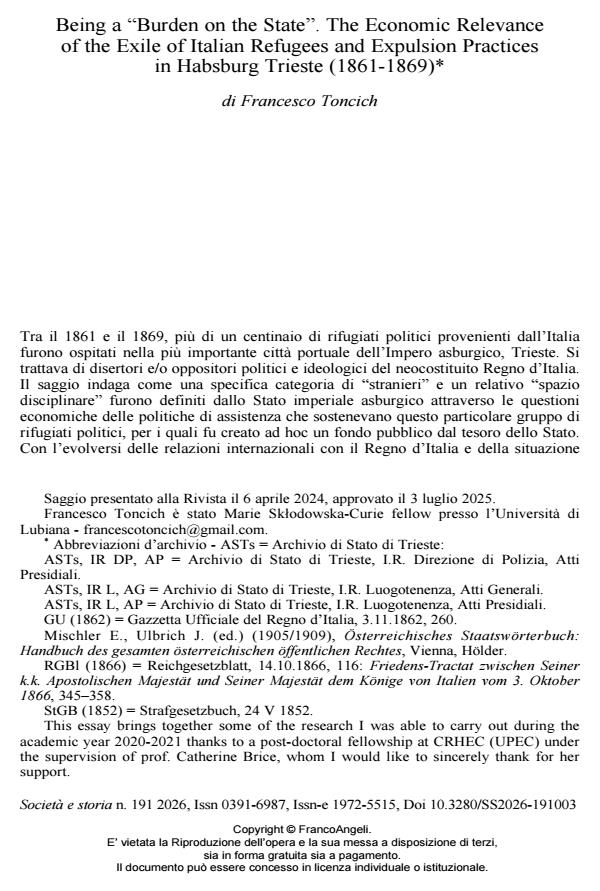
Anteprima articolo

FrancoAngeli è membro della Publishers International Linking Association, Inc (PILA), associazione indipendente e non profit per facilitare (attraverso i servizi tecnologici implementati da CrossRef.org) l’accesso degli studiosi ai contenuti digitali nelle pubblicazioni professionali e scientifiche.

Between 1861 and 1869, more than a hundred political refugees from Italy were hosted in the most important port city of the Habsburg Empire, Trieste. They were deserters and/or political and ideological opponents of the newly established Kingdom of Italy. The essay investigates how a specific category of “aliens” and a related “disciplinary space” were defined by the Habsburg imperial state through the economic issues of the assistance policies that supported this peculiar group of political refugees, for which a public fund was created ad hoc within the state treasury. As both international relations with the Kingdom of Italy and the political and economic situation within the Austrian Empire progressed, the status of these “ItAliens” was transformed from “political refugees” protected by Austrian assistance policies to individuals, who were considered “dangerous” for internal security and therefore eligible for expulsion from the lands of the Habsburg crown.

Tra il 1861 e il 1869, più di un centinaio di rifugiati politici provenienti dall’Italia furono ospitati nella più importante città portuale dell’Impero asburgico, Trieste. Si trattava di disertori e/o oppositori politici e ideologici del neocostituito Regno d’Italia. Il saggio indaga come una specifica categoria di “stranieri” e un relativo “spazio disciplinare” furono definiti dallo Stato imperiale asburgico attraverso le questioni economiche delle politiche di assistenza che sostenevano questo particolare gruppo di rifugiati politici, per i quali fu creato ad hoc un fondo pubblico dal tesoro dello Stato. Con l’evolversi delle relazioni internazionali con il Regno d’Italia e della situazione politica ed economica all’interno dell’Impero austriaco, lo status di questi “ItAliens” si trasformò da “rifugiati politici” protetti dalle politiche di assistenza austriache a individui considerati “pericolosi” per la sicurezza interna e quindi passibili di espulsione dai territori della corona asburgica.

Parole chiave:rifugiati politici, asilo, espulsione, Impero Asburgico, Trieste, inclusione ed esclusione socio--economica.

  1. Rochart G., Massobrio G. (1978), Breve storia dell’esercito italiano dal 1861 al 1843, Turin, Einaudi.
  2. Rogowicz, E. (2009), Asyl-- und Flüchtlingsrecht. Ein Vergleich des materiellen Asyl--und Flüchtlingsrechts sowie ausgewählter Aspekte des Asylverfahrensrechts in den Ländern Deutschland und Polen unter Berücksichtigung der Entwicklung einer europäischen Asyl-- und Flüchtlingspolitik, Hamburg, Verlag Dr. Kovac.
  3. Sandgruber R. (1995), Ökonomie und Politik. Österreichische Wirtschaftsgeschichte vom Mittelalter bis zur Gegenwart, Vienna, Carl Ueberreuter.
  4. Sassen S. (1999), Migranti, coloni, rifugiati. Dall’emigrazione di massa alla fortezza Europa, Milan, Feltrinelli.
  5. Schwerhoff G. (2006), Vertreibung als Strafe. Der Stadt-- und Landverweis im Ancien Regime, in Ausweisung -- Abschiebung -- Vertreibung in Europa: 16.--20. Jahrhundert, edited by S. Hahn, A. Komlosy, I. Reiter--Zatloukal, Innsbruck/Vienna, Studien Verlag, pp. 48--72.
  6. Silvestri M. (2017), Lassù nella Trieste asburgica. La questione dei regnicoli e l’identità rimossa, Gorizia, LEG.
  7. Steidl A. (2021), On many routes: Internal, European, and Transatlantic Migration in the Late Habsburg Empire, West Lafayette, Purdue University Press.
  8. Stourzh, G. (2011), The Ethnicizing of Politics and “National Indifference” in Late Imperial Austria, in Der Umfang der österreichischen Geschichte, edited by G. Stourzh, Vienna, Böhlau, pp. 283--323.
  9. Toncich F. (2022), Inside and Outside the Habsburg Public Health System: Managing Complexity Within the Austrian Littoral (1849--1880s), in «Annales. Series Historia et Sociologia», 32/4, pp. 523--534.
  10. Tóth H. (2014), An Exiled Generation: German and Hungarian Refugees of Revolution, 1848--1871, Cambridge, Cambridge University Press.
  11. Vivante A. (1912), Irredentismo adriatico. Contributo alla discussione sui rapporti austro--italiani, Florence, La Voce.
  12. Wendelin H. (2000), Schub und Heimatrecht in Grenze und Staat. Paßwesen, Staatsbürgerschaft, Heimatrecht und Fremdengesetzgebung in der österreichischen Monarchie 1750--1867, edited by W. Heindl, E. Saurer, Vienna, Bohlau, pp. 173--346.
  13. Winkler M. (2017), Exil als wechselseitige Herausforderung. Französische Revolutionsemigranten in der Habsburgermonarchie, in Aufnahmeland Österreich. Über den Umgang mit Massenflucht seit dem 18. Jahrhundert, edited by R. Garstenauer, B. Kuzmany, Vienna, Mandelbaum, pp. 69--93.
  14. Cova U. (1998), Il consolato napoletano a Trieste ai tempi dell’Intendenza commerciale per il Litorale, in Per la storia del Mezzogiorno medievale e moderno: studi in memoria di Jole Mazzoleni, Rome, Ministero per i beni culturali e ambientali, Ufficio centrale per i beni archivistici, pp. 749--761.
  15. Dorsi P. (1996), I regnicoli: una componente dimenticata della società triestina in età asburgica in Trieste, Austria, Italia tra Settecento e Novecento: studi in onore di Elio Apih, edited by M. Cattaruzza, Udine, Del Bianco, pp. 113--130.
  16. Foucault M. (1975), Surveiller et punir. Naissance de la prison, Paris, Gallimard. Garstenauer R. and Kuzmany B. (2017), Nichts Neues in Österreich. Wandel und Konstanten in der Bewältigung von Flüchtlingskrisen in den letzten dreihundert Jahren, in Aufnahmeland Österreich. Über den Umgang mit Massenflucht seit dem 18. Jahrhundert, edited by R. Garstenauer and B. Kuzmany, Vienna, Mandelbaum, pp. 7--41.
  17. Girardi G. (2022), I beni degli esuli. I sequestri austriaci nel Lombardo--Veneto (1848--1866), Rome, Viella.
  18. Gottsmann A. (2015), Il punto di vista di Vienna: l’Italia e gli italiani prima delle Grande Guerra, in «Atti e memorie della Società dalmata di storia patria», 37, pp. 37--56.
  19. Hirschhausen U.V. (2007), Von imperialer Inklusion zur nationalen Exklusion Staatsbürgerschaft in Österreich--Ungarn 1867--1923. Discussion Paper SP IV 2007--403, Berlin, Wissenschaftszentrum Berlin für Sozialforschung (WZB).
  20. Judson P. (2016), The Habsburg Empire. A New History, Cambridge, Belknap, 2016. Komlosy A. (2000), Ökonomische Grenzen in Grenze und Staat. Paßwesen,
  21. Staatsbürgerschaft, Heimatrecht und Fremdengesetzgebung in der österreichischen Monarchie 1750--1867, edited by W. Heindl and E. Saurer, Vienna, Böhlau, pp. 809--876.
  22. Komlosy A. (2006), Der Staat schiebt ab, Zur nationalstaatlichen Konsolidierung von Heimat und Fremde im 18. und 19. Jahrhundert, in Ausweisung -- Abschiebung --Vertreibung in Europa: 16.--20. Jahrhundert, edited by S. Hahn, A. Komlosy and I. Reiter--Zatloukal, Innsbruck/Vienna, Studien Verlag, pp. 87--114.
  23. Millo A. (2002), Un porto tra centro e periferia (1861--1918), in Il Friuli--Venezia Giulia (Storia d’Italia. Le regioni dall’Unità a oggi), 1 vol., edited by R. Finzi, C. Magris and G. Miccoli, Turin, Einaudi, pp. 181--235.
  24. Osmanbasic A. (2010), Entwicklung des österreichischen Asyl-- und Fremdenrechts im Kontext politischen und sozialen Wandels, MA--Thesis, University of Graz.
  25. Osterhammel J. (2009), Die Verwandlung der Welt: eine Geschichte des 19. Jahrhunderts, Munich, Beck.
  26. Petri, R. (2012), Cittadinanza, dimora, espulsione. Riflessioni sull’Austria ottocentesca, in Regionale Zivilgesellschaft in Bewegung. Cittadini innanzi tutto, edited by Hannes Obermair, Stephanie Reisse and Carlo Romeo, Vienna/Bozen, Folio, pp. 32--51.
  27. Pinto C. (2019), La guerra per il Mezzogiorno: Italiani, borbonici e briganti 1860--1870, Bari, Laterza.
  28. Pitt--Rivers J. (2012), The Law of Hospitality, in «HAU: Journal of Ethnographic Theory», 2/1, pp. 501--517
  29. Pozzi G. (2019), Un’ospitalità ostile. Etnografia delle politiche per gli sfrattati a Milano, in «Meridiana», 95, pp. 195--221.
  30. Reiter H. (1992), Politisches Asyl im 19. Jahrhundert: Die deutschen politischen Flüchtlinge des Vormärz und der Revolution von 1848/49 in Europa und den USA, Berlin, Duncker & Humblot.
  31. Reiter I.R. (2000), Ausgewiesen, abgeschoben: Eine Geschichte des Ausweisungsrechts in Österreich vom ausgehenden 18. bis ins 20. Jahrhundert, Frankfurt am Main, Peter Lang.
  32. Andreozzi D. e Gatti C. (eds.) (2005), Trieste e l’Adriatico. Uomini, merci, conflitti, Trieste, Edizioni Università di Trieste.
  33. Brice C. e Aprile S. (eds.) (2013), Exil et fraternité en Europe au XIXe siècle, Pompignan, Editions Bière.
  34. Burke P. (2017), Exiles and Expatriates in the History of Knowledge, 1500--2000, Wahrman, Brandeis University Press.
  35. Caglioti D. (2021), War and Citizenship. Enemy Aliens and National Belonging from the French Revolution to the First World War, Cambridge, Cambridge University Press.
  36. Catalan T. (2017), «Signori, conviene partire, partire assolutamente». La deportazione politica in America dei patrioti italiani dal porto di Trieste (1835--1837): aspetti materiali e organizzativi, in «MEFRIM», 129/2, text available at the following URL: https://journals.openedition.org/mefrim/3198 (last consulted: 22 March 2022).
  37. Cattaruzza, M. (1988), Nationalitätenkonflikt in Triest im Rahmen der Nationalitätenfrage in der Habsburgermonarchie 1850--1918, in Deutschland und Europa in der Neuzeit, edited by R. Melville, C. Scharf, M. Vogt and U. Wengenroth, Stuttgart, Franz Steiner, pp. 709--726.
  38. Cattaruzza, M. (2002), Il primato dell’economia: l’egemonia politica del ceto mercantile (1814--1860), in Il Friuli--Venezia Giulia (Storia d’Italia. Le regioni dall’Unità a oggi), 1 vol., edited by R. Finzi, C. Magris and G. Miccoli, Turin, Einaudi, pp. 149--179.
  39. Cattaruzza, M. (2012), Die Migration nach Triest von der Mitte des 19. Jahrhunderts bis zum Ersten Weltkrieg, in Die Moderne und ihre Krisen: Studien von Marina Cattaruzza zur europäischen Geschichte des 19. und 20. Jahrhunderts. Festgabe zu ihrem 60. Geburtstag, edited by S. Zala, Göttingen, V&R Unipress, pp. 83--114.

Francesco Toncich, Being a “Burden on the State”. The Economic Relevance of the Exile of Italian Refugees and Expulsion Practices in Habsburg Trieste (1861-­1869) in "SOCIETÀ E STORIA " 191/2025, pp 36-57, DOI: 10.3280/SS2026-191003