Public Value Disclosure in Healthcare Organizations’ Strategic Planning: Evidence from Italy
Titolo Rivista MANAGEMENT CONTROL
Autori/Curatori Diana Ferullo, Natalia Aversano, Gabriele Bosco, Paolo Tartaglia Polcini
Anno di pubblicazione 2026 Fascicolo 2026/1
Lingua Inglese Numero pagine 25 P. 41-65 Dimensione file 211 KB
DOI 10.3280/MACO2026-001003
Il DOI è il codice a barre della proprietà intellettuale: per saperne di più
clicca qui
Qui sotto puoi vedere in anteprima la prima pagina di questo articolo.
Se questo articolo ti interessa, lo puoi acquistare (e scaricare in formato pdf) seguendo le facili indicazioni per acquistare il download credit. Acquista Download Credits per scaricare questo Articolo in formato PDF
FrancoAngeli è membro della Publishers International Linking Association, Inc (PILA), associazione indipendente e non profit per facilitare (attraverso i servizi tecnologici implementati da CrossRef.org) l’accesso degli studiosi ai contenuti digitali nelle pubblicazioni professionali e scientifiche.
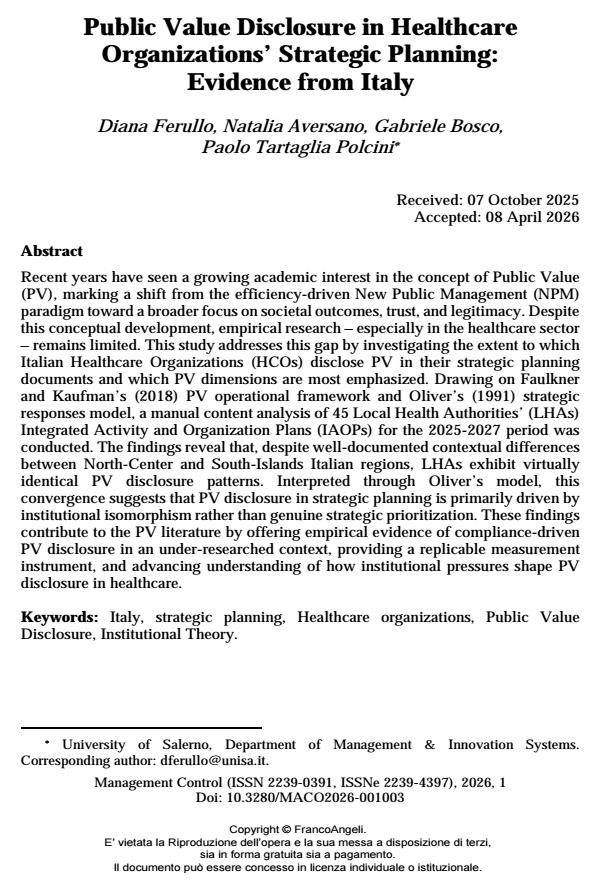
Recent years have seen a growing academic interest in the concept of Public Value (PV), marking a shift from the efficiency-driven New Public Management (NPM) paradigm toward a broader focus on societal outcomes, trust, and legitimacy. Despite this conceptual development, empirical research - especially in the healthcare sector - remains limited. This study addresses this gap by investigating the extent to which Italian Healthcare Organizations (HCOs) disclose PV in their strategic planning documents and which PV dimensions are most emphasized. Drawing on Faulkner and Kaufman’s (2018) PV operational framework and Oliver’s (1991) strategic responses model, a manual content analysis of 45 Local Health Authorities’ (LHAs) Integrated Activity and Organization Plans (IAOPs) for the 2025-2027 period was conducted. The findings reveal that, despite well-documented contextual differences between North-Center and South-Islands Italian regions, LHAs exhibit virtually identical PV disclosure patterns. Interpreted through Oliver’s model, this convergence suggests that PV disclosure in strategic planning is primarily driven by institutional isomorphism rather than genuine strategic prioritization. These findings contribute to the PV literature by offering empirical evidence of compliance-driven PV disclosure in an under-researched context, providing a replicable measurement instrument, and advancing understanding of how institutional pressures shape PV disclosure in healthcare.
Parole chiave:Italy, strategic planning, Healthcare organizations, Public Value Disclosure, Institutional Theory.
Diana Ferullo, Natalia Aversano, Gabriele Bosco, Paolo Tartaglia Polcini, Public Value Disclosure in Healthcare Organizations’ Strategic Planning: Evidence from Italy in "MANAGEMENT CONTROL" 1/2026, pp 41-65, DOI: 10.3280/MACO2026-001003