Digitalization and managerial control of street-level action: The case of an Italian Public Higher Institution
Titolo Rivista MANAGEMENT CONTROL
Autori/Curatori Tiziana Di Cimbrini, Manuel Miclucci
Anno di pubblicazione 2026 Fascicolo 2026/1 Suppl.
Lingua Inglese Numero pagine 25 P. 137-161 Dimensione file 129 KB
DOI 10.3280/MACO2026-001-S1007
Il DOI è il codice a barre della proprietà intellettuale: per saperne di più
clicca qui
Qui sotto puoi vedere in anteprima la prima pagina di questo articolo.
Se questo articolo ti interessa, lo puoi acquistare (e scaricare in formato pdf) seguendo le facili indicazioni per acquistare il download credit. Acquista Download Credits per scaricare questo Articolo in formato PDF
FrancoAngeli è membro della Publishers International Linking Association, Inc (PILA), associazione indipendente e non profit per facilitare (attraverso i servizi tecnologici implementati da CrossRef.org) l’accesso degli studiosi ai contenuti digitali nelle pubblicazioni professionali e scientifiche.
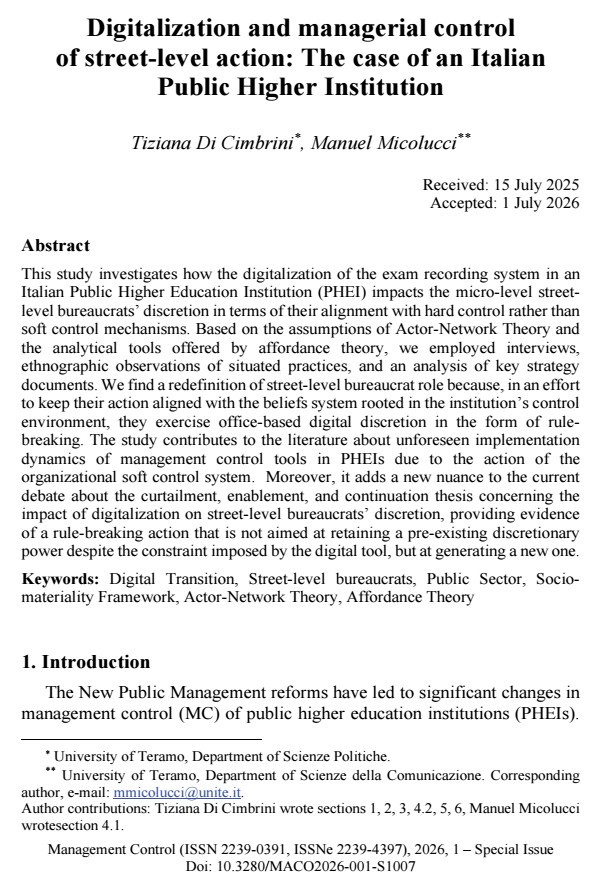
This study investigates how the digitalization of the exam recording system in an Italian Public Higher Education Institution (PHEI) impacts the micro-level street-level bureaucrats’ discretion in terms of their alignment with hard control rather than soft control mechanisms. Based on the assumptions of Actor-Network Theory and the analytical tools offered by affordance theory, we employed interviews, ethnographic observations of situated practices, and an analysis of key strategy documents. We find a redefinition of street-level bureaucrat role because, in an effort to keep their action aligned with the beliefs system rooted in the institution’s control environment, they exercise office-based digital discretion in the form of rule-breaking. The study contributes to the literature about unforeseen implementation dynamics of management control tools in PHEIs due to the action of the organizational soft control system. Moreover, it adds a new nuance to the current debate about the curtailment, enablement, and continuation thesis concerning the impact of digitalization on street-level bureaucrats’ discretion, providing evidence of a rule-breaking action that is not aimed at retaining a pre-existing discretionary power despite the constraint imposed by the digital tool, but at generating a new one.
Parole chiave:Digital Transition, Street-level bureaucrats, Public Sector, Socio-materiality Framework, Actor-Network Theory, Affordance Theory
- Bozeman B. (2022). Rules compliance behavior: A heuristic model. Perspectives on Public Management and Governance, 5(1), pp. 36-49.
- Adler N. J., and Harzing A.W. (2009). When knowledge wins: Transcending the sense and nonsense of academic rankings. Academy of Management Learning and Education, 8(1), pp. 72-95.
- Agar M. (2004). We have met the other and we’re all nonlinear: Ethnography as a nonlinear dynamic system. Complexity, 10(2), pp. 16-24.
- Ahrens T., Khalifa R. (2015), The impact of regulation on management control: Compliance as a strategic response to institutional logics of university accreditation. Qualitative Research in Accounting and Management, 12(2), pp. 106-126. DOI: 10.1108/QRAM-04-2015-0041
- Allini A., Caldarelli A., Spanò R. (2017). La disclosure nei Piani della Performance delle università italiane. Intenti simbolici verso approcci sostanziali di legittimazione. Management Control, 1, pp. 37-59. DOI: 10.3280/MACO2017-001003
- Allini A., Caldarelli A., Spanò R., Zampella A., (2019). Legitimating efforts in performance plans: evidences on the thoroughness of disclosure in the Italian higher education setting. Management Control, 1, pp. 143-168. DOI: 10.3280/MACO2019-001007
- Allini A., Spanò R., Zampella A., Meucci F. (2020). Integrated Performance Plans in Higher Education as means of accounting change. Insights into the Italian context. Management control, 1, pp. 87-110. DOI: 10.3280/MACO2020-001005
- Alshuaibi A.H. (2023) The role of digital transformation in developing the performance of Umm Al-Qura University employees. Information Sciences Letters, 12(5), pp. 2235-2245.
- Alter S. (2014). Theory of Workarounds. Communications of the Association for Information Systems 34 (March), pp. 1041-66. DOI: 10.17705/1CAIS.03455
- Avallone F., Quagli A., Ramassa P. (2012). La produzione scientifica dei docenti italiani di Economia Aziendale. Un’analisi esplorativa nel triennio 2008-2010. Management Control, 3, pp. 119-150. DOI: 10.3280/MACO2011-003006
- Aversano N., Manes Rossi F., Tartaglia Polcini (2017). I sistemi di misurazione della performance nelle università: considerazioni critiche sul sistema italiano. Management Control, 1, pp. 15-36. DOI: 10.3280/MACO2017-001002
- Bannink D., Six F., van Wijk E. (2015). Bureaucratic, market or professional control? A theory on the relation between street-level task characteristics and the feasibility of control mechanisms. In Understanding street-level bureaucracy (pp. 205-226). Policy Press.
- Beerepoot I., Koorn J., van de Weerd I., van den Hooff B., Leopold H., Reijers H. A. (2020). Working around health information systems: The role of power. In H. Krcmar, J.
- Fedorowicz, W. F. Boh, J. M. Leimeister, and S. Wattal (Eds.). ICIS 2019 Proceedings: 40th International Conference on Information Systems, ICIS 2019 Munich (pp. 1-17).
- Bekkers V. (2004). E-government and the emergence of virtual organizations in the public sector. Information polity, 8(3-4), pp. 89-101. DOI: 10.3233/IP-2003-0032
- Boitier M., Rivière A. (2016). Management Control Systems, Vectors of a Managerial Logic: Institutional Change and Conflicts of Logics at University. Comptabilite-Controle-Audit, 22, pp. 47-79.
- Bovens M., Zouridis S. (2002). From street-level to system-level bureaucracies: How information and communication technology is transforming administrative discretion and constitutional control. Public Administration Review, 62(2), pp. 174-184. DOI: 10.1111/0033-3352.00168
- Broadbent J., Laughlin R. (2007). Performance Management Systems in and of Higher Education Institutions in England: professionalism, managerialism and management. Roehampton University Research Papers, Roehampton University, Roehampton.
- Broccardo L., Truant E., Argento D. (2023). Digitalization and management control in the public sector: what is next?. In: Handbook of Big Data and Analytics in Accounting and Auditing (pp. 279-308). Singapore: Springer Nature Singapore.
- Busch P. A., Henriksen H. Z. (2018). Digital discretion: A systematic literature review of ICT and street-level discretion. Information polity, 23(1), pp. 3-28. DOI: 10.3233/IP-170050
- Busch P. A., Henriksen H. Z., Sæbø Ø. (2018). Opportunities and challenges of digitized discretionary practices: A public service worker perspective. Government Information Quarterly, 35(4), pp. 547-556.
- Callon M. (1986). The sociology of an actor-network: The case of the electric vehicle. In: Mapping the dynamics of science and technology: Sociology of science in the real world (pp. 19-34). London: Palgrave Macmillan UK. DOI: 10.1007/978-1-349-07408-2_2
- Callon M., Law J. (1997). After the individual in society: Lessons on collectivity from science, technology and society. Canadian Journal of Sociology/Cahiers canadiens de sociologie, pp. 165-182. DOI: 10.2307/3341747
- Cantele S., Martini M., Campedelli B. (2012). Gli atenei italiani e gli strumenti di pianificazione e controllo: a che punto siamo?. Management Control, 1, pp. 55-83. DOI: 10.3280/MACO2012-001004
- Coran G., Donna G., Sostero U. (2023). L’analisi del bilancio delle università attraverso gli indici: indagine su un campione di atenei statali. Management Control, 1, pp. 165-193. DOI: 10.3280/MACO2023-001008
- Coran G., Sostero U., (2020). Il bilancio degli atenei: schemi di analisi. Management Control, 3, pp. 113-141. DOI: 10.3280/MACO2020-003006
- Davis J. L. (2020). How artifacts afford: The power and politics of everyday things. MIT Press.
- Davis J. L., Chouinard J. B. (2016). Theorizing affordances: From request to refuse. Bulletin of science, technology and society, 36(4), pp. 241-248. Frontiers in Psychology, 13, 1081595.
- du Gay P. (2000). In praise of bureaucracy - Weber - organization - ethics. London: Sage. du Gay P. (2009). Max Weber and the ethics of office. In: P. Adler (ed.). Oxford handbook of sociology and organizational studies: Classical foundations, pp. 146-73. Oxford: Oxford Univ. Press.
- Evans S. K., Pearce K. E., Vitak J., Treem J. W. (2017). Explicating affordances: A conceptual framework for understanding affordances in communication research. Journal of computer-mediated communication, 22(1), pp. 35-52.
- Evans T. (2020). Street-level bureaucrats: Discretion and compliance in policy implementation. In: Oxford research encyclopedia of politics (pp. 1-21).
- Evans T., Harris J. (2004). Street-level bureaucracy, social work and the (exaggerated) death of discretion. British Journal of Social Work, 34(6), pp. 871-895.
- Ezza A., Fadda N., Pischedda G., Marinò L., (2019). Il grande gap: gli effetti del performance budgeting sulle politiche di reclutamento delle Università italiane. Management Control, 2, pp. 99-121. DOI: 10.3280/MACO2019-002005
- Farneti F., Siboni B., del Sordo C. (2017). La misurazione della performance sociale nell’esperienza dell’Università di Bologna. Management Control, 1, pp. 135-164. DOI: 10.3280/MACO2017-001007
- Francesconi A., Guarini E. (2017). Performance-based funding e sistemi di allocazione delle risorse ai dipartimenti: prime evidenze nelle università italiane. Management control, 1, pp. 113-134. DOI: 10.3280/MACO2017-001006
- Francesconi A., Guarini E., Magli F. (2020). Distorsioni nel sistema di accountability delle Università: analisi di un caso. Management Control, 1, pp. 59-86. DOI: 10.3280/MACO2020-001004
- Gigli S., Mariani L., Paletta A. (2021). Management accounting and governance implications: The case of the University of Bologna. Management Control, 2, pp. 289-311. DOI: 10.3280/MACO2021-002-S1013
- Gigli S., Tieghi M. (2017). La riforma del sistema informativo-contabile degli atenei italiani. Una proposta di analisi del nuovo modello di bilancio. Management Control, 1, pp. 61- 90. DOI: 10.3280/MACO2017-001004
- Gordon E., Harlow J., Whitman S. A., Lee M. (2024). Data Discretion: Screen-Level Bureaucrats and Municipal Decision-Making. Digital Government: Research and Practice, 5(2), pp. 1-14. DOI: 10.1145/3652950
- Guenther T.W., Schmidt U. (2015). Adoption and Use of Management Controls in Higher Education Institutions. In: Welpe I., Wollersheim J., Ringelhan S., Osterloh M. (eds). Incentives and Performance. Springer, Cham.
- Heidelberg R. L. (2024). What’s old is new: AI and bureaucracy. In: Handbook on Public Policy and Artificial Intelligence (pp. 53-65). Edward Elgar Publishing.
- Heinicke X., Guenther T. W. (2020). The role of management controls in the higher education sector: An investigation of different perceptions. European Accounting Review, 29(3), pp. 581-630. DOI: 10.1080/09638180.2019.1619603
- Huuskonen S., Vakkari P. (2013). ‘I Did It My Way’: Social Workers as Secondary Designers of a Client Information System. Information Processing and Management, 49(1), pp. 380-391.
- Jensen D. C. (2018). Does Core task matter for decision-making? A comparative case study on whether differences in job characteristics affect discretionary street-level decision-making. Administration and Society, 50(8), pp. 1125-1147. DOI: 10.1177/0095399715609383
- Johansson J. (2025). Research on digital discretion - The subjectification of street-level work in public administration. Review of Policy Research, 42(1), pp. 122-148.
- Kvale S., Brinkmann S. (2009). InterViews: Learning the Craft of Qualitative Research Interviewing. Sage.
- Lamboglia R., Mancini D., Paolone F. (2018). A roadmap for performance measurement in smarter universities. Management Control, 2, pp. 113-133. DOI: 10.3280/MACO2018-SU2006
- Lambovska M., Angelova-Stanimirova A. (2025). Unveiling Challenges to Management Control Systems in Higher Education: A Systematic Literature Review. World, 6(3), 100.
- Lartey P. Y., Akolgo I. G., Jaladi S. R., Ayeduvor S., Afriyie S. O. (2023). Recent advances in internal control: Soft control overcoming the limits of hard control. Financial Metrics in Business, 4(1), pp. 289-302. DOI: 10.25082/FMB.2023.01.004
- Latour B. (1987). Science in Action. Cambridge, MA: Harvard University Press.
- Latour B. (1992). Where are the missing masses? The sociology of a few mundane artifacts. In: Bijker WE and Law J (eds). Shaping Technology/Building Society: Studies in Sociotechnical Change. Cambridge, MA: The MIT Press, pp. 225-258.
- Latour B. (1996). On Interobjectivity. Mind, Culture, and Activity, 3(4), pp. 228-245.
- Latour B. (2005). Reassembling the social: An introduction to actor-network-theory. Oxford university press.
- Law J. (1992). Notes on the theory of the actor-network: Ordering, strategy, and heterogeneity. Systems practice, 5, pp. 379-393. DOI: 10.1007/BF01059830
- Law J. (2008). Actor-Network Theory and Material Semiotics. In: B. S. Turner (Ed.). The New Blackwell Companion to Social Theory (pp. 141-158).
- Leonardi P. M. (2011). When Flexible Routines Meet Flexible Technologies: Affordance, Constraint, and the Imbrication of Human and Material Agencies. MIS Quarterly, 35(1), pp. 147-167. DOI: 10.2307/23043493
- Leonardi P. M. (2013). Theoretical foundations for the study of sociomateriality. Information and organization, 23(2), pp. 59-76.
- Leonardi P. M., Treem J. W. (2020). Behavioral visibility: A new paradigm for organization studies in the age of digitization, digitalization, and datafication. Organization Studies.
- Lipsky M. (2010). Street-level bureaucracy: Dilemmas of the individual in public services. Russell Sage Foundation.
- Macchioni R., Manes Rossi F., Luise C. (2024). Il PIAO come strumento di cambiamento strategico: il caso dell’Università Vanvitelli. Management Control, 3, pp. 135-153. DOI: 10.3280/MACO2024-003007
- Marchi L., Marasca S., Giuliani M. (2014). Valutare la ricerca nella prospettiva europea e internazionale: prime riflessioni. Management Control, 3, pp. 99-113. DOI: 10.3280/MACO2013-003006
- Marienfeldt J. (2024). Does digital government hollow out the essence of street-level bureaucracy? A systematic literature review of how digital tools’ foster curtailment, enablement and continuation of street-level decision-making. Social Policy and Administration, 58(5), pp. 831-855.
- Marigonda P. (2012). Il sistema bibliotecario dell’Università IUAV di Venezia: il sistema delle misurazioni. Management Control, 2, pp. 117-135. DOI: 10.3280/MACO2012-002006
- Maynard-Moody S., Musheno M. (2012). Social equities and inequities in practice: Street-level workers as agents and pragmatists. Public Administration Review, 72(1), pp. 16-23.
- Maynard-Moody S., Williams S., Musheno M. (2003). Cops, teachers, counsellors: Stories from the front lines of public service. University of Michigan Press.
- Merchant K.A. (1982). The Control Function of Management. Sloan Management Review, 23(4), pp. 43-55.
- Modell S. (2003). Goals versus institutions: The development of performance measurement in the Swedish university sector. Management Accounting Research, 14(4), pp. 333-359.
- Møller A. M., Pedersen K. Z., Pors A. S. (2022). The bureaucratic ethos in street-level work: Revitalizing Weber’s ethics of office. Perspectives on Public Management and Governance, 5(2), pp. 151-163.
- Mozzoni I., Fanelli S., Zangrandi A. (2017). Il confronto di performance economico-finanziarie nelle Università: un possibile modello di analisi per indici. Management Control, 1, pp. 91-112. DOI: 10.3280/MACO2017-001005
- Munteanu I., Newcomer K. (2020). Leading and learning through dynamic performance Systems Management in government. Public Administration Review, 80(2), pp. 316-325.
- Paolini A., Quagli A. (2013). Una riflessione sugli strumenti bibliometrici per la valutazione della ricerca e una proposta: il real impact factor. Management Control, 3, pp. 115-128. DOI: 10.3280/MACO2013-003007
- Paolini A., Soverchia M. (2013). Le università statali italiane verso la contabilità economico-patrimoniale ed il controllo di gestione. Management Control, 3, pp. 77-98. DOI: 10.3280/MACO2013-003005
- Paolini A., Soverchia M. (2017). I sistemi informativi per il controllo e la valutazione delle performance nelle università italiane. Management Control, 1, pp. 5-14. DOI: 10.3280/MACO2017-001001
- Pedersen K. Z., Pors A. S. (2023). Discretionary responses in frontline encounters: Balancing standardization with the ethics of office. Journal of Public Administration Research and Theory, 33(1), pp. 80-93.
- Pop-Vasileva A., Baird K., Blair B. (2011). University corporatisation. Accounting, Auditing and Accountability Journal, 24(4), pp. 408-439. DOI: 10.1108/09513571111133045
- Rajabov S. B., ogli Alimov J. S. (2025). Modern Approaches to Modernizing the Management System in Higher Education through Digital Technologies. Academic Journal of Science, Technology and Education, 1(5), 34-38.
- Rubino F., Puntillo P., Veltri S. (2017). Il ruolo dei manager universitari in un'ottica di performance integrata: analisi di un caso studio. Management Control, 3, pp. 95-122. DOI: 10.3280/MACO2017-003007
- Scholkmann A. (2020). Why don’t we all just do the same? Understanding variation in PBL implementation from the perspective of Translation Theory. Interdisciplinary Journal of Problem-Based Learning, 14(2).
- Scholkmann A. (2023). Who Are the Frontline Workers of Digital Transformations in Higher Education? A Conceptual Elaboration. In: Pinheiro R., Edelhard Tømte C., Barman L., Degn L., Geschwind L. (eds). Digital Transformations in Nordic Higher Education. Palgrave Macmillan, Cham.
- Soares C., Grimmelikhuijsen S., Meijer A. (2024). Screen-level bureaucrats in the age of algorithms: An ethnographic study of algorithmically supported public service workers in the Netherlands Police. Information Polity, 29(3), pp. 277-292. DOI: 10.3233/IP-220070
- Soffer P., Outmazgin N., Hadar I., Tzafrir S. (2023). Why work around the process? Analyzing workarounds through the lens of the theory of planned behavior. Business and Information System Enginering, 65(4), pp. 369-389.
- Ter Bogt H. J., Scapens R. W. (2012). Performance management in universities: Effects of the transition to more quantitative measurement systems. European Accounting Review, 21(3), pp. 451-497. DOI: 10.1080/09638180.2012.668323
- Tieghi M., Orelli R. L., Padovani E. (2018). Accounting reform in Italian universities. Internal response to accounting change. Management Control, 1, pp. 117-138. DOI: 10.3280/MACO2018-001006
- Università degli Studi di Teramo, Piano di potenziamento delle infrastrutture digitali dell'Ateneo 2021-2023.
- Università degli Studi di Teramo, Piano Triennale per la transizione digitale, 2023-2025 https://www.unite.it/UniTE/Engine/RAServePG.php/P/697261UTE0400/M/20011UTE0 400.
- Vale J., Amaral J., Abrantes L., Leal C., Silva R. (2022). Management accounting and control in higher education institutions: A systematic literature review. Administrative Sciences, 12(1), 14.
- van Berkel R., Penning de Vries J., Knies E. (2022). Managing street-level bureaucrats’ performance by promoting professional behavior through HRM. Public Personnel Management, 51(2), pp. 189-212. DOI: 10.1177/00910260211046554
- Venance S. L., LaDonna K. A., Watling C. J. (2014). Exploring frontline faculty perspectives after a curriculum change. Medical Education, 48(10), pp. 998-1007.
- Wellman N., Tröster C., Grimes M., Roberson Q., Rink F., Gruber M. (2023). Publishing Multimethod Research in AMJ: A Review and Best-Practice Recommendations. Academy of Management Journal, 66, pp. 1007-1015.
- Zacka B. (2017). When the state meets the street: Public service and moral agency. Cambridge, MA: Belknap Press of Harvard Univ. Press.
Tiziana Di Cimbrini, Manuel Miclucci, Digitalization and managerial control of street-level action: The case of an Italian Public Higher Institution in "MANAGEMENT CONTROL" 1 Suppl./2026, pp 137-161, DOI: 10.3280/MACO2026-001-S1007