L’errore in psicoterapia. Una prospettiva tra Control-Mastery theory e cognitivismo evoluzionista

Titolo Rivista PSICOBIETTIVO
Autori/Curatori Armando Cotugno, Walter Sapuppo
Anno di pubblicazione 2014 Fascicolo 2014/1
Lingua Italiano Numero pagine 15 P. 24-38 Dimensione file 557 KB
DOI 10.3280/PSOB2014-001003
Il DOI è il codice a barre della proprietà intellettuale: per saperne di più clicca qui

Qui sotto puoi vedere in anteprima la prima pagina di questo articolo.

Se questo articolo ti interessa, lo puoi acquistare (e scaricare in formato pdf) seguendo le facili indicazioni per acquistare il download credit. Acquista Download Credits per scaricare questo Articolo in formato PDF
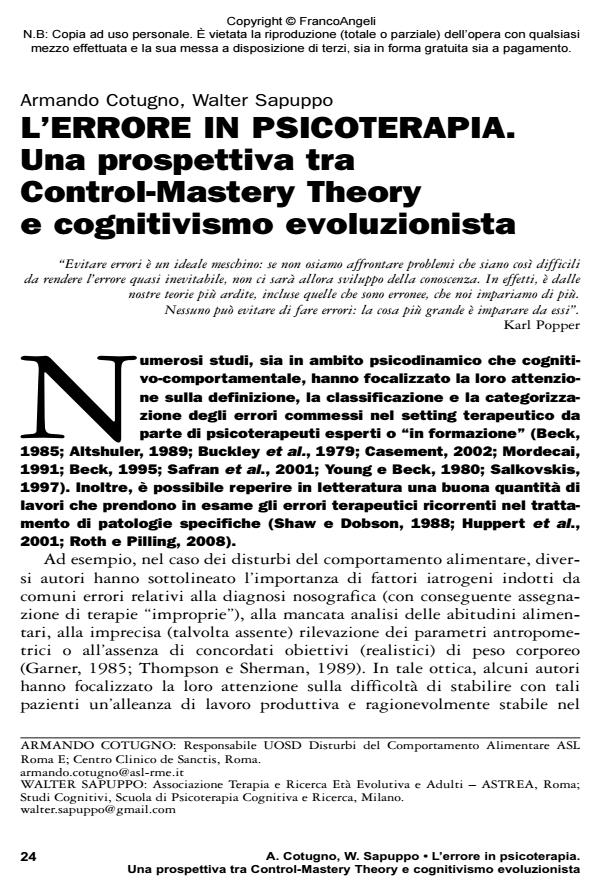
Anteprima articolo

FrancoAngeli è membro della Publishers International Linking Association, Inc (PILA), associazione indipendente e non profit per facilitare (attraverso i servizi tecnologici implementati da CrossRef.org) l’accesso degli studiosi ai contenuti digitali nelle pubblicazioni professionali e scientifiche.

Sia in ambito psicodinamico che cognitivo-comportamentale, il concetto di errore terapeutico rappresenta un argomento controverso e di cruciale importanza. Nel concepire l’errore come un evento che colpisce in modo negativo il paziente (direttamente o indirettamente) attraverso la compromissione del corso o della qualità della terapia stessa, gli autori prendono in esame differenti studi presenti in letteratura che testimoniano l’attenzione dedicata alla classificazione degli errori, ai fattori iatrogeni derivati da distorsioni o carenze di tecnica terapeutica e la conseguente necessità di condividere criteri di azione sistematici ed empiricamente derivati con cui valutare le competenze specialistiche, l’attitudine al trattamento nonché le caratteristiche personologiche del terapeuta. La cornice teorica descritta, con l’ausilio di esemplificazioni cliniche, è quella cognitivo-evoluzionista e della Control-Mastery Theory.

Parole chiave:Errore; psicoterapia; cognitivo evoluzionista; Control- Mastery Theory; alleanza terapeutica.

  1. Incerti A., Scarinci A. (a cura di) (2008) Assessment dell’ansia in psicoterapia cognitivo comportamentale, Erickson, Trento
  2. Lichtenberg J. (1989) Psychoanalysis and Motivation, The Analytic Press, Hillsdale Liotti G. (1994) La dimensione interpersonale della coscienza, Carocci, Roma
  3. Liotti G. (2001) Le opere della coscienza: Psicopatologia e psicoterapia nella prospettiva cognitivo-evoluzionista, Raffello Cortina, Milano
  4. Liotti G. (2005) La dimensione interpersonale della coscienza, Carocci, Roma
  5. Liotti G., Monticelli F. (a cura di) (2008) I sistemi motivazionali nel dialogo clinico. Il manuale AIMIT, Raffaello Cortina, Milano
  6. Mancini F., Barcaccia B. ( 2009) “La diagnosi in psicoterapia cognitivo compor tamentale”, in Dazzi N., Lingiardi V., Ganzillo F. (a cura di), La diagnosi psicologica, Raffaello Cortina, Milano
  7. Merton R.K. (1971) “La profezia che si autoavvera”, in Teoria e Struttura Sociale, vol. II, Il Mulino, Bologna
  8. Mordecai E.M. (1991) “A classification of empathic failures for psychotherapists and supervisors”, Psychoanalytic Psychology, 8: 251-262
  9. Popper K.R. (1974) La ricerca non ha fine. Autobiografia intellettuale, Armando, Roma
  10. Powell B., Cooper G., Hoffman K., Marvin B. (2014) The Circle of Security Intervention. Enhancing Attachment in Early Parent-Child Relationships, The Guilford Press, New York
  11. Prasko J., Vyskocilova J., Slepecky M., Novotny M. (2011) “Principles of supervision in cognitive behavioural therapy”, Biomed. Pap. Med. Fac. Univ.
  12. Palacky Olomouc Czech Repub, 156 (1): 70-79
  13. Roth A.D., Pilling S. (2008) “Using an Evidence-Based Methodology to Identify the Competences Required to Deliver Effective Cognitive and Behavioural Therapy for Depression and Anxiety Disorders”, Behavioural and Cognitive Psychotherapy, 36: 129-147
  14. Safran J.D., Muran J.C., Samstag L.W., Stevens C. (2001) “Repairing alliance ruptures”, Psychotherapy, 38: 406-412
  15. Safran J.D., Muran J.C. (2000) Teoria e pratica dell’alleanza terapeutica (trad. it. Laterza, Roma-Bari, 2003)
  16. Safran J.D., Segal Z.V. (1990/1996) Interpersonal Process in Cognitive Therapy, Basic Books, New York, 2a ed. Aronson, Northvale, NJ
  17. Salkovskis P.M. (a cura di) (1997) Frontiers of cognitive therapy, Guilford Press, New York
  18. Schore A.N. (2003) “Parent-Infant Communication and the neurobiology of Emotional Development”, in Erlbaum L., Affect Regulation and the Origin of the Self, Hillsdale, New Jersey
  19. Semerari A. (2000) Storia, teorie e tecniche della psicoterapia cognitiva, Laterza, Roma-Bari
  20. Shaw B.F., Dobson K.S. (1988) “Competency judgments in the training and evaluation of psychotherapists”, Journal of Consulting and Clinical Psychology, 56 (5): 666-672
  21. Silberschatz G. (2005) Trasformative relationships: The Control-Mastery Theory of psychotherapy, Routledge, Hove
  22. Sibilia L. (2011) Gli errori in psicoterapia come processo di problem solving, Relazione tenuta al Convegno: “Errori in psicoterapia” presso la LUMSA, Roma.http://www.crpdownload.com/ErroriSibiliaIdee.pdf
  23. Stern D.N. (1998) Le interazioni madre-bambino, Raffaello Cortina, Milano
  24. Thompson R.A., Sherman R.T. (1989) “Therapist errors in treating eating disorders: Relationship and Process”, Psychotherapy, 26: 62-68
  25. Trevarthen C. (2005) “Stepping Away from the Mirror: Pride and Shame in Advetures of Companionship. Reflections on the Nature and Emotional Needs of Infant Intersubjectivity”, in Carter C.S., Ahnert L., Grossmann K.E., Hrdy S.B., Lamb M.E., Porges S.W., Sachser (eds.), Attachment and Bonding. A New Synthesis, The MIT Press, Cambridge
  26. Tronik E.Z. (1986) “Interactive mismatch and repair challenges to the coping infant”, Zero to Three, 6: 1-6
  27. Tronik E.Z. (1998) “Dyadically expanded states of consciousness and the process of terapeutic change”, Infant Mental Health Journal, 19 (3): 290-299
  28. Watzlawick P., Beavin J.H., Jackson D.D. (1971) Pragmatica della comunicazione umana, Astrolabio Ubaldini, Roma
  29. Weiss J. (1993) Come funziona la psicoterapia, Bollati Boringhieri, Torino
  30. Weiss J., Sampson H., The Mount Zion Psychotherapy Research Group
  31. (1986) The Psychoanalytic Process: Theory, Clinical Observation, and Empirical Research, Guilford, New York
  32. Williams M., Haverkamp B.E. (2010) “Identifying Critical Competencies for Psychotherapeutic Practice With Eating Disordered Clients: A Delphi Study”, Eating Disorders, 18 (2): 91-109
  33. Wolman W.L. (2005) “Internal and External Supervision of Boundary Mistakes”, Australasian journal of psychotherapy, 24 (2): 1-15
  34. Young J., Beck A. (1980) Cognitive therapy scale: rating manual. http://academyofct.org/files/documentlibrary/CTRSManual.pdf
  35. Altshuler K.Z. (1989) “Common mistakes made by beginning psychotherapists”, Academic Psychiatry, 13: 73-80
  36. Beck A.T., Emery G., Greenberg R.L. (1985) Anxiety disorders and phobias: A cognitive perspective, Basic Books, New York
  37. Beck J.S. (1995) Cognitive therapy: Basics and beyond, The Guilford Press, New York
  38. Buckley P., Karasu T.B., Charles E. (1979) “Common mistakes in psychotherapy”, American Journal of Psychiatry, 136: 1578-1580
  39. Bugas J., Silberschatz G. (2005) “How patients coach their therapists in psychotherapy”, in G. Silberschatz (ed.), Transformative relationships: The Control-Mastery theory of psychotherapy, Routledge, New York, pp. 153- 167
  40. Casement P. (2002) Learning from Our Mistakes, Guildford, New York
  41. Cotugno A. (2007) “Tra nuvole e orologi: riflessioni sul processo terapeutico in una prospettiva cognitivo-evoluzionista”, Psicobiettivo, 26: 17-37
  42. Cotugno A., Iannucci C., Manaresi F., Mantione G., Monticelli F. (2008) “Analisi dei momenti problematici in psicoterapia: il contributo dell’AIMIT”, in Liotti G., Monticelli F. (a cura di), I sistemi motivazionali nel dialogo clinico: il manuale AIMIT, Raffaello Cortina, Milano
  43. Cotugno A., Sapuppo W. (2013) “Rotture e riparazioni dell’aleanza terapeutica e cicli cognitivo-interpersonali nei disturbi del comportamento alimentare: aspetti clinici e impasse nel trattamento”, Cognitivismo Clinico, 9 (1): 41-52
  44. Friedberg R.D., Taylor L.A. (1994) “Perspectives on supervision in cognitive therapy”, Journal of Rational-Emotive and Cognitive-Behavior Therapy, 12 (3): 147-161
  45. Garner D.M. (1985) “Iatrogenesis in anorexia nervosa and bulimia nervosa”, International Journal of Eating Disorders, 4: 701-726
  46. Gilbert P. (1989) Human Nature and Suffering, Lawrence Erlbaum Associates, Hove, UK
  47. Huppert J.D., Bufka L.F., Barlow D.H., Gorman J.M., Shear M.K., Woods
  48. S.W. (2001) “Therapists, therapist variables, and cognitive-behavioral therapy outcome in a multicenter trial for panic disorder”, Journal of Consulting and Clinical Psychology, 69 (5): 747-755

Armando Cotugno, Walter Sapuppo, L’errore in psicoterapia. Una prospettiva tra Control-Mastery theory e cognitivismo evoluzionista in "PSICOBIETTIVO" 1/2014, pp 24-38, DOI: 10.3280/PSOB2014-001003