Enhancing teacher professional development through micro-credentials: emerging insights and challenges
Titolo Rivista CADMO
Autori/Curatori Francesca Fioretti, Brit Svoen
Anno di pubblicazione 2026 Fascicolo 2025/2
Lingua Inglese Numero pagine 16 P. 53-68 Dimensione file 186 KB
DOI 10.3280/CAD2025-002004
Il DOI è il codice a barre della proprietà intellettuale: per saperne di più
clicca qui
Qui sotto puoi vedere in anteprima la prima pagina di questo articolo.
Se questo articolo ti interessa, lo puoi acquistare (e scaricare in formato pdf) seguendo le facili indicazioni per acquistare il download credit. Acquista Download Credits per scaricare questo Articolo in formato PDF
FrancoAngeli è membro della Publishers International Linking Association, Inc (PILA), associazione indipendente e non profit per facilitare (attraverso i servizi tecnologici implementati da CrossRef.org) l’accesso degli studiosi ai contenuti digitali nelle pubblicazioni professionali e scientifiche.
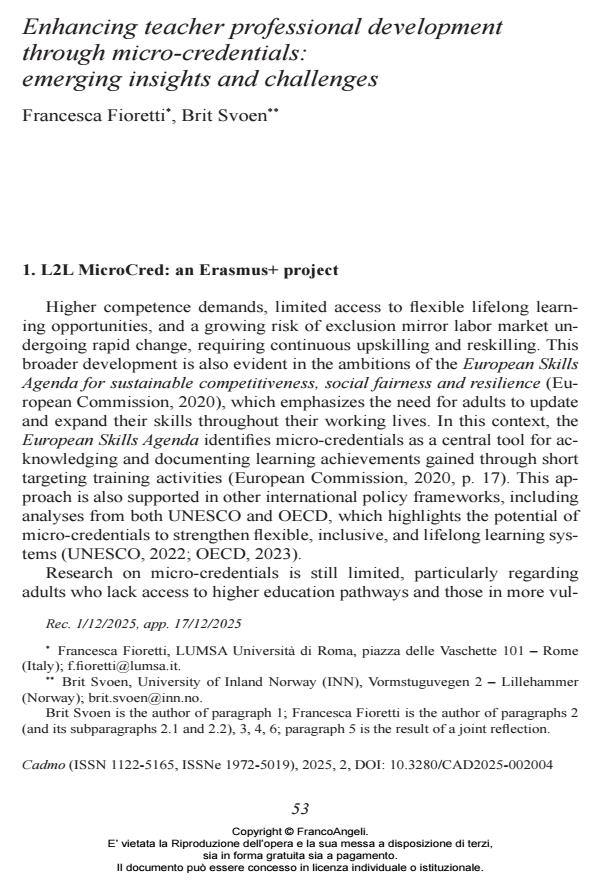
In recent years, micro-credentials have garnered significant attention at the European level. Structured as short, tailored learning modules aimed at developing particular skills and providing formal recognition to their users, micro-credentials represent a particularly innovative tool in the professional development of teachers within the Italian context. This initiative is framed within the Erasmus+ L2L MicroCred project, involving universities from Norway, Italy, Ireland, and Australia, dedicated to developing relevant micro-credentials to support adult education within a lifelong learning perspective. Drawing on a focus group and interviews conducted with teachers and key educational sector representatives, this contribution explores the emerging opportunities and challenges associated with employing micro-credentials to effectively foster teachers’ continuing professional development in Italy.
Parole chiave:micro-credential, professional development, lifelong learning, Erasmus+.
- ANPAL (2023), Rapporto italiano di referenziazione delle qualificazioni al Quadro Europeo EQF – Aggiornamento 2022 – Manutenzione 2022, Ministero del La-voro e delle Politiche Sociali, https://europass.europa.eu/system/files/2023-10/ RAPPORTO%20REFERENZIAZIONE%20_APRILE%202023_IT_V5.pdf.
- Barber. M., Mourshed, M. (2007), How the World’s Best-Performing School Systems Come Out on Top. Washington: McKinsey.
- Braun, V., Clarke. V. (2006), “Using thematic analysis in psychology”, Qualitative Re-searchinPsychology,3(2),pp.77-101,
- Council of the European Union (2022), “Council Recommendation of 16 June 2022 on a European approach to micro-credentials for lifelong learning and employa-bility”, Official Journal of the European Union, C 243/10, https://eur-lex.europa. eu/legal-content/EN/TXT/?uri=CELEX:32022H0627%2802%29.
- DeMonte, J. (2017), Micro-Credentials for Teachers: What Three Early Adopters Have Learned So Far, Washington: American Institutes for Research, https:// www.air.org/resource/report/micro-credentials-teachers-what-three-early-adop-ters-have-learned-so-far.
- Digital Promise (2016), Micro-credentials: driving teacher learning & leadership, Center for Teaching Quality, https://digitalpromise.org/reportsandresources/mi-cro-credentials-driving-teacher-learning-leadership/.
- European Commission (2020), European Skills Agenda for sustainable competitive-ness, social fairness and resilience (COM(2020) 274 final), P. O. o. t. E. Union, https://eur-lex.europa.eu/legal-content/EN/TXT/?uri=celex:52020DC0274.
- European Commission (2021), Proposal for a Council Recommendation on a Eu-ropean approach to micro-credentials for lifelong learning and employability. (COM(2021) 770 final). Brussels: Publications Office of the European Union, https://eur-lex.europa.eu/resource.html?uri=cellar:10b78e47-59aa-11ec-91ac-01aa75ed71a1.0001.02/DOC_1&format=PDF.
- European Commission/EACEA/Eurydice (2021), Teachers in Europe: Careers, De-velopment and Wellbeing, Eurydice report. Luxembourg: Publications Office of the European Union.
- European Commission: European Education and Culture Executive Agency (2021), Adult education and training in Europe – Building inclusive pathways to skills and qualifications. Luxembourg: Publications Office of the European Union, https://data.europa.eu/doi/10.2797/788535.
- Kompetansebehovsutvalget (2022), Høyere yrkesfaglig utdanning for et arbeidsliv i endring (KBU-temarapport, Issue, Direktoratet for høyere utdanning og kom-petanse, https://www.kompetansebehovsutvalget.no/uploads/n0bpygpN/KBU-te marapport-2022.pdf.
- Mortari, L. (2024), “La formazione dei professionisti dell’educazione”, Scuola & Formazione, 3, pp. 20-24.
- OECD (2020), TALIS 2018 Results, vol. II: Teachers and School Leaders as Valued Pro-fessionals, TALIS, Paris: OECD Publishing,
- OECD (2023), Micro-credentials for lifelong learning and employability: Uses and possibilities, OECD Education Policy Perspectives, Issue 66, https://www.oecd.org/content/dam/oecd/en/publications/reports/2023/03/micro-credentials-for-lifelong-learning-and-employability_13dd81a9/9c4b7b68-en.pdf.
- OECD (2025), Results from TALIS 2024: The State of Teaching, TALIS. Paris: OECD Publishing,
- RUIAP (2024), Toolkit per lo sviluppo di micro-credenziali nelle università RUIAP, retrieved from: https://www.ruiap.it/wp-content/uploads/2024/03/Toolkit-RUI-AP-per-microcredenziali_01-03-2024.pdf.
- Svoen, B., Dobson, S., Kristiansen, L., Thorsplass, I., Hundevadt, M. O., Johansen, L. T. (2025), Learning to Learn: Competence needs and barriers for marginal-ised adults - Regional insights and solution pathways from Italy, Australia, Ire-land and Norway (L2L Microcred), Universitetet i Innlandet Oppdragsrapport, https://nva.sikt.no/registration/0199e7fcbd49-21a98543-185c-4d44-b82f-c2e 69a0b9e90.
- Tammaro, R., Petolicchio, A., D’Alessio, A. (2018), “Teacher training and recruitment systems: a leitmotiv”, Italian Journal of Educational Research, 19, pp. 53-68, re-trieved from https://ojs.pensamultimedia.it/index.php/sird/article/view/2545.
- UNESCO (2022), Towards a common definition of micro-credentials, UNESCO, https://unesdoc.unesco.org/ark:/48223/pf0000381668.
- A micro-credential on formative assessment for pre- and in-service teachers: evidence from an Italian trial Valeria Damiani, Brian Shee, Gabriella Agrusti, Greg Larkin, in CADMO 1/2026 pp.24
DOI: 10.3280/cad2026oa23295
Francesca Fioretti, Brit Svoen, Enhancing teacher professional development through micro-credentials: emerging insights and challenges in "CADMO" 2/2025, pp 53-68, DOI: 10.3280/CAD2025-002004