Il carteggio Kant-von Herbert: un semplice caso di patologizzazione della soggettività femminile?
Titolo Rivista RIVISTA DI STORIA DELLA FILOSOFIA
Autori/Curatori Ilaria Ferrara
Anno di pubblicazione 2026 Fascicolo 2025/4
Lingua Italiano Numero pagine 23 P. 652-674 Dimensione file 253 KB
DOI 10.3280/SF2025-004008
Il DOI è il codice a barre della proprietà intellettuale: per saperne di più
clicca qui
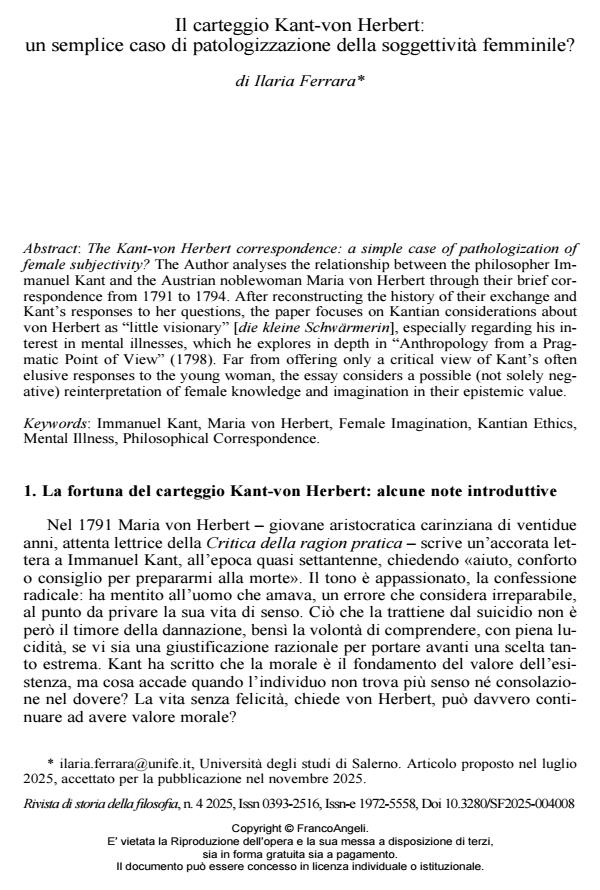
Qui sotto puoi vedere in anteprima la prima pagina di questo articolo.
Se questo articolo ti interessa, lo puoi acquistare (e scaricare in formato pdf) seguendo le facili indicazioni per acquistare il download credit. Acquista Download Credits per scaricare questo Articolo in formato PDF
FrancoAngeli è membro della Publishers International Linking Association, Inc (PILA), associazione indipendente e non profit per facilitare (attraverso i servizi tecnologici implementati da CrossRef.org) l’accesso degli studiosi ai contenuti digitali nelle pubblicazioni professionali e scientifiche.
The Author analyses the relationship between the philosopher Im- manuel Kant and the Austrian noblewoman Maria von Herbert through their brief cor- respondence from 1791 to 1794. After reconstructing the history of their exchange and Kant’s responses to her questions, the paper focuses on Kantian considerations about von Herbert as “little visionary” [die kleine Schwärmerin], especially regarding his in- terest in mental illnesses, which he explores in depth in “Anthropology from a Prag- matic Point of View” (1798). Far from offering only a critical view of Kant’s often elusive responses to the young woman, the essay considers a possible (not solely neg- ative) reinterpretation of female knowledge and imagination in their epistemic value.
Parole chiave:Immanuel Kant, Maria von Herbert, Female Imagination, Kantian Ethics, Mental Illness, Philosophical Correspondence.
Ilaria Ferrara, Il carteggio Kant-von Herbert: un semplice caso di patologizzazione della soggettività femminile? in "RIVISTA DI STORIA DELLA FILOSOFIA" 4/2025, pp 652-674, DOI: 10.3280/SF2025-004008