Dalle esperienze infantili avverse (ACE) ai disturbi del comportamento alimentare: il ruolo dei sintomi post-traumatici e della disregolazione emotiva

Titolo Rivista MALTRATTAMENTO E ABUSO ALL’INFANZIA
Autori/Curatori Elena Camisasca
Anno di pubblicazione 2026 Fascicolo 2026/1
Lingua Italiano Numero pagine 19 P. 75-93 Dimensione file 144 KB
DOI 10.3280/MAL2026-001005
Il DOI è il codice a barre della proprietà intellettuale: per saperne di più clicca qui

Qui sotto puoi vedere in anteprima la prima pagina di questo articolo.

Se questo articolo ti interessa, lo puoi acquistare (e scaricare in formato pdf) seguendo le facili indicazioni per acquistare il download credit. Acquista Download Credits per scaricare questo Articolo in formato PDF
Anteprima articolo

FrancoAngeli è membro della Publishers International Linking Association, Inc (PILA), associazione indipendente e non profit per facilitare (attraverso i servizi tecnologici implementati da CrossRef.org) l’accesso degli studiosi ai contenuti digitali nelle pubblicazioni professionali e scientifiche.

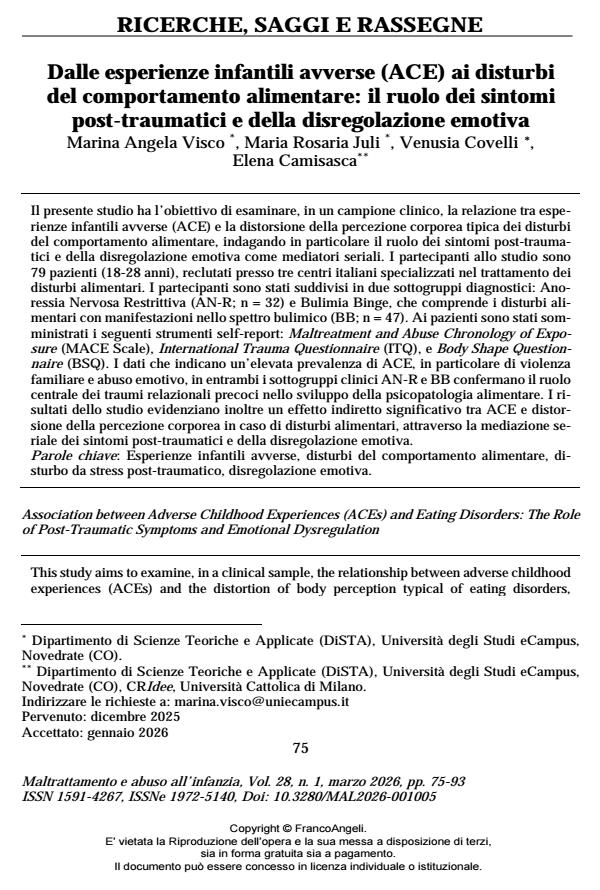
Il presente studio ha l’obiettivo di esaminare, in un campione clinico, la relazione tra esperienze infantili avverse (ACE) e la distorsione della percezione corporea tipica dei disturbi del comportamento alimentare, indagando in particolare il ruolo dei sintomi post-traumatici e della disregolazione emotiva come mediatori seriali. I partecipanti allo studio sono 79 pazienti (18-28 anni), reclutati presso tre centri italiani specializzati nel trattamento dei disturbi alimentari. I partecipanti sono stati suddivisi in due sottogruppi diagnostici: Anoressia Nervosa Restrittiva (AN-R; n = 32) e Bulimia Binge, che comprende i disturbi alimentari con manifestazioni nello spettro bulimico (BB; n = 47). Ai pazienti sono stati somministrati i seguenti strumenti self-report: Maltreatment and Abuse Chronology of Exposure (MACE Scale), International Trauma Questionnaire (ITQ), e Body Shape Questionnaire (BSQ). I dati che indicano un’elevata prevalenza di ACE, in particolare di violenza familiare e abuso emotivo, in entrambi i sottogruppi clinici AN-R e BB confermano il ruolo centrale dei traumi relazionali precoci nello sviluppo della psicopatologia alimentare. I risultati dello studio evidenziano inoltre un effetto indiretto significativo tra ACE e distorsione della percezione corporea in caso di disturbi alimentari, attraverso la mediazione seriale dei sintomi post-traumatici e della disregolazione emotiva.

Parole chiave:Esperienze infantili avverse, disturbi del comportamento alimentare, disturbo da stress post-traumatico, disregolazione emotiva.

  1. American Psychiatric Association (2022). Diagnostic and statistical manual of mental disorders (5th ed., text rev.). American Psychiatric Publishing.
  2. Amianto, F., Spalatro, A. V., Rainis, M., Andriulli, C., Lavagnino, L., Abbate-Daga, G., & Fassino, S. (2018). Childhood emotional abuse and neglect in obese patients with and without binge eating disorder: Personality and psychopathology correlates in adulthood. Psychiatry research, 269, 692-699.
  3. Brewerton, T. D. (2007). Eating disorders, trauma, and comorbidity: Focus on PTSD. Eating Disorders, 15(4), 285-304. DOI: 10.1080/10640260701454311
  4. Brustenghi, F., Mezzetti, F. A. F., Di Sarno, C., Giulietti, C., Moretti, P., & Tortorella, A. (2019). Eating Disorders: the Role of Childhood Trauma and the Emotion Dysregulation. Psychiatria Danubina, 31(Suppl 3), 509-511.
  5. Burns, E. E., Fischer, S., Jackson, J. L., & Harding, H. G. (2012). Deficits in emotion regulation mediate the relationship between childhood abuse and later eating disorder symptoms. Child abuse & neglect, 36(1), 32-39.
  6. Caslini, M., Bartoli, F., Crocamo, C., Dakanalis, A., Clerici, M., & Carrà, G. (2016). Disentangling the Association Between Child Abuse and Eating Disorders: A Systematic Review and Meta-Analysis. Psychosomatic medicine, 78(1), 79-90. DOI: 10.1097/PSY.0000000000000233
  7. Ciringione, L., Perinelli, E., Mancini, F., & Prunetti, E. (2025). Beyond the Scars: An Analysis of Adverse Childhood Experiences and the Interconnections Between Emotion Dysregulation, Dissociation, and Trauma in Patients with Borderline Personality Disorder. Brain Sciences, 15(8), 889.
  8. Cooper, P. J., Taylor, M. J., Cooper, Z., & Fairbum, C. G. (1987). The development and validation of the Body Shape Questionnaire. International Journal of eating disorders, 6(4), 485-494.
  9. Cortés-García, L., Takkouche, B., Seoane, G., & Senra, C. (2019). Mediators linking insecure attachment to eating symptoms: A systematic review and meta-analysis. PloS one, 14(3), e0213099.
  10. Cloitre, M., Shevlin, M., Brewin, C. R., Bisson, J. I., Roberts, N. P., Maercker, A., Karatzias, T., & Hyland, P. (2018). The International Trauma Questionnaire: development of a self-report measure of ICD-11 PTSD and complex PTSD. Acta psychiatrica Scandinavica, 138(6), 536-546.
  11. Crisafi, C., Ragonese, N., & Caretti, V. (2015). Il ruolo del trauma infantile nell’insorgenza del Binge Eating Disorder. Maltrattamento e abuso all’infanzia, 17(1), 13-30.
  12. Day, S., Hay, P., Tannous, W. K., Fatt, S. J., & Mitchison, D. (2024). A systematic review of the effect of PTSD and trauma on treatment outcomes for eating disorders. Trauma, Violence, & Abuse, 25(2), 947-964. DOI: 10.1177/15248380231167399
  13. Eielsen, H. P., Ulvenes, P., Hoffart, A., Rø, Ø., Rosenvinge, J. H., & Vrabel, K. (2024). Childhood trauma and outcome trajectories in patients with longstanding eating disorders across 17 years. International journal of eating disorders, 57(1), 81-92.
  14. Felitti, V. J., Anda, R. F., Nordenberg, D., Williamson, D. F., Spitz, A. M., Edwards, V., Koss, M. P., & Marks, J. S. (1998). Relationship of childhood abuse and household dysfunction to many of the leading causes of death in adults. The Adverse Childhood Experiences (ACE) Study. American journal of preventive medicine, 14(4), 245-258.
  15. Gratz, K. L., & Roemer, L. (2004). Multidimensional assessment of emotion regulation and dysregulation: Development, factor structure, and initial validation of the difficulties in emotion regulation scale. Journal of Psychopathology and Behavioral Assessment, 26: 41-54. (Erratum published December 2008, Journal of Psychopathology and Behavioral Assessment, 30, 315) adattamento italiano a cura di Sighinolfi, C., Norcini Pala, A., Chiri, L., Marchetti, I., Sica, C. (2010). Difficulties in Emotion Regulation Scale (DERS): Psicoterapia Cognitiva E Comportamentale, 16(2), 141-170.
  16. Guillaume, S., Jaussent, I., Maimoun, L., Ryst, A., Seneque, M., Villain, L., Hamroun, D., Lefebvre, P., Renard, E., & Courtet, P. (2016). Associations between adverse childhood experiences and clinical characteristics of eating disorders. Scientific reports, 6, 35761.
  17. Harrison, A., Sullivan, S., Tchanturia, K., & Treasure, J. (2010). Emotional functioning in eating disorders: Attentional bias, emotion recognition and emotion regulation. Psychological Medicine, 40(11), 1887-1897. DOI: 10.1017/S0033291710000036
  18. Haynos, A. F., Wang, S. B., & Fruzzetti, A. E. (2018). Restrictive eating is associated with emotion regulation in a non-clinical sample. Eating disorders, 26(1), 5-12. DOI: 10.1080/10640266.2018.1418264
  19. Hicks White, A. A., Pratt, K. J., & Cottrill, C. (2018). The relationship between trauma and weight status among adolescents in eating disorder treatment. Appetite, 129, 62-69.
  20. Hoover, L. V., Yu, H. P., Duval, E. R., & Gearhardt, A. N. (2022). Childhood trauma and food addiction: The role of emotion regulation difficulties and gender differences. Appetite, 177, 106137.
  21. Hughes, K., Bellis, M. A., Hardcastle, K. A., Sethi, D., Butchart, A., Mikton, C., Jones, L., & Dunne, M. P. (2017). The effect of multiple adverse childhood experiences on health: a systematic review and meta-analysis. The Lancet. Public health, 2(8), e356-e366. DOI: 10.1016/S2468-2667(17)30118-4
  22. Kent, A., & Waller, G. (2000). Childhood emotional abuse and eating psychopathology. Clinical psychology review, 20(7), 887-903.
  23. Koçak, Z., & Çagatay, S. E. (2024). Childhood traumas and emotional eating: The mediating role of self-esteem, and emotion dysregulation. Current Psychology: A Journal for Diverse Perspectives on Diverse Psychological Issues, 43(25), 21783-21791.
  24. Lavender, J. M., Wonderlich, S. A., Engel, S. G., Gordon, K. H., Kaye, W. H., & Mitchell, J. E. (2015). Dimensions of emotion dysregulation in anorexia nervosa and bulimia nervosa: A conceptual review of the empirical literature. Clinical psychology review, 40, 111-122.
  25. Li, Y., He, Z., Liu, Z., Peng, N., Xiao, Y., Ye, Y., & Zhou, X. (2025). Adverse Childhood Experiences and the Diagnosis of ICD-11 Post-traumatic Stress Disorder or Complex Post-traumatic Stress Disorder: A Systematic Review and Three-level Meta-analysis. Trauma, Violence, & Abuse. DOI: 10.1177/15248380251336188
  26. McKay, M. T., Kilmartin, L., Meagher, A., Cannon, M., Healy, C., & Clarke, M. C. (2022). A revised and extended systematic review and meta-analysis of the relationship between childhood adversity and adult psychiatric disorder. Journal of psychiatric research, 156, 268-283.
  27. Miethe, S., Wigger, J., Wartemann, A., Fuchs, F. O., & Trautmann, S. (2023). Posttraumatic stress symptoms and its association with rumination, thought suppression and experiential avoidance: A systematic review and meta-analysis. Journal of Psychopathology and Behavioral Assessment, 45(2), 480-495.
  28. Mitchell, K. S., Mazzeo, S. E., Schlesinger, M. R., Brewerton, T. D., & Smith, B. N. (2012). Comorbidity of partial and subthreshold PTSD among men and women with eating disorders in the National Comorbidity Survey- Replication Study. International Journal of Eating Disorders, 45, 307-315.
  29. Molendijk, M. L., Hoek, H. W., Brewerton, T. D., & Elzinga, B. M. (2017). Childhood maltreatment and eating disorder pathology: a systematic review and dose-response meta-analysis. Psychological medicine, 47(8), 1402-1416. DOI: 10.1017/S0033291716003561
  30. Monteleone, A. M., Cascino, G., Pellegrino, F., Ruzzi, V., Patriciello, G., Pellegrino, F., & Monteleone, P. (2018). Emotional dysregulation and traumatic experiences in eating disorders: Clinical implications. Frontiers in Psychology, 9, 2303.
  31. Monteleone, A. M., Cascino, G., Pellegrino, F., Ruzzi, V., Patriciello, G., Marone, L., De Felice, G., Monteleone, P., & Maj, M. (2019). The association between childhood maltreatment and eating disorder psychopathology: A mixed-model investigation. European psychiatry: the journal of the Association of European Psychiatrists, 61, 111-118.
  32. Monteleone, A. M., Ruzzi, V., & Monteleone, P. (2021). The role of trauma and emotion dysregulation in eating disorders: Emerging evidence. Neuroscience & Biobehavioral Reviews, 129, 1-10.
  33. Palmisano, G. L., Innamorati, M., & Vanderlinden, J. (2016). Life adverse experiences in relation with obesity and binge eating disorder: A systematic review. Journal of behavioral addictions, 5(1), 11-31. DOI: 10.1556/2006.5.2016.018
  34. Pugh, M., Waller, G., & Esposito, M. (2018). Childhood trauma, dissociation, and the internal eating disorder ‘voice’. Child Abuse & Neglect, 86, 197-205.
  35. Rabito-Alcón, M. F., Baile, J. I., & Vanderlinden, J. (2021). Mediating Factors between Childhood Traumatic Experiences and Eating Disorders Development: A Systematic Review. Children (Basel, Switzerland), 8(2), 114.
  36. Racine, S. E., & Wildes, J. E. (2015). Emotion dysregulation and anorexia nervosa: an exploration of the role of childhood abuse. The International journal of eating disorders, 48(1), 55–58.
  37. Russo, J. E., Dhruve, D. M., & Oliveros, A. D. (2023). Childhood Trauma and PTSD Symptoms: Disentangling the Roles of Emotion Regulation and Distress Tolerance. Research on child and adolescent psychopathology, 51(9), 1273-1287.
  38. Schweitzer, C., DiGiovanni, A., Bu, D., Burynski, R., Kassim, A., Sabry, A., Russell, M., & Sandelich, S. (2025). The impact of adverse childhood experiences on emotional regulation in adult ED patients. Journal of affective disorders, 393(Pt B), 120419.
  39. Speranza, A. M., & Alberigi, E. (2006). La relazione tra abuso e disturbi alimentari: il ruolo della dissociazione. Maltrattamento e abuso all’infanzia, 1.
  40. Teicher, M. H., & Parigger, A. (2015). The 'Maltreatment and Abuse Chronology of Exposure' (MACE) scale for the retrospective assessment of abuse and neglect during development. PloS one, 10(2), e0117423.
  41. Trottier, K., & MacDonald, D. E. (2017). Update on Psychological Trauma, Other Severe Adverse Experiences and Eating Disorders: State of the Research and Future Research Directions. Current psychiatry reports, 19(8), 45.
  42. Vajda, A., & Láng, A. (2014). Emotional abuse, neglect in eating disorders and their relationship with emotion regulation. Procedia-Social and Behavioral Sciences, 131, 386-390.
  43. Visco, M.A., Juli M.R., Covelli, V., & Camisasca, E. (2025). Associations between Adverse Childhood Experiences Subtypes and Eating Disorders: A Systematic Review. Maltrattamento e Abuso all’infanzia, 1, 13-44. DOI: 10.3280/MAL2025-001002
  44. Wiss, D. A., & Lafata, E. M. (2025). Structural equation modeling of adverse childhood experiences, ultra-processed food intake, and symptoms of post-traumatic stress disorder, ultra-processed food addiction, and eating disorder among adults seeking nutrition counseling in Los Angeles, CA. Appetite, 208, 107938.
  45. Zelkowitz, R. L., Zerubavel, N., Zucker, N. L., & Copeland, W. E. (2021). Longitudinal associations of trauma exposure with disordered eating: Lessons from the Great Smoky Mountains Study. Eating disorders, 29(3), 208-225. DOI: 10.1080/10640266.2021.1921326

Elena Camisasca, Dalle esperienze infantili avverse (ACE) ai disturbi del comportamento alimentare: il ruolo dei sintomi post-traumatici e della disregolazione emotiva in "MALTRATTAMENTO E ABUSO ALL’INFANZIA" 1/2026, pp 75-93, DOI: 10.3280/MAL2026-001005