Evolving Roles and Strategic Influence of CFOs within Modern Management Control Systems: A Systematic Literature Review
Titolo Rivista MANAGEMENT CONTROL
Autori/Curatori Edoardo Borlatto, Elisa Ballesio, Elisa Truant, Laura Broccardo
Anno di pubblicazione 2026 Fascicolo 2026/1
Lingua Inglese Numero pagine 24 P. 17-40 Dimensione file 152 KB
DOI 10.3280/MACO2026-001002
Il DOI è il codice a barre della proprietà intellettuale: per saperne di più
clicca qui
Qui sotto puoi vedere in anteprima la prima pagina di questo articolo.
Se questo articolo ti interessa, lo puoi acquistare (e scaricare in formato pdf) seguendo le facili indicazioni per acquistare il download credit. Acquista Download Credits per scaricare questo Articolo in formato PDF
FrancoAngeli è membro della Publishers International Linking Association, Inc (PILA), associazione indipendente e non profit per facilitare (attraverso i servizi tecnologici implementati da CrossRef.org) l’accesso degli studiosi ai contenuti digitali nelle pubblicazioni professionali e scientifiche.
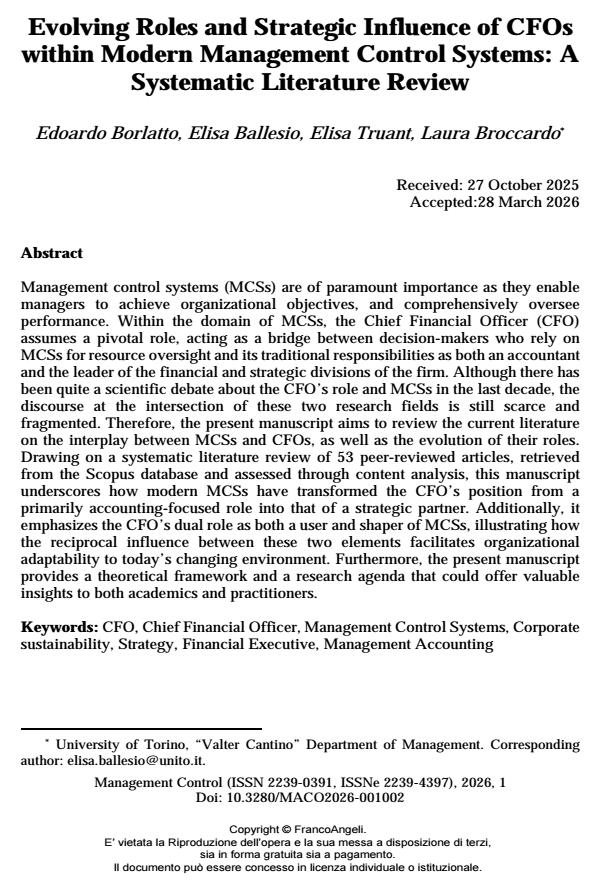
Management control systems (MCSs) are of paramount importance as they enable managers to achieve organizational objectives, and comprehensively oversee performance. Within the domain of MCSs, the Chief Financial Officer (CFO) assumes a pivotal role, acting as a bridge between decision-makers who rely on MCSs for resource oversight and its traditional responsibilities as both an accountant and the leader of the financial and strategic divisions of the firm. Although there has been quite a scientific debate about the CFO’s role and MCSs in the last decade, the discourse at the intersection of these two research fields is still scarce and fragmented. Therefore, the present manuscript aims to review the current literature on the interplay between MCSs and CFOs, as well as the evolution of their roles. Drawing on a systematic literature review of 53 peer-reviewed articles, retrieved from the Scopus database and assessed through content analysis, this manuscript underscores how modern MCSs have transformed the CFO’s position from a primarily accounting-focused role into that of a strategic partner. Additionally, it emphasizes the CFO’s dual role as both a user and shaper of MCSs, illustrating how the reciprocal influence between these two elements facilitates organizational adaptability to today’s changing environment. Furthermore, the present manuscript provides a theoretical framework and a research agenda that could offer valuable insights to both academics and practitioners.
Parole chiave:CFO, Chief Financial Officer, Management Control Systems, Corporate sustainability, Strategy, Financial Executive, Management Accounting
- Abdul Rasid, Z., Ruhana Isa, S., Khairuzzaman Wan, C., & Ismail, W. (2014), Management accounting systems, enterprise risk management and organizational performance in financial institutions, Asian Review of Accounting, 22(2), 128-144.
- Agliati, M. (2003), I nuovi contenuti della funzione amministrazione, finanza e controllo nelle imprese italiane. Cambiamenti di ruolo ed evoluzione degli assetti operativi della funzione, in A. Bertoni & C. Conti (Eds.), I nuovi contenuti della funzione amministrazione, finanza e controllo. Tecnologia, modelli manageriali e contesto operativo (pp. 13-62). EGEA.
- Albertini, E. (2019), The contribution of management control systems to environmental capabilities, Journal of Business Ethics, 159(4), 1163-1180.
- Amigoni, F. (1984), La funzione amministrativa: strutture, posizioni, professionalità, Economia Aziendale, III(1).
- Anzilago, M., Gomez-Conde, J., & Lunkes, R. J. (2024), How do Managers use Management Control Systems in Response to Shareholder Activism?, The European Accounting Review, 33(1), 105-132. DOI: 10.1080/09638180.2022.2063152
- Asiaei, K., Bontis, N., Barani, O., Moghaddam, M., & Sidhu, J. (2022), The role of sustainability control systems in translating CSR into performance in Iran, Management Decision, 60(5), 1438-1468.
- Baird, K., Su, S., & Munir, R. (2019), Levers of control, management innovation and organisational performance, Pacific Accounting Review, 31(3), 358-375.
- Baxter, J., & Chua, W. F. (2008). Be(com)ing the chief financial officer of an organisation: Experimenting with Bourdieu’s practice theory. Management Accounting Research, 19(3), 212-230.
- Berg, T., & Madsen, D. Ø. (2020), The evolution of a management control package: a retrospective case study, Journal of Applied Accounting Research, 21(4), 763-781.
- Bernard, D. (2021), Implied tradeoffs of chief financial officer accounting expertise: Evidence from firm-manager matching, Management Science, 67(9), 5776-5799.
- Bezuidenhout, S., de Villiers, C., & Dimes, R. (2023), How management control systems can enable, constrain, and embed integrated reporting, Accounting and Finance, 63(4), 4251-4273.
- Bhimani, A., & Bromwich, M. (2009), Management accounting in a digital and global economy: The interface of strategy, technology, and cost information. In Accounting, Organizations, and Institutions (pp. 85-111), Oxford University Press.
- Bouillon, M. L., Ferrier, G. D., Stuebs, M. T., Jr, & West, T. D. (2006), The economic benefit of goal congruence and implications for management control systems, Journal of Accounting and Public Policy, 25(3), 265-298.
- Brink, A. G., Eller, C. K., & Green, K. Y. (2018), The effects of Corporate Social Responsibility and wrongdoer rank on whistleblowing, Accounting and the Public Interest, 18(1), 104-128.
- Broccardo, L., Ballesio, E., Crocco, E., & Giordino, D. (2024), Performance management systems in micro, small, and medium enterprises: Lessons learned from times of uncertainty, Management Control, 3, 15-38.
- Broccardo, L., Ballesio, E., Giordino, D., & Giacosa, E. (2025), Guiding the Algorithm: Harnessing artificial intelligence to nurture SMEs management control systems, Management Control, 1, 13-36.
- Broccardo, L., Ballesio, E., Yaqub, M. Z., & Mohapatra, A. K. (2025), A bridge to success: the role of management accountants’ intellectual capital in driving organizational decision-making through knowledge management, Journal of Knowledge Management, 29(5), 1365-1411.
- Brunetti, G. (1997), Le prospettive di cambiamento delle figure professionali amministrative, in A. Pistoni & L. Songini (Eds.), Il management del 2000: quali sfide per la funzione amministrativa?, Egea.
- Burkert, M., & Lueg, R. (2013), Differences in the sophistication of Value-based Management – The role of top executives, Management Accounting Research, 24(1), 3-22,
- Burns, J., & Scapens, R. (2000), The changing nature of management accountants and the emergence of ‘hybrid’ accountants, IFAC.
- Byrne, S., & Pierce, B. (2018), Exploring management accountants’ role conflicts and ambiguities and how they cope with them, Qualitative Research in Accounting & Management, 15(4), 410-436,
- Cantele, S., Valcozzena, S., Campedelli, B., de’ Stefani, C., & De Luca, M. (2024), The interaction of sustainability governance structure and sustainability management control systems: An Italian case study, Management Control, 2, 53-74,
- Cattaneo, C., & Bassani, G. (2019), Enterprise Risk Management e Management Accounting Systems in una Banca di Credito Cooperativo, Management Control, 1, 13-33,
- Chatpibal, M., Chaiyasoonthorn, W., & Chaveesuk, S. (2024), Driving financial results is not the only priority! An exploration of the future role of chief financial officer: a grounded theory approach, Meditari Accountancy Research, 32(3), 857-887.
- Christensen, D. S., Schneider, P., & Orton, J. (2019), Flight or fight: a case study in resolving ethical issues, The Case Journal, 15(4), 295-305.
- Corsi, K., Castellano, N. G., Lamboglia, R., & Mancini, D. (2017), Reshaping accounting and management control systems: New opportunities from business information systems, Springer International Publishing.
- Dávila, A., Derchi, G.-B., Oyon, D., & Schnegg, M. (2024), External complexity and the design of management control systems: a case study, Management Accounting Research, 63, 100875.
- Edirisinghe, U. C., Hossain, M. M., & Alam, M. (2024), Managerial conception of integrating sustainability into management control systems: evidence from Sri Lankan manufacturing companies, Qualitative Research in Accounting & Management, 21(2), 105-139. Doi. 10.1108/qram-05-2023-0093.
- Enslin, Z. (2023). Management accountants’ susceptibility to overconfidence: the overplacement perspective. Review of Behavioral Finance, 15(6), 827–845. https://doi.org/10.1108/rbf-07-2021-0138
- Feng, M., Ge, W., Luo, S., & Shevlin, T. (2011), Why do CFOs become involved in material accounting manipulations?, Journal of Accounting and Economics, 51(1-2), 21-36.
- Firk, S., Gehrke, Y., Richter, S., & Wolff, M. (2025), CFO career concerns and strategic decisions: An empirical analysis of M&as, The European Accounting Review, 34(2), 487-518. DOI: 10.1080/09638180.2023.2291405
- Firk, S., Schmidt, T., & Wolff, M. (2019), CFO emphasis on value-based management: Performance implications and the challenge of CFO succession, Management Accounting Research, 44, 26-43.
- Fisher, J. G. (1995), Contingency-Based Research on Management Control Systems: Categorization by Level of Complexity, Journal of Accounting Literature, 14, 24-53.
- Florackis, C., & Sainani, S. (2018), How do chief financial officers influence corporate cash policies?, Journal of Corporate Finance, 52, 168-191.
- Fogel, K., Jandik, T., & McCumber, W. R. (2018), CFO social capital and private debt, Journal of Corporate Finance, 52, 28-52.
- Freeman, R.E. (1984), Strategic management: A stakeholder approach, Cambridge University Press.
- Gebhardt, M., Schneider, A., Siedler, F., Ottenstein, P., & Zülch, H. (2024), Climate reporting in the fast lane? The impact of corporate governance on the disclosure of climate-related risks and opportunities, Business Strategy and the Environment, 33(7), 7253-7272.
- Goretzki, L., Strauss, E., & Weber, J. (2013), An institutional perspective on the changes in management accountants’ professional role, Management Accounting Research, 24(1), 41-63.
- Haislip, J. Z., Masli, A., Richardson, V. J., & Watson, M. W. (2015), External reputational penalties for CEOs and CFOs following information technology material weaknesses, International Journal of Accounting Information Systems, 17, 1-15.
- Hambrick, D. C., & Mason, P. A. (1984), Upper echelons: The organization as a reflection of its top managers, Academy of Management Review, 9(2), 193. DOI: 10.2307/258434
- Hoitash, R., Hoitash, U., & Johnstone, K. M. (2012), Internal control material weaknesses and CFO compensation, Contemporary Accounting Research, 29(3), 768-803.
- Hoitash, R., Hoitash, U., & Kurt, A. C. (2016), Do accountants make better chief financial officers?, Journal of Accounting and Economics, 61(2-3), 414-432.
- Hsieh, H.-F., & Shannon, S. E. (2005), Three approaches to qualitative content analysis, Qualitative Health Research, 15(9), 1277-1288. DOI: 10.1177/1049732305276687
- Järvenpää, M. (2007), Making Business Partners: A Case Study on how Management Accounting Culture was Changed, The European Accounting Review, 16(1), 99-142. DOI: 10.1080/09638180701265903
- Kapiyangoda, K., & Gooneratne, T. (2021), Management accounting research in family businesses: a review of the status quo and future agenda, Journal of Accounting & Organizational Change, 17(3), 352-372.
- Karaevli, A., & Özcan, S. (2022), Why some CFOs make better M&A deals, MIT Sloan Management Review, 63, 78-84.
- Khajehnejad, S., & Linder, S. (2022), Why the type of information observable to peers matters: Peer monitoring and performance measure manipulation, Management Accounting Research, 57, 100815.
- Kim, M., & Schmidgall, R. S. (2019), Key managerial and financial accounting skills for private club managers: Comparison to lodging managers, International Journal of Hospitality & Tourism Administration, 20(4), 379-399. DOI: 10.1080/15256480.2017.1397583
- Lindvall, J., & Iveroth, E. (2011), Creating a global network of shared service centres for accounting, Journal of Accounting & Organizational Change, 7(3), 278-305. DOI: 10.1108/18325911111164213
- Mariani, M. M., Perez-Vega, R., & Wirtz, J. (2022), AI in marketing, consumer research and psychology: A systematic literature review and research agenda, Psychology & Marketing, 39(4), 755-776.
- Marzi, G., Balzano, M., Caputo, A., & Pellegrini, M. M. (2025), Guidelines for Bibliometric-Systematic Literature Reviews: 10 steps to combine analysis, synthesis and theory development, International Journal of Management Reviews, 27(1), 81-103.
- Massaro, M., Dumay, J., & Guthrie, J. (2016), On the shoulders of giants: undertaking a structured literature review in accounting, Accounting Auditing & Accountability, 29(5), 767-801.
- Matos, L. M., Rampasso, I. S., Quelhas, O. L. G., Leal Filho, W., & Anholon, R. (2022), Technological innovation management: understanding difficulties in an emerging country to enhance manufacturers performance, International Journal of Productivity and Performance Management, 71(6), 2280-2295.
- McCoy, T. L. (2015), An Investigation of Management Accountants’ Experience with Ethical Dilemmas Involving Financial Reporting and Employee Supervision, J. Legal Ethical & Regul. Issues, 18, 125.
- Morelli, M., & Lecci, F. (2014), Management control systems (MCS) change and the impact of top management characteristics: the case of healthcare organisations, Journal of Management Control, 24(3), 267-298.
- Naranjo-Gil, D., Maas, V. S., & Hartmann, F. G. H. (2009), How CFOs determine management accounting innovation: An examination of direct and indirect effects, The European Accounting Review, 18(4), 667-695. DOI: 10.1080/09638180802627795
- Nartey, E. (2023), COVID-19 uncertainty, pandemic management strategy, management control and public health performance, Management Research Review, 46(11), 1619-1636.
- Niven, D. (1993), When times get tough, what happens to TQM? Case study, Harvard Business Review, 71(3), 20-22; discussion 22-9, 32-34.
- Norris, M., & Oppenheim, C. (2007), Comparing alternatives to the Web of Science for coverage of the social sciences’ literature, Journal of Informetrics, 1(2), 161-169.
- Pavlatos, O., & Kostakis, X. (2018), The impact of top management team characteristics and historical financial performance on strategic management accounting, Journal of Accounting & Organizational Change, 14(4), 455-472.
- Petera, P., Wagner, J., & Pakšiová, R. (2021), The influence of environmental strategy, environmental reporting and environmental management control system on environmental and economic performance, Energies, 14(15), 4637.
- Qiao, L., Adegbite, E., & Nguyen, T. H. (2022), Chief financial officer overconfidence and stock price crash risk, International Review of Financial Analysis, 84(102364), 102364.
- Rickwood, C. P., Coates, J. B., & Stacey, R. J. (1990), Stapylton: strategic management accounting to gain competitive advantage, Management Accounting Research, 1(1), 37-49.
- Senftlechner, D., & Hiebl, M. R. W. (2015), Management accounting and management control in family businesses: Past accomplishments and future opportunities, Journal of Accounting & Organizational Change, 11(4), 573-606.
- Simons, R. (1995), Levers of control: how managers use innovative control systems to drive strategic renewal, Harvard Business School.
- Spraakman, G., O’Grady, W., Askarany, D., & Akroyd, C. (2015), Employers’ perceptions of information technology competency requirements for management accounting graduates, Accounting Education, 24(5), 403-422. DOI: 10.1080/09639284.2015.1089177
- Thelwall, M. (2018), Dimensions: A competitor to Scopus and the web of science?, Journal of Informetrics, 12(2), 430-435.
- Truant, E., Crocco, E., Culasso, F., & Alshibani, S. M. (2025), Fifty years of management control systems research: a bibliometric review of the literature and research agenda, International Journal of Productivity and Performance Management, 74(2), 491-519.
- Uhde, D. A., Klarner, P., & Tuschke, A. (2017), Board monitoring of the chief financial officer: A review and research agenda, Corporate Governance an International Review, 25(2), 116-133.
- Velte, P., & Stawinoga, M. (2020), Do chief sustainability officers and CSR committees influence CSR-related outcomes? A structured literature review based on empirical-quantitative research findings, Journal of Management Control, 31(4), 333-377.
- Vermiglio, C., Noto, G., Rodríguez Bolívar, M. P., & Zarone, V. (2022). Disaster management and emerging technologies: a performance-based perspective. Meditari Accountancy Research, 30(4), 1093-1117.
- Vesty, G., & Oliver, J. (2014), Corporate strategy and accounting for sustainability in investment appraisal, Corporate Ownership and Control, 11(2), 377-388.
- Vincent, N. E., Higgs, J. L., & Pinsker, R. E. (2017), IT governance and the maturity of IT risk management practices, Journal of Information Systems, 31(1), 59-77.
- Vola, P., & Gelmini, L. (2022), Climate change skills for the new CFOs. A preliminary analysis on TCFD by Italian listed companies, Management Control, 2, 189-209.
- Wang, B., Wang, Z., Wen, J., & Zhang, X. T. (2021), Executive gender and firm environmental management: Evidence from CFO transitions, Sustainability, 13(7), 3653.
- Zhong, W., & Yan, W. (2022), An empirical study on the impact of CFO overconfidence on corporate financial risk: Empirical evidence from Chinese listed companies, Journal of Economics Business and Management, 10(2), 104-109.
- Yang Spencer, S., Adams, C., & Yapa, P. W. S. (2013), The mediating effects of the adoption of an environmental information system on top management’s commitment and environmental performance, Sustainability Accounting Management and Policy Journal, 4(1), 75-102.
- Zoni, L., & Pippo, F. (2017), CFO and finance function: what matters in value creation, Journal of Accounting & Organizational Change, 13(2), 216-238.
Edoardo Borlatto, Elisa Ballesio, Elisa Truant, Laura Broccardo, Evolving Roles and Strategic Influence of CFOs within Modern Management Control Systems: A Systematic Literature Review in "MANAGEMENT CONTROL" 1/2026, pp 17-40, DOI: 10.3280/MACO2026-001002