Cracks in sovereign trust. Accounting and institutional crisis in a public monopoly: The Real Compagnia di Assicurazioni Marittime in the Kingdom of Naples (1751-1802)
Titolo Rivista CONTABILITÀ E CULTURA AZIENDALE
Autori/Curatori Alessio Maria Musella
Anno di pubblicazione 2026 Fascicolo 2025/1
Lingua Inglese Numero pagine 34 P. 9-42 Dimensione file 285 KB
DOI 10.3280/CCA2025-001002
Il DOI è il codice a barre della proprietà intellettuale: per saperne di più
clicca qui
Qui sotto puoi vedere in anteprima la prima pagina di questo articolo.
Se questo articolo ti interessa, lo puoi acquistare (e scaricare in formato pdf) seguendo le facili indicazioni per acquistare il download credit. Acquista Download Credits per scaricare questo Articolo in formato PDF
FrancoAngeli è membro della Publishers International Linking Association, Inc (PILA), associazione indipendente e non profit per facilitare (attraverso i servizi tecnologici implementati da CrossRef.org) l’accesso degli studiosi ai contenuti digitali nelle pubblicazioni professionali e scientifiche.
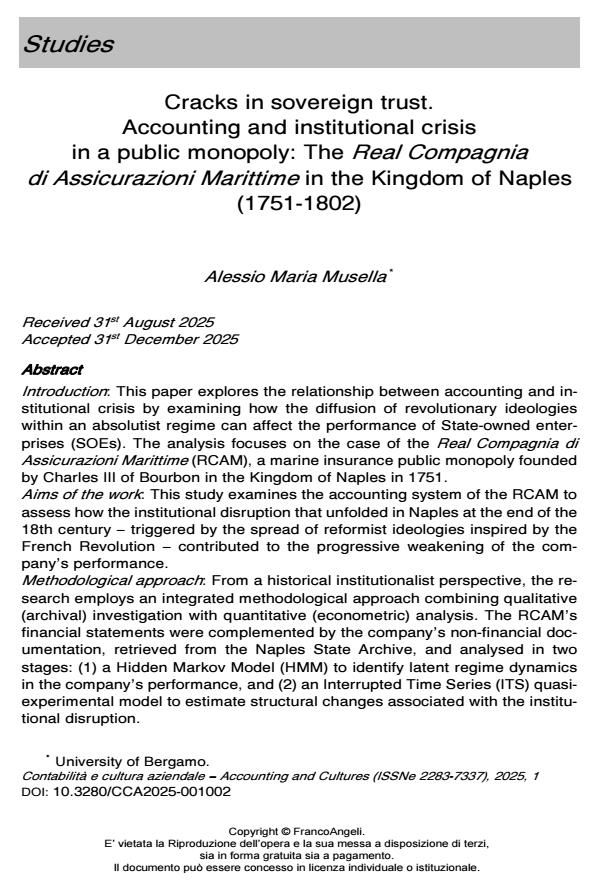
Introduction: This paper explores the relationship between accounting and in-stitutional crisis by examining how the diffusion of revolutionary ideologies within an absolutist regime can affect the performance of State-owned enter-prises (SOEs). The analysis focuses on the case of the Real Compagnia di Assicurazioni Marittime (RCAM), a marine insurance public monopoly founded by Charles III of Bourbon in the Kingdom of Naples in 1751. Aims of the work: This study examines the accounting system of the RCAM to assess how the institutional disruption that unfolded in Naples at the end of the 18th century – triggered by the spread of reformist ideologies inspired by the French Revolution – contributed to the progressive weakening of the com-pany’s performance. Methodological approach: From a historical institutionalist perspective, the re- search employs an integrated methodological approach combining qualitative (archival) investigation with quantitative (econometric) analysis. The RCAM’s financial statements were complemented by the company’s non-financial doc-umentation, retrieved from the Naples State Archive, and analysed in two stages: (1) a Hidden Markov Model (HMM) to identify latent regime dynamics in the company’s performance, and (2) an Interrupted Time Series (ITS) quasi-experimental model to estimate structural changes associated with the institu-tional disruption. Main findings: The findings demonstrate how the “crack in trust” in the abso-lutist government of King Ferdinand IV of Bourbon affected the RCAM’s fate, within a broader context shaped by reformist currents inspired by Enlighten-ment ideas and by the spread of libertarian thought from revolutionary France into the Kingdom of Naples. Contribution to the literature: This study contributes to the literature by high- lighting accounting’s potential to reflect institutional instability within a public monopoly. It also supports the use of econometrics in accounting history re-search.
Parole chiave:public monopoly, historical institutionalism, quantitative analysis, Southern Italy, marine insurance, state-owned enterprises
Alessio Maria Musella, Cracks in sovereign trust. Accounting and institutional crisis in a public monopoly: The Real Compagnia di Assicurazioni Marittime in the Kingdom of Naples (1751-1802) in "CONTABILITÀ E CULTURA AZIENDALE" 1/2025, pp 9-42, DOI: 10.3280/CCA2025-001002