Il ruolo attuale delle Nazioni Unite nella risoluzione dei conflitti
Titolo Rivista WELFARE E ERGONOMIA
Autori/Curatori Valentina Della Fina
Anno di pubblicazione 2026 Fascicolo 2026/1 Suppl.
Lingua Italiano Numero pagine 17 P. 17-33 Dimensione file 128 KB
DOI 10.3280/WE2026-001-S1002
Il DOI è il codice a barre della proprietà intellettuale: per saperne di più
clicca qui
Qui sotto puoi vedere in anteprima la prima pagina di questo articolo.
Se questo articolo ti interessa, lo puoi acquistare (e scaricare in formato pdf) seguendo le facili indicazioni per acquistare il download credit. Acquista Download Credits per scaricare questo Articolo in formato PDF
FrancoAngeli è membro della Publishers International Linking Association, Inc (PILA), associazione indipendente e non profit per facilitare (attraverso i servizi tecnologici implementati da CrossRef.org) l’accesso degli studiosi ai contenuti digitali nelle pubblicazioni professionali e scientifiche.
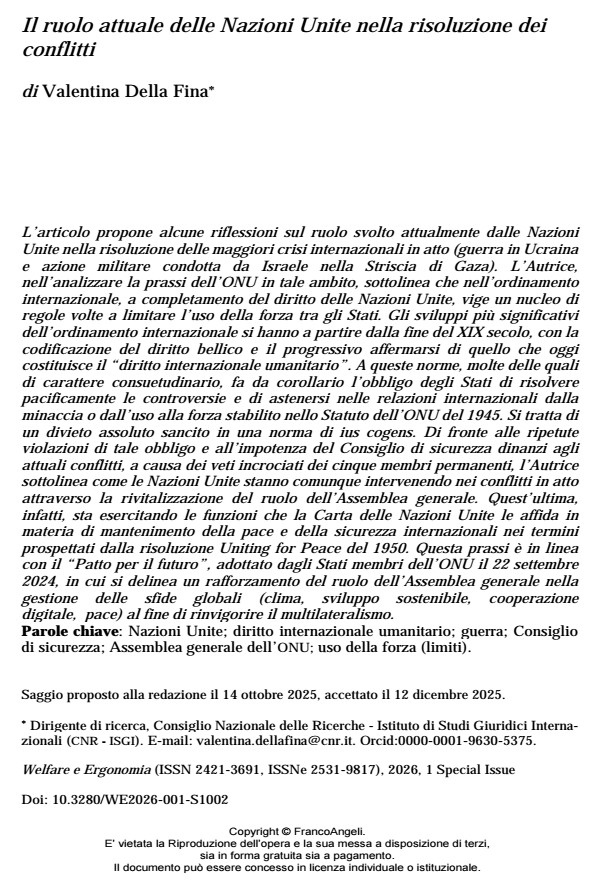
L’articolo propone alcune riflessioni sul ruolo svolto attualmente dalle Nazioni Unite nella risoluzione delle maggiori crisi internazionali in atto (guerra in Ucraina e azione militare condotta da Israele nella Striscia di Gaza). L’Autrice, nell’analizzare la prassi dell’ONU in tale ambito, sottolinea che nell’ordinamento internazionale, a completamento del diritto delle Nazioni Unite, vige un nucleo di regole volte a limitare l’uso della forza tra gli Stati. Gli sviluppi più significativi dell’ordinamento internazionale si hanno a partire dalla fine del XIX secolo, con la codificazione del diritto bellico e il progressivo affermarsi di quello che oggi costituisce il “diritto internazionale umanitario”. A queste norme, molte delle quali di carattere consuetudinario, fa da corollario l’obbligo degli Stati di risolvere pacificamente le controversie e di astenersi nelle relazioni internazionali dalla minaccia o dall’uso alla forza stabilito nello Statuto dell’ONU del 1945. Si tratta di un divieto assoluto sancito in una norma di ius cogens. Di fronte alle ripetute violazioni di tale obbligo e all’impotenza del Consiglio di sicurezza dinanzi agli attuali conflitti, a causa dei veti incrociati dei cinque membri permanenti, l’Autrice sottolinea come le Nazioni Unite stanno comunque intervenendo nei conflitti in atto attraverso la rivitalizzazione del ruolo dell’Assemblea generale. Quest’ultima, infatti, sta esercitando le funzioni che la Carta delle Nazioni Unite le affida in materia di mantenimento della pace e della sicurezza internazionali nei termini prospettati dalla risoluzione Uniting for Peace del 1950. Questa prassi è in linea con il “Patto per il futuro”, adottato dagli Stati membri dell’ONU il 22 settembre 2024, in cui si delinea un rafforzamento del ruolo dell’Assemblea generale nella gestione delle sfide globali (clima, sviluppo sostenibile, cooperazione digitale, pace) al fine di rinvigorire il multilateralismo.
Parole chiave:Nazioni Unite; diritto internazionale umanitario; guerra; Consiglio di sicurezza; Assemblea generale dell’ONU; uso della forza (limiti).
- Alisher T. and Aigerim T. (2024). Hybrid warfare and the challenge to international law. Eurasian Science Review, 2(5): 10-19.
- Anich G. (2023). A new life for Uniting for Peace?. Revista tribuna internacional, 23: 43-61.
- Archibong J. (2024). The war in Ukraine and the application of international humanitarian law. Academy of Strategic Management Journal, 23: 1-12.
- Aust H.P and Breton A.R. (2025). The Corporate Identity of UNSC Resolution 2803: Trump’s Gaza Plan as a Business Strategy on New Cities Construction. EJIL: Talk! -- Testo disponibile al sito: https://www.ejiltalk.org/unsc-resolution-2803/, 6 dicembre 2025.
- Buchan R. (2023). Non-Forcible Measures and the Law of Self-Defence. The International & Comparative Law Quarterly, 72: 1-33.
- Burgis-Kasthala M. (2025). UNSC Resolution 2803. EJIL:Talk! -- Testo disponibile al sito: https://www.ejiltalk.org/unsc-resolution-2803/, 5 dicembre 2025.
- Cadin R. (2022). La guerra in Ucraina davanti al Consiglio di sicurezza: solo la Norvegia conosce la Carta delle Nazioni Unite?. Ordine internazionale e diritti umani, 1: 251-259.
- Castellarin E. (2022). La fourniture d’armes à l’Ukraine: quel cadre en droit international?. Le club des juristes. -- Testo disponibile al sito: https://www.leclubdesjuristes.com/international/la-fourniture-darmes-a-lukraine-quel-cadre-en-droit-international-480/, 3 dicembre 2025.
- Chiarini B. e Sbriglia P. (2024). Il «male» strategico: la guerra. Schemi strategici per l’analisi dei conflitti. Soveria Mannelli: Rubettino.
- Conforti B. e Focarelli C. (2023). L’ONU. Padova: Cedam.
- Favuzza F. (2022). L’art. 2 comune. In: I “nuovi” commentari alle convenzioni di Ginevra del 1949. Riflessioni nell'anniversario dei settant'anni delle Convenzioni. Atti del XVI Convegno nazionale di aggiornamento degli Istruttori di Diritto internazionale umanitario della Croce Rossa Italiana. -- Testo disponibile al sito: https://cri.it/wp-content/uploads/2023/01/CRI_Atti-Benevento-2019_web_def.pdf, 3 dicembre 2025.
- Gargiulo P. (2023). Assemblea generale e mantenimento della pace: riflessioni sull’antica questione dell’ampliamento dei poteri. In: Gargiulo P., Ingravallo I. e Rossi P., a cura di, L’ONU nei nuovi assetti sistemici internazionali: le riforme necessarie pace e sicurezza internazionali, sviluppo sostenibile, tutela dei diritti umani. Napoli: Editoriale scientifica.
- Henckaerts J.M., Doswald-Beck L., Alvermann C., Dörmann K and Rolle B., a cura di (2005). Customary International Humanitarian Law. Vol. 1 Rules. Cambridge: Cambridge University Press.
- Latino A. (2024). L’invio di armi all’Ucraina fra Costituzione e diritto internazionale. DPCE Online, 63(SP1). -- https://doi.org/10.57660/dpceonline.2024.2156.
- Marchisio S. (2021). Corso di diritto internazionale. Torino: Giappichelli.
- Marchisio S. (2012). L’ONU. Il diritto delle Nazioni Unite. Bologna: il Mulino.
- Milanovic M. (2025). The Bottom Line of the ICJ’s UNRWA Advisory Opinion. EJIL:Talk! -- Testo disponibile al sito: https://www.ejiltalk.org/the-bottom-line-of-the-icjs-unrwa-advisory-opinion/, 7 dicembre 2025.
- Mori T. (2018). Origins of the Right of Self-Defence in International Law: From the Caroline Incident to the United Nations Charter. Leiden: Brill.
- Nevitt M. (2022). The Operational and Legal Risks of a No-Fly Zone over Ukrainian Skies. Just Security. -- Testo disponibile al sito: https://www.justsecurity.org/80641/the-operational-and-legal-risks-of-a-no-fly-zone-over-ukrainian-skies/, 3 dicembre 2025.
- Picone P. (2005). Obblighi erga omnes e codificazione della responsabilità degli Stati. Rivista di diritto internazionale, 4: 893-954.
- Ronzitti N. (2021). Diritto internazionale dei conflitti armati. Torino: Giappichelli.
- Roscini M. (2014). Cyber Operations and the Use of Force in International Law. Oxford: Oxford University Press.
- Rossi P. (2022). La compatibilità con la Costituzione italiana e il diritto internazionale dell’invio di armi all’Ucraina. SIDIblog. -- Testo disponibile al sito: http://www.sidiblog.org/2022/03/08/la-compatibilita-con-la-costituzione-italiana-e-il-diritto-internazionale-dellinvio-di-armi-allucraina/, 3 dicembre 2025.
- Ruys T. (2010). ‘Armed Attack’ and Article 51 of the UN Charter: Evolutions in Customary Law and Practice. Cambridge: Cambridge University Press.
- Simma B., Khan D.E., Nolte G., and Paulus A., a cura di (2024). The Charter of the United Nations. A Commentary. Oxford: Oxford University Press.
- Tams C. (2024). Article 2 (4). In: Simma B., Khan D.E., Nolte G. and Paulus A., a cura di (2024). The Charter of the United Nations. A Commentary. Oxford: Oxford University Press.
- Weller M., a cura di (2015). The Oxford Handbook of the Use of Force in International Law. Oxford: Oxford University Press.
- Zappalà S. (2024). Reazioni all’esercizio del potere di veto: recenti tendenze nei rapporti tra Consiglio di sicurezza e Assemblea generale delle Nazioni Unite. La Comunità internazionale, 2: 185-207.
Valentina Della Fina, Il ruolo attuale delle Nazioni Unite nella risoluzione dei conflitti in "WELFARE E ERGONOMIA" 1 Suppl./2026, pp 17-33, DOI: 10.3280/WE2026-001-S1002