A settant’anni dal “Manifesto Russell-Einstein”: origini ed eredità di un documento
Titolo Rivista WELFARE E ERGONOMIA
Autori/Curatori Maurizio Gentilini
Anno di pubblicazione 2026 Fascicolo 2026/1 Suppl.
Lingua Italiano Numero pagine 25 P. 35-59 Dimensione file 103 KB
DOI 10.3280/WE2026-001-S1003
Il DOI è il codice a barre della proprietà intellettuale: per saperne di più
clicca qui
Qui sotto puoi vedere in anteprima la prima pagina di questo articolo.
Se questo articolo ti interessa, lo puoi acquistare (e scaricare in formato pdf) seguendo le facili indicazioni per acquistare il download credit. Acquista Download Credits per scaricare questo Articolo in formato PDF
FrancoAngeli è membro della Publishers International Linking Association, Inc (PILA), associazione indipendente e non profit per facilitare (attraverso i servizi tecnologici implementati da CrossRef.org) l’accesso degli studiosi ai contenuti digitali nelle pubblicazioni professionali e scientifiche.
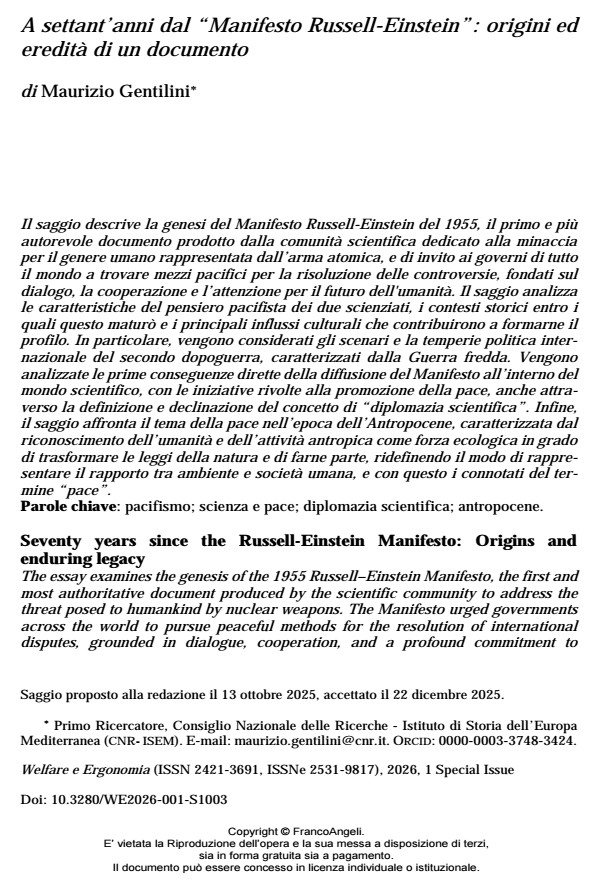
Il saggio descrive la genesi del Manifesto Russell-Einstein del 1955, il primo e più autorevole documento prodotto dalla comunità scientifica dedicato alla minaccia per il genere umano rappresentata dall’arma atomica, e di invito ai governi di tutto il mondo a trovare mezzi pacifici per la risoluzione delle controversie, fondati sul dialogo, la cooperazione e l’attenzione per il futuro dell'umanità. Il saggio analizza le caratteristiche del pensiero pacifista dei due scienziati, i contesti storici entro i quali questo maturò e i principali influssi culturali che contribuirono a formarne il profilo. In particolare, vengono considerati gli scenari e la temperie politica internazionale del secondo dopoguerra, caratterizzati dalla Guerra fredda. Vengono analizzate le prime conseguenze dirette della diffusione del Manifesto all’interno del mondo scientifico, con le iniziative rivolte alla promozione della pace, anche attraverso la definizione e declinazione del concetto di “diplomazia scientifica”. Infine, il saggio affronta il tema della pace nell’epoca dell’Antropocene, caratterizzata dal riconoscimento dell’umanità e dell’attività antropica come forza ecologica in grado di trasformare le leggi della natura e di farne parte, ridefinendo il modo di rappresentare il rapporto tra ambiente e società umana, e con questo i connotati del termine “pace”.
Parole chiave:pacifismo; scienza e pace; diplomazia scientifica; antropocene.
- Alberti V., a cura di (2013). Il concetto di Pace. Attualità della Pacem in Terris nel 50° anniversario (1963-2013). Roma: Libreria Editrice Vaticana.
- Angelini G., a cura di (2012). Nazione, democrazia e pace. Tra Ottocento e Novecento. Milano: FrancoAngeli.
- Anta C.G. (2022). Bertrand Russell: the idea of a world government. Il Politico, 87, 2(257): 23-42.
- Anta C.G. (2020). Idee e modelli del pacifismo tra XIX e XX secolo. Il Politico, 85, 2(253): 109-132.
- Applebaum A. (2016). La cortina di ferro. La disfatta dell'Europa dell'Est. 1944-1956. Milano: Mondadori.
- Arnaldi S., a cura di (2023). Science diplomacy. Foundations and practice. Trieste: EUT.
- Ballini P.L. e Conticelli G. (2014). La Pira, l’Europa dei popoli e il mondo: le pietre del dialogo. Firenze: Polistampa.
- Bendiscioli M. (1933). Romanesimo e germanesimo: la crisi dell’Occidente. Brescia: Morcelliana.
- Bernstein R. (2001). The History of the Bulletin of the Atomic Scientists: The First 50 Years. Chicago: University of Chicago Press.
- Bianchi B. (2023). Non resistere al male con il male. Obiezione di coscienza e pacifismo nel pensiero di Tolstoj. Milano: Biblion.
- Biasutti F. (1979). La dottrina della scienza in Spinoza. Scienze Filosofiche, 23.
- Bobbio N. (1999). Diritti e pace. In: Id., Teoria generale della politica. Torino: Einaudi, 453-466.
- Bobbio N. (1997). L’età dei diritti. Torino: Einaudi.
- Bobbio N. (1984). Il problema della guerra e le vie della pace. Bologna: il Mulino.
- Boersema D. (2017). Positive and Negative Peace. In: Fiaia A., a cura di, The Routledge Handbook of Pacifism and Nonviolence. New York: Routledge.
- Bonneuil C. e Fressoz J.B. (2019). Infeld. L’evento Antropocene. Roma: Treccani Libri.
- Bordoni C. (2021). Post-società. Il mondo dopo la fine della modernità. Roma: Luiss University Press.
- Bori P.C. (1998). Introduzione a Tolstoj L., Guerra e Pace. Torino: Einaudi, XI-LVIII.
- Bori P.C. (1991). Tolstoj oltre la letteratura. Fiesole: Edizioni Cultura della pace.
- Brown M.E. (2001). The Perils of an Atomic Age: Einstein, Russell, and the Cold War. Social Studies of Science, 31(2): 233-245.
- Buber M. (1923). Ich und Du. Leipzig: Insel-Verlag.
- Cattaneo F. (2013). L’idea di repubblica. Da Kant a Habermas. Torino: Giappichelli.
- Clavarino L. (2021). Italian Physicists and the Bomb: Edoardo Amaldi’s Network for Arms Control and Peace during the Cold War. Journal of Contemporary History, 56(3): 665-692.
- Cooper A.F., Heine J. e Thakur R.C., a cura di (2013). The Oxford Handbook of Modern Diplomacy. Oxford UK: University Press.
- Copeland D. (2016). Science Diplomacy. In: The SAGE Handbook of Diplomacy. London: SAGE Publications.
- Corona G. (2023). L’Italia dell’Antropocene. Percorsi di storia ambientale tra XX e XXI secolo. Roma: Carocci.
- Crutzen P.J. (2005). Benvenuti nell’Antropocene. L’uomo ha cambiato il clima, la Terra entra in una nuova era. Milano: Mondadori.
- Crutzen P.J. (2002). Geology of mankind, Nature, 415.
- Davis L. and Patman R. (2016). The Advent of Science Diplomacy. In: The WSPC Reference on Natural Resources and Environmental Policy in the Era of Global Change. Singapore: World Scientific Publishing Co.
- Einstein A. and Infeld L. (1938). The Evolution of Physics. Cambridge: Cambridge University Press.
- Freud S. e Einstein A. (1979). Perché la guerra?. In: Freud S., Opere. Torino: Bollati Boringhieri, Vol. XI, 287-303.
- Galtung J. (1996). Peace by peaceful means. Peace and conflict, development and civilization. London: SAGE Publications Ltd.
- Galtung J. (1987). Gandhi oggi. Per un’alternativa politica nonviolenta. Torino: Edizioni Gruppo Abele.
- Galtung J. (1969). Violence, Peace, and Peace Research. The Journal of Peace Research, 3: 167-191.
- Gandhi M.K. (1969). An Autobiography. Ahmedabad: Navajivan Publishing House.
- Garthoff R.L. (1994). The Great Transition. American-Soviet Relations and the End of the Cold War. Washington D.C.: Brookings Institution.
- Gazzillo F. e Ortu F. (2013). Sigmund Freud. La costruzione di un sapere. Roma: Carocci.
- Gentilini M. (2014). Un impegno per la pace. L’Università internazionale delle istituzioni e dei popoli per la pace. Trento: Fondazione Museo Storico del Trentino.
- Gibelli A. (2007). L’officina della guerra. La Grande Guerra e le trasformazioni del mondo mentale. Torino: Bollati Boringhieri.
- Ginzburg L. (1968). Prefazione a Tolstoj L., Guerra e Pace. Torino: Einaudi. II-X.
- Giovagnoli A., a cura di (2003). Pacem in terris. Tra azione diplomatica e guerra globale. Milano: Guerini e Associati.
- Gonzague de Reynold L. (1934). L’Europe tragique. Paris: Spes.
- Gosling F.G. (2009). Einstein, Russell, and the Promise of a Nuclear-Free World. The Bulletin of the Atomic Scientists, 65(5): 56-63.
- Gozzi G. (2001). Storia dei diritti umani e delle libertà fondamentali. Roma-Bari: Laterza.
- Graziosi A. (2023). Occidenti e modernità. Vedere un mondo nuovo. Bologna: il Mulino.
- Greco P. (2017). Fisica per la pace. Tra scienza e impegno civile. Roma: Carocci.
- Guardini R. (1950). La fine dell’epoca moderna. Brescia: Morcelliana.
- Habermas J. (1998). L’idea della pace perpetua due secoli dopo. In: Id. L’inclusione dell’altro. Milano: Feltrinelli, 177-215.
- Habermas J. (1996). Fatti e norme. Contributi a una teoria discorsiva del diritto e della democrazia. Milano: Guerini e Associati.
- Harris M. (2005). Einstein, Russell and the Political Role of Scientists in the Atomic Age. History of Science, 43(3): 239-257.
- Hegel G.W.F. (1965). Lineamenti di filosofia del diritto, a cura di E. Gans. Bari: Laterza.
- Henderson W.O. (1973). Russell and Einstein: The Legacy of the Manifesto. Journal of the History of Ideas, 34(1): 87-101.
- Hentschel K. (1996). Physics and National Socialism: An Anthology of Primary Sources. Basel: Birkhäuser Verlag.
- Hobsbawm E. (1994). The Age of Extremes. The Short Twentieth Century, 1914-1991. New York: Pantheon Books-Random House [ed. it.: Id (1995). Il secolo breve. 1914-1991. Milano: Rizzoli]
- Holt D. (1998). The Einstein-Russell Manifesto and the Birth of the Anti-Nuclear Movement. International Journal of Peace Studies, 3(1): 31-45.
- Huizinga J. (1935). In de schaduwen vena morgen. Een diagnose van het geestelijk lijden van onzen tijd. Haarlem NL: H.D. Tjeenk Willink (I ed. eng.: In the Shadows of Tomorrow. A diagnosis of the spiritual distemper of our time, London, W. Heinemann, 1936; I ed. it.: La crisi della civiltà, Torino, Einaudi, 1937).
- Jayaraman T. (2005). Albert Einstein: Radical pacifist and democrat. International Journal of Social Economics, 32 (10): 842-849.
- Kaiser Wilhelm-Gesellschaft zur Förderung der Wissenschaften, & Max-Planck-Gesellschaft zur Förderung der Wissenschaften (1961). 50 Jahre Kaiser-Wilhelm-Gesellschaft und Max-Planck-Gesellschaft zur Förderung der Wissenschaften, 1911-1961: Beiträge und Dokumente. Die Gesellschaft.
- Kant I. (1995). Per la pace perpetua. Progetto filosofico (1795). In: Id. Scritti politici e di filosofia della storia e del diritto, a cura di N. Bobbio, L. Firpo e V. Mathieu. Torino: Utet, 283-336.
- Keynes J.M. (1919). The Economic Consequence of the Peace. London: Mac Millan.
- La Pira G. (1989). Giorgio La Pira sindaco: scritti, discorsi e lettere, a cura di U. De Siervo, Gianni e Giorgio Giovannoni. Firenze: Cultura Nuova.
- La Pira G. (1978). Il sentiero di Isaia. Scritti e discorsi (1965-1977), a cura di Gianni e Giorgio Giovannoni. Firenze: Cultura.
- Lelyveld J. (2011). Great Soul: Mahatma Gandhi and His Struggle with India. New York: Knopf.
- Levi L., a cura di (2021). Albert Einstein. Dal pacifismo all’idea del governo mondiale. Soveria Mannelli: Rubbettino.
- Lewis S. e Maslin M. (2020). Il pianeta umano. Come abbiamo creato l’Antropocene. Torino: Einaudi.
- Losurdo D. (2016). Un mondo senza guerre. L’idea di pace dalle promesse del passato alle tragedie del presente. Roma: Carocci.
- Melloni A. (2010). Pacem in terris. Storia dell’ultima enciclica di Papa Giovanni. Bari-Roma: Laterza.
- Musini P. (1984). Gandhi. Il seme della non violenza. Brescia: Editrice La Scuola.
- Nacci M. (2014). Tecnica e guerra. In: Eco U., a cura di, Storia della civiltà europea, Roma: Istituto dell’Enciclopedia Italiana. Ad vocem.
- Nardulli G. (1999). Ricerca scientifica, ricerca militare, nuove tecnologie. Verona: Il Ponte.
- Nathan O. and Norden H. (1981). Einstein on peace. New York: Avenel Books.
- New frontiers in science diplomacy. Navigating the changing balance of power (2010). London: The Royal Society – AAAS.
- Ortega y Gasset J. (1930). La rebelión de las masas. Madrid: Revista de Occidente (trad. it.: La ribellione delle masse, Bologna, il Mulino, 1962).
- Osterhammel J. (2014). The transformation of the world. A global history of the nineteenth century. Princeton: Princeton University Press.
- Papisca A. (2016). Il Diritto della dignità umana. Riflessioni sulla globalizzazione dei diritti umani. Padova: Marsilio.
- Pocock J.G. (2009). The Reconstruction of Political Thought: The Russell-Einstein Manifesto and the Cold War. The Journal of Modern History, 81(3): 598-626.
- Pombeni P., a cura di (2019). The historiography of transition. Critical phases in the development of Modernity (1494-1973). London: Taylor & Francis.
- Price D.J. (2008). Albert Einstein as Pacifist and Democrat during World War I. European Journal of Political Theory, 3(7): 245-262.
- Regis S. (2021). Einstein: le strade verso il pacifismo. Rivista di Studi Filosofici, 1(21): 55-70.
- Rothermund D. (2022). Gandhi. Il rivoluzionario non violento. Bologna: il Mulino.
- Ruffini P. (2017). Science and diplomacy: a new dimension of international relations. Heidelberg-Berlin: Springer Int. Verlag.
- Rühe P. (2001). Gandhi. London-New York: Phaidon.
- Russell B. (1995). Pacifism and revolution: 1916-18 ed. Rempel R.A. In: The collected papers of Bertrand Russell. London: Routledge.
- Russell B. (1967). The Autobiography of Bertrand Russell. London: George Allen & Unwin. (Trad. it.: L’autobiografia di Bertrand Russell. Milano: Longanesi, 1970).
- Russell B. (1959). Common Sense and Nuclear Warfare. London: George Allen & Unwin.
- Russell B. (1923). The Prospects of Industrial Civilization. London: Allen & Unwin.
- Russell B. (1917a). Political Ideals. New York: The Century Company.
- Russell B. (1917b). National Independence and Internationalism. The Atlantic Monthly, 119: 622-628.
- Russell B. (1916a). War as an Institution. The Atlantic Monthly, 117: 603-613.
- Russell B. (1916b). Principles of Social Reconstruction. London: Allen & Unwin.
- Russell B. and Einstein A. (1955). The Russell-Einstein Manifesto. Bulletin of the Atomic Scientists, 11(6): 164-171.
- Salvatore A. (2010). Il pacifismo. Roma: Carocci.
- Spinoso G. e Turrini C. (2022). Giorgio La Pira: i capitoli di una vita. Firenze: University Press.
- Spinoza B. (2007). Trattato teologico-politico, a cura di E. Giancotti Boscherini e P. Totaro. Torino: Einaudi.
- Sprengler O. (1923). Der Untergang des Abendlandes. Umrisse einer Morphologie der Weltgeschichte. Wien: Braunmuller-Beck.
- Sturzo L. (1929). The international community and the right of war. London: George Allen & Unwin Ltd. (I ed. it.: La comunità internazionale e il diritto di guerra, Bologna: Zanichelli, 1954).
- Tirman J. (1984). The Militarization of High Technology. Ballinger, Cambridge USA: Ballinger.
- Turekian V., Macindoe S., Copeland D., Davis L., Patman R. and Pozza M. (2015). The Emergence of Science Diplomacy. In: Davis L. and Patman R., a cura di. Science Diplomacy. New Day or False Dawn?. Singapore: World Scientific Publishing Co.
- Vigilante A. (2009). Il Dio di Gandhi. Religione, etica e politica. Bari: Levante.
- Vigna C. e Zanardo S. (2005). La regola d’oro come etica universale. Milano: Vita e Pensiero.
- Von Clausewitz C. (2007). Della guerra, edizione a cura di G.E. Rusconi. Torino: Einaudi.
- Wilson R.L. (2003). Peace and Science: Bertrand Russell’s Call for a New Ethical Framework. Ethics and International Affairs, 17(2): 11-29.
- Zahra T. (2025). Globalization Is Collapsing. Brace Yourselves. New York Times, April 5.
- Zahra T. (2023). Against the World: Anti-Globalism and Mass Politics Between the World Wars. New York: W.W. Norton & Company.
Maurizio Gentilini, A settant’anni dal “Manifesto Russell-Einstein”: origini ed eredità di un documento in "WELFARE E ERGONOMIA" 1 Suppl./2026, pp 35-59, DOI: 10.3280/WE2026-001-S1003