Ruolo della scienza e dell’educazione trasformativa per una cultura della pace
Titolo Rivista WELFARE E ERGONOMIA
Autori/Curatori Adriana Valente, Valentina Tudisca
Anno di pubblicazione 2026 Fascicolo 2026/1 Suppl.
Lingua Italiano Numero pagine 18 P. 137-154 Dimensione file 112 KB
DOI 10.3280/WE2026-001-S1008
Il DOI è il codice a barre della proprietà intellettuale: per saperne di più
clicca qui
Qui sotto puoi vedere in anteprima la prima pagina di questo articolo.
Se questo articolo ti interessa, lo puoi acquistare (e scaricare in formato pdf) seguendo le facili indicazioni per acquistare il download credit. Acquista Download Credits per scaricare questo Articolo in formato PDF
FrancoAngeli è membro della Publishers International Linking Association, Inc (PILA), associazione indipendente e non profit per facilitare (attraverso i servizi tecnologici implementati da CrossRef.org) l’accesso degli studiosi ai contenuti digitali nelle pubblicazioni professionali e scientifiche.
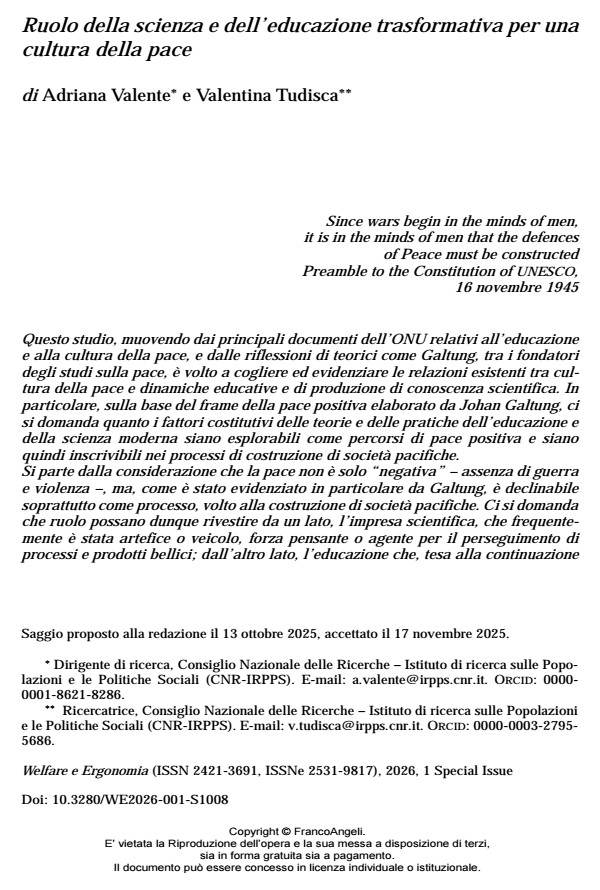
Questo studio, muovendo dai principali documenti dell’ONU relativi all’educazione e alla cultura della pace, e dalle riflessioni di teorici come Galtung, tra i fondatori degli studi sulla pace, è volto a cogliere ed evidenziare le relazioni esistenti tra cultura della pace e dinamiche educative e di produzione di conoscenza scientifica. In particolare, sulla base del frame della pace positiva elaborato da Johan Galtung, ci si domanda quanto i fattori costitutivi delle teorie e delle pratiche dell’educazione e della scienza moderna siano esplorabili come percorsi di pace positiva e siano quindi inscrivibili nei processi di costruzione di società pacifiche. Si parte dalla considerazione che la pace non è solo “negativa” – assenza di guerra e violenza –, ma, come è stato evidenziato in particolare da Galtung, è declinabile soprattutto come processo, volto alla costruzione di società pacifiche. Ci si domanda che ruolo possano dunque rivestire da un lato, l’impresa scientifica, che frequentemente è stata artefice o veicolo, forza pensante o agente per il perseguimento di processi e prodotti bellici; dall’altro lato, l’educazione che, tesa alla continuazione della società, oltre che allo sviluppo individuale, può essere utilizzata come strumento per il consolidamento di società non inclusive e il mantenimento delle distanze tra classi sociali. Tra i fattori considerati, un ruolo particolare è rivestito dagli aspetti dialogici e relazionali, nonché dal concetto di trasformazione. La cultura della pace, infatti, è indissolubilmente legata al dialogo, al confronto, alla collaborazione, alla presa d’atto della varietà dei punti di vista in una prospettiva di superamento dei particolarismi. Dal canto suo, la scienza moderna ha definito i propri paradigmi epistemologici basandosi sul ripudio della segretezza e del principio di autorità e sull’avvio di processi dialogici, in continua negoziazione, tra le discipline e con la società. La “coscienza dialogica” avanzata da Morin in opposizione al “delirio” di guardare le cose da un unico punto di vista, apre la strada sul piano educativo a un’idea di trasformazione sociale, concetto variamente declinato da filosofi, sociologi e pedagogisti ed espresso con particolare efficacia da Bertoni Jovine. L’analisi di ricerche e sperimentazioni centrate su diverse dimensioni dell’educazione trasformativa e dell’approccio partecipato nella ricerca sociale, concorre a delineare il ruolo delle scienze umane e sociali nella costruzione di una cultura della pace.
Parole chiave:pace positiva; educazione; scienza; studi sulla pace; dialogo; scienza e società.
- AA.VV. (2023). Report last 20. Edizioni città del sole.
- Akrich M. (1992). Beyond social construction of technology: the shaping of people and things in the innovation process. New technology at the outset, 173-190.
- Bauman Z. and Portera A. (2021). Education and intercultural identity. A Dialogue Between Zygmunt Bauman and Agostino Portera. Routledge.
- Bertoni Jovine D. (1964). Sul rapporto scuola-società. Scuola e città, 9: 527-529.
- Bertoni Jovine D. e Gabelli A. (1961). Educazione e vita sociale: una antologia dagli scritti. Torino: Loescher.
- Biesta G.J. e Miedema S. (2002). Instruction or pedagogy? The need for a transformative conception of education. Teaching and Teacher education, 18(2): 173-181.
- Bijker E., Hughes T.P. and Pinch T. (1987). The Social Construction of Technological Systems: New Directions in the Sociology and History of Technology. Cambridge, Mass.: MIT Press.
- Consiglio Nazionale delle Ricerche (2018). Relazione sulla ricerca e l’innovazione in Italia. Roma: Cnr Edizioni.
- Dewey J. (1923). Democracy and education: An introduction to the philosophy of education. Macmillan.
- European Commission (2015). Rome Declaration on Responsible Research and Innovation in Europe. In: The contribution of the European Commission to Responsible Research and Innovation. A review of the Science and Society (FP6) and Science in Society (FP7) pro- grammes. Roma: Cnr Edizioni.
- Ferrarotti F. (1965). Max Weber e il destino della ragione. Bari: Laterza.
- Fleck L. (1981). Genesis and Development of a Scientific Fact. Chicago: University of Chicago Press.
- Funtowicz S. (2017). Why knowledge assessment?. In: Pereira A.G., Vaz S.G. and Tognetti S., editors, Interfaces between science and society. Routledge.
- Funtowicz S. and Ravetz J.R. (1997). Environmental problems, post-normal science, and extended peer communities. Études et Recherches sur les Systèmes Agraires et le Développement, 30: 169-175.
- Gallo G. (2012). Costruzione della pace e nonviolenza. La matematica può dirci qualcosa?. In: Gronchi M. e Soriani Innocenti M., a cura di, Societas et universitas. Miscellanea di scritti offerti a don Severino Dianich. Pisa: Edizioni ETS.
- Galtung J. (2013). Lectio Magistralis: La trasformazione nonviolenta dei conflitti. Università degli Studi di Milano, 13 dicembre.
- Galtung J. (1972). A structural theory of imperialism. African Review, 1(4): 93-138.
- Galtung J. and Fischer D. (2013). Johan Galtung: Pioneer of peace research. New York: Springer.
- Greco P. (2017). Fisica per la pace: tra scienza e impegno civile. Roma: Carocci editore.
- Haraway D.J. (2000). Testimone-modesta@femaleman-incontra-Oncotopo. Femminismo e tecnoscienza. Milano: Feltrinelli.
- Haraway D.J. (1985). A cyborg manifesto, Science, Technology, and Socialist Feminism, in late Twentieth century. In: Simians Cyborgs and Women, editors, The reinvention of nature. London: Routledge.
- Huxley A.L. (2022). Science, liberty and peace. DigiCat.
- Institute for Economics & Peace (2024). Global Peace Index 2024: Measuring Peace in a Complex World. Sydney. -- http://visionofhumanity.org/resources.
- Jasanoff S. (2012). The politics of public reason. In: Rubio F.D. e Baert P., editors, The politics of knowledge. Oxford: Routledge.
- Kant I. (2022). Per la pace perpetua. Milano: Ibex Edizioni. (Prima traduzione italiana dal tedesco di A. Massoni pubblicata da Milano: Società Editrice Sonzogno, 1883).
- Keller-Fox E. (1996). Vita, scienza & Cyberscienza. Milano: Garzanti.
- Latour B. (1987). Science in action: How to follow scientists and engineers through society. Cambridge: Harvard university press.
- Lundvall B-A. and Lorenz E. (2006). Welfare and learning in Europe: how to revitalize the Lisbon process and break the stalemate. In: Lundvall B-A. and Lorenz E., editors, How Europe’s Economies Learn. Oxford: Oxford University Press.
- Marchesini N., Tudisca V., Pennacchiotti C. e Valente A. (2023). Punti di vista delle Consulte Provinciali Studentesche su Europa ed educazione – Risultati dell’indagine Educazione ed Europeità. IRPPS Working papers, 133/2023.
- Marcuse H. (1991). One-dimensional Man: studies in ideology of advanced industrial society, London: Routledge.
- Merton R.K. (1973). The sociology of science. Theoretical end empirical investigation. Chicago: University of Chicago Press.
- Montessori M. (1949). Educazione e Pace. Milano: Garzanti.
- Morin E. (1993). Introduction à la pensee complexe. Milano: Sperling & Kupfer.
- Navarro-Castro L. and Nario-Galace J. (2019). Peace education: A pathway to a culture of peace (3rd Edition). Quezon City: Center for Peace Education.
- ONU (2024). Resolution adopted by the General Assembly on 22 September 2024, The Pact for the Future.
- ONU (2016). Resolution 71/189. Declaration on the Right to Peace.
- ONU (1999). Resolution 53/243. Declaration and Programme of Action on a Culture of Peace.
- Pennacchiotti C., Tudisca V., Valente A. e la Rete Officina 2020-2021 (2022). L’educazione al tempo dell’incertezza - Immaginare e progettare i futuri dell’educazione in un contesto europeo e globale. Roma: Istituto di Ricerche sulla Popolazione e le Politiche Sociali (IRPPS Monografie).
- Pontecorvo C. (1988). I bambini parlano per fare scienza: la formazione del linguaggio scientifico nella discussione in classe. In: Guerriero A.R., editor, L’educazione linguistica e i linguaggi delle scienze. Firenze: La Nuova Italia. Quaderni del Giscel.
- Popper K.R. (1972). Relazione al congresso di Tu¨bingen della Società tedesca di sociologia nell’ottobre 1961. In: Adorno, Popper, Dahrendorf, Habermas, Albert e Pilot, Dialettica e positivismo in sociologia. Torino: Einaudi.
- Rossi P. (2015). La nascita della scienza moderna in Europa. Bari: Gius. Laterza & Figli Spa.
- Rossi P. (2004). La comunicazione: una conquista storica. In: Pitrelli N. e Sturloni G., a cura di, La comunicazione della scienza: atti del I e II convegno nazionale (Vol. 2). Roma: Zadigroma.
- Russell B. and Einstein A. (1955, July 9). Russell-Einstein Manifesto. London.
- Russo L. (2001). La rivoluzione dimenticata: il pensiero scientifico greco e la scienza moderna. Milano: Feltrinelli Editore.
- Tornatore L. (1985). Lingua e scienza nell’educazione di base. In: Mayer M., Noce G. and Olivieri G., a cura di, Atti del seminario L’educazione scientifica nella scuola di base. Frascati: CEDE, I Quaderni di Villa Falconieri 6.
- Tudisca V., Marchesini N. e Valente A. (2023). Visioni di Europa e fiducia nella scienza della comunità studentesca italiana. Welfare e Ergonomia, 2: 157-172.
- Tudisca V., Pennacchiotti C. e Valente A. (2022). Comunità estese di pari nella ricerca educativa: il caso delle Officine CNR. In: L’Astorina A., Mangia C., a cura di, Scienza, politica e società: l’approccio post-normale in teoria e nelle pratiche. Roma: Cnr Edizioni, Collana Scienziati in affanno?.
- UNESCO (2023). Raccomandazione sull’educazione alla pace e ai diritti umani, alla comprensione internazionale, alla cooperazione, alle libertà fondamentali, alla cittadinanza globale e allo sviluppo sostenibile, 42 C/40 del 22 settembre 2023.
- UNESCO (2021). Reimagining our futures together: a new social contract for education.
- UNESCO (1994). Declaration and Integrated Framework of Action on Education for Peace, Human Rights and Democracy.
- UNESCO (1945). Constitution, U. N. E. S. C. O., United Nations Educational. Scientific and Cultural Organization.
- Valente A., a cura di (2002). Trasmissione d’élite, o accesso alle conoscenze? Percorsi e contesti della documentazione e comunicazione scientifica. Milano: FrancoAngeli.
- Valente A. e Mayer M. (2018). Le competenze per la ricerca e l’innovazione nella scuola e nella società. In: Archibugi D. e Tuzi F., a cura di, Relazione sulla ricerca e l’innovazione. Analisi e dati di politica della scienza e della tecnologia. Roma: Cnr Edizioni.
- Valente A., Tudisca V. e Pennacchiotti C. (2023). Visioni di scienza e fiducia nei vaccini. In: Archibugi D., Reale E. e Tuzi F., a cura di, Relazione sulla ricerca e l’innovazione in Italia. Roma: Cnr Edizioni.
- Valente A., Tudisca V., Pennacchiotti C., Marchesini N. e Crescimbene C. (2024). Europeità tra narrazioni e percezioni. In: Pennacchiotti C. e Turcio S., a cura di, La società italiana nelle intemperie del nuovo millennio. Roma: Istituto di Ricerche sulla Popolazione e le Politiche Sociali (IRPPS Monografie).
- Wajcman J. (1991). Feminism confronts technology. Penn State Press.
- Winner L. (1980). Do artifacts have politics?. Daedalus, 109 (1):121-136.
- Ziman J. (2000). Real Science. What It Is, and What It Means. Cambridge: Cambridge University Press.
- Ziman J. (2002). La vera scienza. Natura e modelli operativi della prassi scientifica. Bari: Edizioni Dedalo.
Adriana Valente, Valentina Tudisca, Ruolo della scienza e dell’educazione trasformativa per una cultura della pace in "WELFARE E ERGONOMIA" 1 Suppl./2026, pp 137-154, DOI: 10.3280/WE2026-001-S1008