Le dinamiche della pace, verso interazioni consapevoli: la proposta di una metodologia innovativa nel contesto della ricerca-azione
Titolo Rivista WELFARE E ERGONOMIA
Autori/Curatori Erica Rizziato
Anno di pubblicazione 2026 Fascicolo 2026/1 Suppl.
Lingua Italiano Numero pagine 17 P. 155-171 Dimensione file 76 KB
DOI 10.3280/WE2026-001-S1009
Il DOI è il codice a barre della proprietà intellettuale: per saperne di più
clicca qui
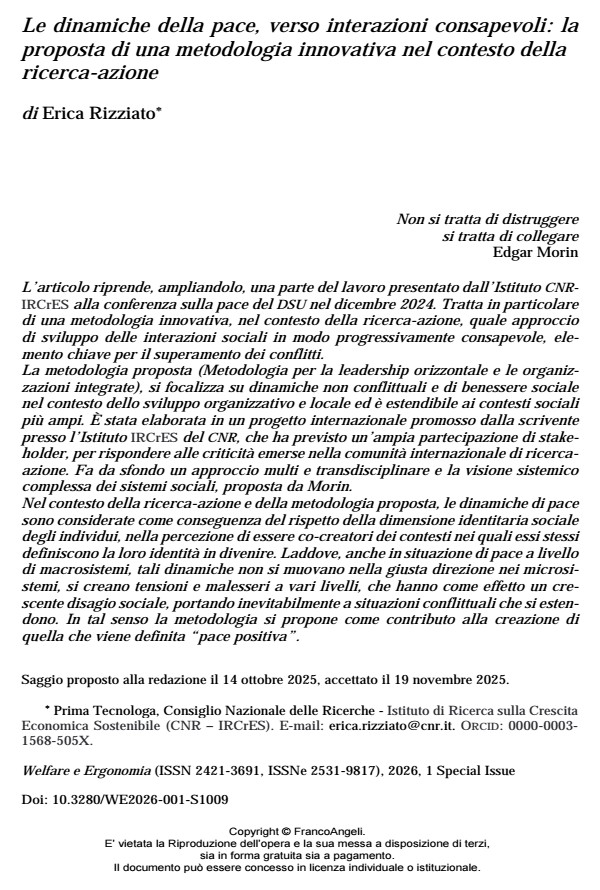
Qui sotto puoi vedere in anteprima la prima pagina di questo articolo.
Se questo articolo ti interessa, lo puoi acquistare (e scaricare in formato pdf) seguendo le facili indicazioni per acquistare il download credit. Acquista Download Credits per scaricare questo Articolo in formato PDF
FrancoAngeli è membro della Publishers International Linking Association, Inc (PILA), associazione indipendente e non profit per facilitare (attraverso i servizi tecnologici implementati da CrossRef.org) l’accesso degli studiosi ai contenuti digitali nelle pubblicazioni professionali e scientifiche.
L’articolo riprende, ampliandolo, una parte del lavoro presentato dall’Istituto CNR- IRCrES alla conferenza sulla pace del DSU nel dicembre 2024. Tratta in particolare di una metodologia innovativa, nel contesto della ricerca-azione, quale approccio di sviluppo delle interazioni sociali in modo progressivamente consapevole, elemento chiave per il superamento dei conflitti. La metodologia proposta (Metodologia per la leadership orizzontale e le organizzazioni integrate), si focalizza su dinamiche non conflittuali e di benessere sociale nel contesto dello sviluppo organizzativo e locale ed è estendibile ai contesti sociali più ampi. È stata elaborata in un progetto internazionale promosso dalla scrivente presso l’Istituto IRCrES del CNR, che ha previsto un’ampia partecipazione di stakeholder, per rispondere alle criticità emerse nella comunità internazionale di ricerca-azione. Fa da sfondo un approccio multi e transdisciplinare e la visione sistemico complessa dei sistemi sociali, proposta da Morin. Nel contesto della ricerca-azione e della metodologia proposta, le dinamiche di pace sono considerate come conseguenza del rispetto della dimensione identitaria sociale degli individui, nella percezione di essere co-creatori dei contesti nei quali essi stessi definiscono la loro identità in divenire. Laddove, anche in situazione di pace a livello di macrosistemi, tali dinamiche non si muovano nella giusta direzione nei microsistemi, si creano tensioni e malesseri a vari livelli, che hanno come effetto un crescente disagio sociale, portando inevitabilmente a situazioni conflittuali che si estendono. In tal senso la metodologia si propone come contributo alla creazione di quella che viene definita “pace positiva”. La sfida, che la metodologia raccoglie, è quella di avviare una crescita culturale di tipo sistemico in cui le individualità sociali delle persone diventino generatrici di una coscienza ecologica di sé, dei contesti e di sé come co-creatori dei contesti. La metodologia è stata sperimentata in varie realtà profit, no profit e pubbliche, nello sviluppo locale, nell’inserimento lavorativo dei giovani e per l’innovazione didattica universitaria. Per estenderne e valorizzarne l’applicazione, nel 2024, chi ha scritto l’articolo ha costituito una società spin off del CNR denominata Istituto internazionale per lo sviluppo umano e organizzativo (IMO).
Parole chiave:dinamiche di pace; ricerca-azione; identità personale e sociale; transdisciplinarietà; apprendimento trasformativo; dialogo generativo; nuove competenze di leadership orizzontale; sviluppo sistemico-evolutivo.
- Assaggioli R. (1977). L’atto di volontà. Roma: Astrolabio.
- Bateson G. (1993). Verso un’Ecologia della Mente. Milano: Adelphi.
- Bateson G. (1984). Mente e natura. Un’unità necessaria. Milano: Adelphi.
- Bekman A. (2010). The horizontal leadership book. Berlin: Alertverlag.
- Bekman A. (2007). The methodology of evidential. In: J.J. Boonstra and L. Caluwè (2007), Intervening and Changing: Looking for Meaning in Interactions. New York: Wiley, pp. 29-45.
- Beer M., Eisenstat R.A. and Spector B. (1990). The Critical Path to Corporate Renewal. Boston: Harvard Business School Press.
- Bertalanffy, von L. (1968). General system theory. Foundations, development, applications. New York: George Braziler.
- Boonstra J. and Caluwè L. (2007). Intervening and Changing: Looking for Meaning in Interactions. New York: Wiley.
- Cambell D., Elgin D., Harman W., Hastings A., Markley O., Matson F, O’Regan B. and Schneid L. (1982). Changing image of the man. Stanford Research Institute, Markley: Pergamon Press.
- Ceruti M. (2017). Il tempo della complessità. Milano: Raffaello Cortina.
- Damasio A. (1995). L’errore di Cartesio. Emozione, ragione e cervello umano. Milano: Adelphi.
- Depolo M. (2007). Psicologia delle organizzazioni. Bologna: il Mulino.
- Doidge N. (2007). The brain who change itself. New York: Penguin book.
- Eccles J. (1994). Come l’io controlla il suo cervello. Milano: Rizzoli.
- Eccles J. e Popper K. (1981). L’io e il suo cervello. Roma: Armando.
- Faggin F. (2022). Irriducibile: la coscienza, la vita, i computer e la nostra natura. Milano: Mondadori.
- Fisher S., Ibrahim A., Ludin J., Smith R. and Williams Steve and Williams Sue. (2000). Working with conflict: skills and strategies for action. London: Zed books.
- Foerster, von H. (1991). Through the Eyes of the Other. In: F. Steier, editor. Researchand Reflectivity. London: Sage.
- French W.L. and Bell C.H. (1998). Organisation Development: Behavioral Science.Intervention for Organisational Improvement. Prentice Hall: Englewood Cliff.
- Galtung J. (2008). Affrontare il conflitto, trascendere e trasformare Pisa: ed. Plus (Pisa university press).
- Galtung J. (1995). Storia dell'idea di pace. Torino: Pangea.
- Gustavsen B. (2001). Teoria e pratica: la mediazione discorso. In: P. Reason e H. Bradbury, a cura di, Libro della ricerca-azione: Indagine e pratica partecipativa. Londra: Sage, pp. 17-26.
- Hosking D.M. and Morley, I.E. (1991). A Social Psicology of Organizing. Harlow: Prentice Hall.
- Kelly G. (2004). La psicologia dei costrutti personali. Milano: Raffaello Cortina.
- Lewin K. (1948). Resolving Social Conflict: Selected Papers on Group Dynamics. Harper: New York.
- Lewin K. (1946). Action research and minority problems. Journal of Social Issues, 2: 34-46.
- Lievegoed B.C.J. (1979). Phases, Crisis and Development in the Individual. London: Rudolf Steiner Press.
- Lievegoed B.C.J. (1973). Developing Organisation. London: Tavistock.
- Luhmann T. (2001). Sistemi sociali. Fondamenti di una teoria generale. Bologna: il Mulino.
- Maslow A. (1954). Motivation and personality. New York: Harper Row.
- Maturana H. e Varela F. (2001). Autopoiesi e cognizione. Venezia: Marsilio.
- Mezirow J. (2003). Apprendimento e trasformazione. Milano: Raffaello Cortina.
- Morin H. (2018). Prefazione. In: Ceruti M. Il tempo della complessità. Milano: Raffaello Cortina.
- Morin H. (2017). Le sfide della complessità. Firenze: Le lettere.
- Morin H. (2014). Insegnare a vivere. Milano: Raffaello Cortina.
- Morin H. (2002). Il metodo 5: L’identità umana. Milano: Raffaello Cortina.
- Mounier E. (1955). Rivoluzione personalista e comunitaria. Milano: Edizioni di Comunità.
- Novara F. (2010). Le ragioni del progetto. In: Rizziato E. (2010). Etica dello sviluppo organizzativo e senso del lavoro: verso un approccio europeo. Milano: FrancoAngeli.
- Novara F. (2004). Si può guarire l’organizzazione? Itinerari d’impresa: management diritto formazione. Soveria Mannelli: Rubbettino.
- Parsons T. (1991). The Social System. London: Routledge.
- Pettigrew A.M. (1988). The Management of Strategic Change. Oxford: Blackwell.
- Poli E. (2014). Anatomia della guarigione. Milano: Anima Edizioni.
- Reason P. and Braddbury H. (2001, 2008, 2015). Handbook of Action Research: Participative Inquiry and Practice. Thousand Oaks: Sage.
- Rizziato E: (2024). Toward a humanism in organizations. Horizontal leadership and cousciousness. Roma: CNR Edizioni.
- Rizziato E. (2022). Lo sviluppo locale: un approccio sistemico e generativo con la leadership orizzontale. Quaderni IRCrES 15. Moncalieri: CNR-IRCrES,
- Rizziato E. (2020). Verso un umanesimo della vita organizzativa: generare sviluppo nella complessità con la leadership orizzontale. Milano: FrancoAngeli.
- Rizziato E. (2018). Organizzazioni e leadership orizzontali: il percorso di training sistemico-evolutivo (TRASE), 12, IRCrES Working Paper: Torino.
- Rizziato E. (2017). Horizontal organization and leadership: a generative approach for an ethic Development in complex systems. Book of proceedings conferenza internazionale Euromed, Roma. -- http://www.emrbi.org/bop2017.pdf.
- Rizziato E. (2014). La ricerca-azione: un approccio per comprendere ed interagire con i processi delle dinamiche socio-economiche, 26, CNR-Ceris Working Paper: Torino. -- http://www.ceris.cnr.it/ceris/workingpaper/2014/WP_26_RIZZIATO.pdf.
- Rizziato E. (2010). Etica dello sviluppo organizzativo e senso del lavoro. Verso la definizione di un approccio europeo. Milano: FrancoAngeli.
- Rizzolatti G. e Sinigaglia C. (2006). So quel che fai. Il cervello che agisce e i neuroni specchio. Milano: Raffaello Cortina.
- Senge P. (1990). The fifth discipline. The art and practice of the learning organization. New York: Doubleday Currency.
- Siegel D.J. (2010). Mindsight. Milano: Raffaello Cortina.
- Siegel D.J. (2001). La mente relazionale. Neurobiologia dell’esperienza interpersonale. Milano: Raffaello Cortina.
- Tomasello M. (2005). Le origini culturali della cognizione umana. Bologna: il Mulino.
- Weick K. e Sutcliffe K. (2007). Governare l’inatteso. Organizzazioni capaci di affrontare le crisi con successo. Milano: Raffaello Cortina.
Erica Rizziato, Le dinamiche della pace, verso interazioni consapevoli: la proposta di una metodologia innovativa nel contesto della ricerca-azione in "WELFARE E ERGONOMIA" 1 Suppl./2026, pp 155-171, DOI: 10.3280/WE2026-001-S1009