Territori, Conflitti e Costruzione della Pace Urbana
Titolo Rivista WELFARE E ERGONOMIA
Autori/Curatori Gabriella Esposito, Giuseppe Pace, Gaia Daldanise, Luisa Fatigati, Stefania Oppido, Stefania Ragozino, Maria Patrizia Vittoria, Erlisiana Anzalone
Anno di pubblicazione 2026 Fascicolo 2026/1 Suppl.
Lingua Italiano Numero pagine 19 P. 173-191 Dimensione file 470 KB
DOI 10.3280/WE2026-001-S1010
Il DOI è il codice a barre della proprietà intellettuale: per saperne di più
clicca qui
Qui sotto puoi vedere in anteprima la prima pagina di questo articolo.
Se questo articolo ti interessa, lo puoi acquistare (e scaricare in formato pdf) seguendo le facili indicazioni per acquistare il download credit. Acquista Download Credits per scaricare questo Articolo in formato PDF
FrancoAngeli è membro della Publishers International Linking Association, Inc (PILA), associazione indipendente e non profit per facilitare (attraverso i servizi tecnologici implementati da CrossRef.org) l’accesso degli studiosi ai contenuti digitali nelle pubblicazioni professionali e scientifiche.
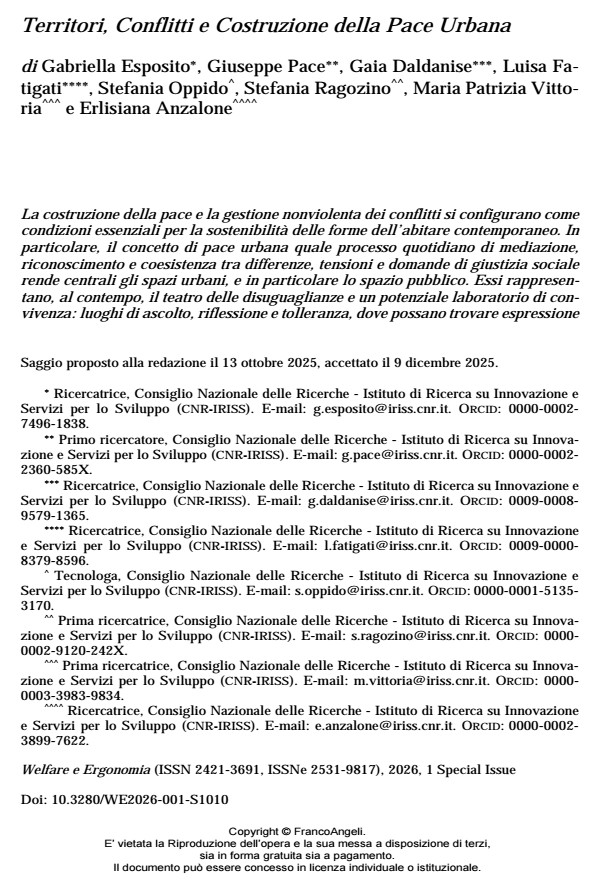
La costruzione della pace e la gestione nonviolenta dei conflitti si configurano come condizioni essenziali per la sostenibilità delle forme dell’abitare contemporaneo. In particolare, il concetto di pace urbana quale processo quotidiano di mediazione, riconoscimento e coesistenza tra differenze, tensioni e domande di giustizia sociale rende centrali gli spazi urbani, e in particolare lo spazio pubblico. Essi rappresentano, al contempo, il teatro delle disuguaglianze e un potenziale laboratorio di convivenza: luoghi di ascolto, riflessione e tolleranza, dove possano trovare espressione pratiche di coesistenza pacifica. Se, invece, risultano teatri di conflittualità e asimmetrie di potere, le città diventano luoghi di violenza, con diverse tipologie di attori che non riescono a dialogare in maniera produttiva tra di loro. A ciò, talvolta, si sommano conflitti bellici che consumano gli spazi urbani, generando profonde trasformazioni sociali e territoriali e lasciando tracce materiali e simboliche con cui la ricerca è chiamata a confrontarsi, al fine di elaborare pratiche capaci di promuovere la coesistenza tra comunità divise e di tutelare le soggettività più vulnerabili. Pertanto, gli urban studies, nei quali si contaminano le discipline urbanistiche, sociologiche ed economiche, possono offrire un importante contributo ai processi di peace-keeping e peace-making, sia in termini di interpretazione dei fenomeni che di azione trasformativa. Il contributo restituisce alcune delle ricerche interdisciplinari che vedono ricercatrici e ricercatori del CNR-IRISS impegnati sul campo su temi connessi alla pace urbana, mediante processi di mutuo apprendimento con le comunità e gli attori territoriali.
Parole chiave:pace urbana; ricerca-azione; rigenerazione urbana; co-design.
- Arnstein S.R. (1969). A Ladder of Citizen Participation. Journal of the American Institute of Planners, 35(4): 216-224. DOI: 10.1080/01944366908977225
- Beall J., Goodfellow T. and Rodgers D. (2013). Cities and conflict in fragile states in the developing world. Urban Studies, 50(15): 3065-3083. DOI: 10.1177/0042098013487775
- Belingardi C.F.M., Poli D. and Ragozino S. (2025). Prospettive femministe sulla città. Vivere insieme tra cura, ecologia e giustizia spaziale. Collana Consiglio Nazionale delle Ricerche, Studi e Ricerche per l’Innovazione, vol. 7. Roma: CNR Edizioni.
- Belingardi C.F.M., Esposito De Vita G., Ragozino S. and Viderman T. (2024). (Re)producing everyday life: urban commoning through care. Contesti: Città, Territori, Progetti, 1: 4-15.
- Björkdahl A. (2013). Urban peacebuilding. Peacebuilding, 1(2): 207-221. DOI: 10.1080/21647259.2013.783254
- Byrne J. and Gormley-Heenan C. (2014). Beyond the Walls: Dismantling Belfast’s Conflict Architecture. City, 18(4-5): 447-454. DOI: 10.1080/13604813.2014.939465
- Boal F. (1996). Integration and Division: Sharing and Segregating in Belfast. Planning Practice and Research, 11(2): 151-158. DOI: 10.1080/02697459650036305
- Bollens S.A. (2006). Urban planning and peace building. Progress in Planning, 66 (2): 67-139.
- Capone N. (2022). Rapporto sui beni comuni a Napoli: Atti e documenti (2011-2021). Napoli: Istituto Italiano per gli Studi Filosofici.
- Choay F. (1965). L’urbanisme. Utopies et réalités. Paris: Editions du Seuil.
- Cognetti F. (2016). Ricerca-azione e università. Produzione di conoscenza, inclusività e diritti. Territorio, 78(3): 40-46.
- De Backer M., Melgaço L., Varna G. and Menichelli F. (2018). Order and Conflict in Public Space. New York & London: Routledge.
- Dell’Era C. and Landoni P. (2014). Living Lab: A methodology between user-centred design and participatory design. Creativity and innovation management, 23(2): 137-154.
- Dolci D. (2020). L’educazione. Roma: Edizioni di Comunità.
- Dotson A.B., Godschalk D. and Kaufman J. (1989). The Planner as Dispute Resolver: Concepts and Teaching Material. Washington D.C.: National Institute for Dispute Resolution.
- Elfversson E., Gusic I. and Rokem J. (2023). Peace in Cities, Peace through Cities? Theorising and Exploring Geographies of Peace in Violently Contested Cities. Peacebuilding, 11(4): 321-337. DOI: 10.1080/21647259.2023.2225914
- Esposito R. (1998). Communitas: Origine e destino della comunità. Torino: Einaudi.
- Esposito De Vita G. (2013). Segregative Power of Violence in Belfast and Naples: Exploring the role of public spaces reconnecting divided societies. In: Madanipour A., Knierbein S. and Degros A. editors, Public Space and the Challenges of Urban Transformation in Europe. New YorK: Routledge, pp. 169-182.
- Esposito De Vita G., Ragozino S. and Mady C. (2024). Embracing Urban complexity: The experience of the AESOP Thematic Group Public Spaces and Urban Cultures. TRIA (Territorio della ricerca su insediamenti e ambiente), 17(32): 5-20. DOI: 10.6093/2281-4574/11015
- Esposito De Vita G., Trillo C. and Martinez- Perez A. (2016). Community planning and urban design in contested places. Some insights from Belfast. Journal of Urban Design, 21(3): 320-334. DOI: 10.1080/13574809.2016.1167586
- Forester J. (1999). The Deliberative Practitioner. Encouraging Participatory Planning Processes. Cambridge Mass.: The MIT Press.
- Forester J. (1998). Considerazioni su quel che dovremo intendere per pratica di piano. CRU, 9-10: 82-98.
- Greenwood D.S., Singer L. and Willis W., editors (2021). Collaborative Governance. Principles, Processes, and Practical Tools. London: Routledge.
- Gusic I. (2022). Peace between peace(s)? Urban peace and the coexistence of antagonists in city spaces. Journal of Intervention and Statebuilding, 16(5): 619-640. DOI: 10.1080/17502977.2022.2129330
- Hasic T. (2004). Reconstruction Planning in Post-Conflict Zones: Bosnia and Herzegovina and the International Community. Stockholm: Royal Institute of Technology.
- Low S., Taplin D. and Shield S. (2005). Rethinking urban parks: Public space and cultural diversity. Austin: University of Texas Press.
- Lynch K. (1960). The Image of the City. Harvard-MIT Joint Center for Urban Studies Series. Cambridge, Mass: MIT Press.
- Mazmanian D.A. and Kraft M. (2009). Toward Sustainable Communities. Transition and Transformations in Environmental Policy. Cambridge Mass.: The MIT Press.
- Montessori M. (2023). Educazione e pace. Milano: Xenia Edizioni.
- Nalbantoglu G.B. and Thai W.C. (1997). Postcolonial Space(s). New York: Princeton Architectural Press.
- Oppido S., Ragozino S., Micheletti S. and Esposito De Vita G. (2018). Sharing responsibilities to regenerate publicness and cultural values of marginalized landscapes: case of Alta Irpinia, Italy. Urbani Izziv, 29: 125-142.
- Pace G. (2021). Heritage Conservation and Community Empowerment. Tools for Living Labs. In: Pace G., Salvarani R. editors, Underground Built Heritage Valorisation: A Handbook. Proceedings of the First Underground4value Training School. Roma: Cnr Edizioni, pp. 197-234.
- Pullan W. and Baillie B. (2013). Introduction. In: Pullan W. and Baillie B., editors. Locating Urban Conflicts. London: Palgrave Macmillan.
- Ragozino S., Esposito De Vita G. e Oppido S. (2022). «Normality was the problem!» Femminismi e Commoning nella riproduzione sociale della città. CRIOS, 24: 74-81. DOI: 10.3280/CRIOS2022-024009
- Robinson L.D., Cawthray J.L., West S.E., Bonn A. and Ansine J. (2018). Ten principles of citizen science. In: Citizen science: Innovation in open science, society and policy. UCL Press, pp. 27-40.
- Saija L. (2007). Prospettive di ricerca-azione nella disciplina urbanistica. FOLIO, 49.
- Sarno F. (2017). Basta un muro. Rinascite urbane tra arte e colore. In: La città creativa. Spazi pubblici e luoghi della quotidianità. CNAPPC, pp. 563-571.
- Stratis S. (2025). Transformative Urban Practice: Supporting the Commons in Spaces of Conflict. Design and Culture, 1-32. DOI: 10.1080/17547075.2025.2530253
- Vittoria M.P. (2020). Quanto vale l’azione di comunità per l’economia locale? Il dibattito tra «Istinti e Istituzioni» nel processo di formazione e consolidamento dei commons urbani a Napoli. Rivista economica del Mezzogiorno, 1-2: 249-275. DOI: 10.1432/97632
- Vittoria M.P. (2019). Comunità artigianali, riutilizzo di edifici dismessi ed entrepreneurial discovery. Alcuni casi emersi dalla realtà napoletana. In: AAVV, a cura di, L’Artigianato Artistico in Campania. Saperi, pratiche e collaborazione in rete per lo Sviluppo del Territorio. Milano: FrancoAngeli.
- Vittoria M.P., Ragozino S. and Esposito De Vita G. (2023). Urban Commons between Ostrom’s and Neo-Materialist Approaches: The Case of Lido Pola in Naples, Southern Italy. Land, 12,524.
- Wennmann A. and Oliver J. (2019). Urban safety and peacebuilding. New York & London: Routledge.
Gabriella Esposito, Giuseppe Pace, Gaia Daldanise, Luisa Fatigati, Stefania Oppido, Stefania Ragozino, Maria Patrizia Vittoria, Erlisiana Anzalone, Territori, Conflitti e Costruzione della Pace Urbana in "WELFARE E ERGONOMIA" 1 Suppl./2026, pp 173-191, DOI: 10.3280/WE2026-001-S1010