Coltivare Gaia: come pensare la nozione di territorio attraverso i saperi e le pratiche dell’agroecologia sperimentale

Titolo Rivista SOCIOLOGIA URBANA E RURALE
Autori/Curatori Andrea Ghelfi
Pubblicazione Online First 17/07/2026 Fascicolo 2026/Online First
Lingua Italiano Numero pagine 19 P. 1-19 Dimensione file 335 KB
DOI 10.3280/SUR2026-22475
Il DOI è il codice a barre della proprietà intellettuale: per saperne di più clicca qui

Qui sotto puoi vedere in anteprima la prima pagina di questo articolo.

Se questo articolo ti interessa, lo puoi acquistare (e scaricare in formato pdf) seguendo le facili indicazioni per acquistare il download credit. Acquista Download Credits per scaricare questo Articolo in formato PDF
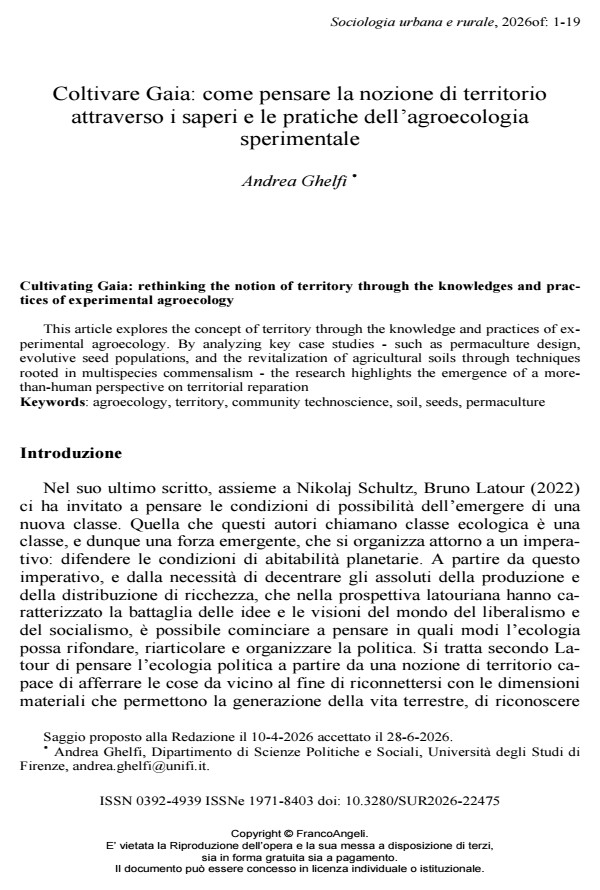
Anteprima articolo

FrancoAngeli è membro della Publishers International Linking Association, Inc (PILA), associazione indipendente e non profit per facilitare (attraverso i servizi tecnologici implementati da CrossRef.org) l’accesso degli studiosi ai contenuti digitali nelle pubblicazioni professionali e scientifiche.

This article explores the concept of territory through the knowledge and practices of ex-perimental agroecology. By analyzing key case studies - such as permaculture design, evolutive seed populations, and the revitalization of agricultural soils through techniques rooted in multispecies commensalism - the research highlights the emergence of a more-than-human perspective on territorial reparation

Parole chiave:agroecology, territory, community technoscience, soil, seeds, permaculture

  1. Malm A., Hornborg A. (2014). The geology of mankind? A critique of the Anthropocene narrative. The Anthropocene Review, 1(1): 62-69. DOI: 10.1177/2053019613516291
  2. Mollison B. (1988). Permaculture: A Designers’ Manual. Tagari Publications.
  3. Mollison B., Holmgren D. (1978). Permaculture One: A Perennial Agriculture for Human Settlements. Tagari Publications.
  4. Moore J.W. (2016). Anthropocene or Capitalocene? Nature, History, and the Crisis of Capitalism. Oakland: PM Press.
  5. Nash L. (2006). Inescapable ecologies. A history of environment, disease, and knowledge. Berkeley: University of California Press.
  6. Pellizzoni L. (2022). Post-work and ecology. In Pellizzoni L., Asara V. (eds.). Handbook of Critical Environmental Politics. Cheltenham: Edward Elgar Publishing.
  7. Puig de la Bellacasa M. (2017). Matters of care: Speculative ethics in more than human worlds. Minneapolis: University of Minnesota Press.
  8. Robinson K.S. (1992). Red Mars. London: HarperCollins. Robinson K.S. (1993). Green Mars. London HarperCollins. Robinson K.S. (1996). Blue Mars. London HarperCollins.
  9. Rosset P., Val V., Barbosa L.P., McCune N. (2019). Agroecology and La Via Campesina II. Peasant agroecology schools and the formation of a sociohistorical and political subject. Agroecology and Sustainable Food Systems, 43(7-8): 895-914. DOI: 10.1080/21683565.2019.1617222
  10. Rosset P., Altieri M. (2017). Agroecology: science and politics. Black Point: Femwood Pub-lishing.
  11. Shiva V. (2008). Soil, Not Oil: Climate Change, Peak Oil and Food Insecurity. London: Zed Books.
  12. Sivini S., Corrado A. (2013). Cibo locale. Percorsi innovativi sulle pratiche di produzione e consumo alimentare. Napoli: Liguori.
  13. Stengers I. (2021). Nel tempo delle catastrofi. Resistere alle barbarie a venire. Torino: Ros-enberg & Sellier.
  14. van der Ploeg J.D. (2008). The New Peasantries. Struggles fo Autonomy annd Sustainability in an Era of Empire and Globalization. London: Earthscan.
  15. Whitefield P. (2004). Earth care manual. A Permaculture Handbook for Britain and other Temperate Climates. East Meon, Hampshire, UK: Permanent Publications.
  16. Whitehead A.N. (1978). Process and Reality. New York: The Free Press.
  17. Wilson R. (2015). Toward an ecopoetics of Oceania worlding the Asia-Pacific region as space-time ecumene. In Shu Y., Pease D.E. (Ed.). American Studies as Transnational Practice: Turning toward the Transpacific. Hanover, NH: Dartmouth College Press.
  18. Zalasiewicz J., Williams M., Steffen W., Crutzen P. (2010). The new world of the Anthro-pocene. Environmental Science & Technology, 44(7), 2228-2231.
  19. Altieri M.A. (2018). Agroecology. The Science of Sustainable Agriculture. Boca Raton: CRC Press.
  20. Altieri M.A., Toledo V.M. (2011). The agroecological revolution in Latin America: rescuing nature, ensuring food sovereignty and empowering peasants. Journal of Peasant Studies, 38(3): 587-612. DOI: 10.1080/03066150.2011.582947
  21. Butler O.E. (1987). Xenogenesis. London: V. Gollancz.
  22. Ceccarelli S., Grando S. (2020). Participatory plant breeding: Who did it, who does it and where? Experimental Agriculture, 56: 1-11. DOI: 10.1017/S0014479719000127
  23. Ceccarelli S., Guimaraes E.P., Weltzien E. (2009). Plant breeding and farmer participation. Rome: Food and Agriculture Organization of the United Nations.
  24. Centemeri L. (2018). Commons and the new environmentalism of everyday life. Alternative value practices and multispecies commoning in the permaculture movement. Rassegna Italiana di Sociologia, 2: 289-314. DOI: 10.1423/90581
  25. Chakrabarty D. (2009). The climate of history: four theses. Critical Inquiry, 35(2): 197-222. DOI: 10.1086/596640
  26. Crutzen P.J. (2002). Geology of mankind. Nature, (415), 23. doi 10.1038/415023.
  27. Favilli E., Rossi A., Brunori G. (2015). Food networks: collective action and local develop-ment. The role of organic farming as boundary object. Organic Agriculture, 5(3): 235-243.
  28. Garcìa Lopez V., Giraldo O.F., Morales H., Rosset P., Duarte J.M. (2019). Seed sovereignty and agroecological scaling: two cases of seed recovery, conservation, and defense in Co-lombia. Agroecology and Sustainable Food Systems, 43(7-8): 827-847. DOI: 10.1080/21683565.2019.1578720
  29. Gentili A., Zampetti G. (2021). Agroecologia circolare. Dal campo alla tavola. Coltivare biodiversità e innovazione. Milano: Edizioni Ambiente.
  30. Hamilton C., Gemenne F., Bonneuil C. (2015). Anthropocene and the global environmental crisis. Rethinking modernity in a new epoch. London: Routledge.
  31. Holmgren D. (2002). Permaculture. Principles and Pathways Beyond Sustainability. Victo-ria: Holmgren Design Services.
  32. Kingsland S.E. (2005). The evolution of American ecology, 1890-2000. Baltimore, Mary-land: Johns Hopkins University Press.
  33. Krebs C.J. (2016). Why ecology matters. Chicago: The University of Chicago Press.
  34. Lamine C., Magda D., Rivera-Ferre M., Marsden T. (2021). Agroecological transitions, be-tween determinist and open-ended visions. Bruxelles: Peter Lang
  35. Lanka S.V., Khadaroo I., Böhm S. (2017). Agroecology accounting: biodiversity and sus-tainable livelihoods from the margins. Accounting, Auditing & Accountability Journal, 30(7): 1592-1613.
  36. Latour B. (2017). Facing Gaia. Eight lectures on the new climatic regime. Cambridge: Poli-ty Press.
  37. Latour B. (2018). Down to earth: Politics in the new climatic regime. Cambridge: Polity Press.
  38. Latour B. (2024). Come abitare la Terra. Torino: Einaudi.
  39. Latour B., Schultz N. (2022). On the Emergence of an Ecological Class. A Memo. Cam-bridge: Polity Press.
  40. Le Guin U.K. (1972). The Word for World is Forest. New York City: Tor.
  41. Leonardi E., Benegiamo M. (2025). Promesse mancate: ascesa utopica e declino distopico della doppia transizione verde e digitale. Quaderni di rassegna sindacale. Lavori, 2: 131-150.
  42. Lillington I. (2007). The Holistic Life. Sustainability through Permaculture. Stepney: Axiom Publishing.
  43. Macnamara L. (2012). People and Permaculture. Caring and Designing for Ourselves, Each Other and the Planet. East Meon: Permanent Publications.

Andrea Ghelfi, Coltivare Gaia: come pensare la nozione di territorio attraverso i saperi e le pratiche dell’agroecologia sperimentale in "SOCIOLOGIA URBANA E RURALE" Online First/2026, pp 1-19, DOI: 10.3280/SUR2026-22475