L’Open Science per il Welfare: riflessioni sull’infrastruttura digitale FOSSR
Titolo Rivista WELFARE E ERGONOMIA
Autori/Curatori Caterina Ambrosio, Ciro Clemente De Falco, Luciana Taddei
Anno di pubblicazione 2026 Fascicolo 2026/1
Lingua Italiano Numero pagine 13 P. 41-53 Dimensione file 130 KB
DOI 10.3280/WE2026-0001004
Il DOI è il codice a barre della proprietà intellettuale: per saperne di più
clicca qui
Qui sotto puoi vedere in anteprima la prima pagina di questo articolo.
Se questo articolo ti interessa, lo puoi acquistare (e scaricare in formato pdf) seguendo le facili indicazioni per acquistare il download credit. Acquista Download Credits per scaricare questo Articolo in formato PDF
FrancoAngeli è membro della Publishers International Linking Association, Inc (PILA), associazione indipendente e non profit per facilitare (attraverso i servizi tecnologici implementati da CrossRef.org) l’accesso degli studiosi ai contenuti digitali nelle pubblicazioni professionali e scientifiche.
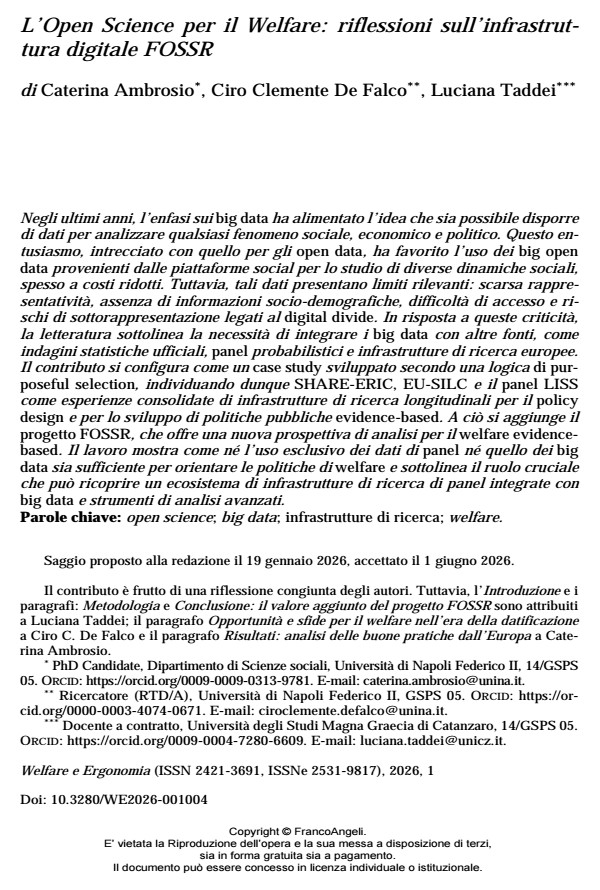
Negli ultimi anni, l’enfasi sui big data ha alimentato l’idea che sia possibile disporre di dati per analizzare qualsiasi fenomeno sociale, economico e politico. Questo entusiasmo, intrecciato con quello per gli open data, ha favorito l’uso dei big open data provenienti dalle piattaforme social per lo studio di diverse dinamiche sociali, spesso a costi ridotti. Tuttavia, tali dati presentano limiti rilevanti: scarsa rappresentatività, assenza di informazioni socio-demografiche, difficoltà di accesso e rischi di sottorappresentazione legati al digital divide. In risposta a queste criticità, la letteratura sottolinea la necessità di integrare i big data con altre fonti, come indagini statistiche ufficiali, panel probabilistici e infrastrutture di ricerca europee. Il contributo si configura come un case study sviluppato secondo una logica di purposeful selection, individuando dunque SHARE-ERIC, EU-SILC e il panel LISS come esperienze consolidate di infrastrutture di ricerca longitudinali per il policy design e per lo sviluppo di politiche pubbliche evidence-based. A ciò si aggiunge il progetto FOSSR, che offre una nuova prospettiva di analisi per il welfare evidence-based. Il lavoro mostra come né l’uso esclusivo dei dati di panel né quello dei big data sia sufficiente per orientare le politiche di welfare e sottolinea il ruolo cruciale che può ricoprire un ecosistema di infrastrutture di ricerca di panel integrate con big data e strumenti di analisi avanzati.
Parole chiave:open science; big data; infrastrutture di ricerca; welfare
- Addeo F., Cerbara L., Ciancimino G., Santurro M., Germani D., Marseglia E., Perrotti M., Piacentini F., Colella E. and Righetto G. (2025). FOSSR Online Training ‘Designing and implementing longitudinal and panel surveys’.
- Aragona B. and De Rosa R. (2018). Policy making at the time of Big Data: datascape, datasphere, data culture. Sociologia Italiana, 11. DOI: 10.1485/AIS_2018/11_3434226
- Borgman C.L. (2015). Big Data, Little Data, No Data: Scholarship in the Networked World. Cambridge, MA: MIT Press.
- Cerbara L., Biolcati Rinaldi F., Ecchia G., Germani D., Mencarini L., Pennacchiotti C., Primerano I., Santurro M., Taddei L., Vezzoni C. and Weber G. (2026, in corso di pubblicazione). Probabilistic surveys to monitor population and societal change. In: E. Reale and G. Cerulli, editors, Research infrastructures for open science in social science research: Lessons from the FOSSR case. Springer Nature.
- Cheney-Lippold J. (2017). We Are Data: Algorithms and the Making of Our Digital Selves. NYU Press.
- D’Ambrosio G., Marchesini N., Pennacchiotti C. e Primerano I. (2025). Creazione e sviluppo di un’infrastruttura di ricerca nelle scienze sociali in Italia: il progetto FOSSR. IRPPS Working Papers, 1(1): 1-39. -- http://epub.irpps.cnr.it/index.php/wp/article/view/321.
- Das M., Knoef M. (2019). Experimental and Longitudinal Data for Scientific and Policy Research: Open Access to Data Collected in the Longitudinal Internet Studies for the Social Sciences (LISS) Panel. In: Crato N., Paruolo P., editors, Data-Driven Policy Impact Evaluation. Springer, Cham. 131-146. DOI: 10.1007/978-3-319-78461-8_9
- De Bresser J. and Knoef M. (2015). Can the Dutch meet their own retirement expenditure goals?. Labour Economics, 34: 100-117.
- Kitchin R. (2014). The Data Revolution: Big Data, Open Data, Data Infrastructures and Their Consequences. London: Sage. DOI: 10.4135/9781473909472
- Manovich L. (2011). Trending: The promises and the challenges of big social data. Debates in the digital humanities, 2(1): 460-475.
- Miguel E., Camerer C., Casey K., Cohen J., Esterling K. M., Gerber A., ... and Van der Laan M. (2014). Promoting transparency in social science research. Science, 343(6166): 30-31.
- O’Neil C. (2016). Weapons of Math Destruction: How Big Data Increases Inequality and Threatens Democracy. New York: Crown Publishing.
- Patton M.Q. (2002). Qualitative Research & Evaluation Methods (3rd ed.). Thousand Oaks, CA: Sage Publications.
- Piacentini F., Colella E. and Righetto G. (2025, luglio 16). FOSSR Online Training ‘Designing and implementing longitudinal and panel surveys’.
- Punziano G., Marrazzo F. and Acampa S. (2021). An application of content analysis to crowdtangle data: the 2020 constitutional referendum campaign on Facebook. Current Politics & Economics of Europe, 32(4).
- Reale E. and Cerulli G. (2023, ottobre 16). FOSSR First Policy-maker session. Data driven policy learning: the role of FOSSR.
- Rogers R. (2013). Digital methods. Cambridge, MA: MIT Press.
- Santini Z.I., Jose P.E., Koyanagi A., Meilstrup C., Nielsen L., Madsen K.R. and Koushede V. (2020). Formal social participation protects physical health through enhanced mental health: A longitudinal mediation analysis using three consecutive waves of the Survey of Health, Ageing and Retirement in Europe (SHARE). Social Science & Medicine, 251, 112906.
- Santurro M., Biolcati Rinaldi F., Cerbara L., Heins F., Paparusso A., Pennacchiotti C., Piacentini F., Taddei L. and Vezzoni C. (2025). Designing the Italian Online Probability Panel: Innovations and Challenges to Foster Open Science. In: di Bella E., Gioia V., Lagazio C., Zaccarin S., editors, Statistics for Innovation 1. SIS 2025. Italian Statistical Society Series on Advances in Statistics. Springer, Cham. DOI: 10.1007/978-3-031-96736-8_43
- Simons-Op het Veld A.M.W. (2018). Socioeconomic health inequalities: exploring the role of social mobility, unhealthy homogenization, and perceived classism. Doctoral Thesis, Maastricht University. Datawyse / Universitaire Pers Maastricht.
- Stake R.E. (1995). The Art of Case Study Research. Thousand Oaks, CA: Sage Publications.
- Taddei L. and Paolucci M. (2026). The Rise of Social Science Infrastructures in Europe and Italy. In: Taddei L., Paolucci M., editors, Longitudinal Data Infrastructures in Europe. Tools for Open Science in Social Science Research, pp. 69-79. Cham: Springer.
- Taddei L., Biolcati Rinaldi F., Heins F., Marchesini N., Paparusso A., Pennacchiotti C., Piacentini F., Primerano I., Vezzoni C., Santurro M. (2026). The Italian way to an Online Probability Panel. In: Taddei L., Paolucci M., editors, Longitudinal Data Infrastructures in Europe. Tools for Open Science in Social Science Research, pp. 141-152. Cham: Springer.
- Taddei L., D’Ambrosio G., Visconti F. (2026). Gli Online Probability Panel: caratteristiche, potenzialità e sviluppi. In: Cerbara L., Pennacchiotti C., Primerano I., Taddei L., editors, Italian Online Probability Panel. Ideazione, realizzazione e contesto del primo panel probabilistico online in Italia, pp. 30-47. Milano: FrancoAngeli.
- Taddei L., Germani D., Marchesini N., Paolillo R., Pennacchiotti C., Primerano I., Santurro M. and Cerbara L. (2025). Comparison of Online Probability Panels in Europe: New Trends and Old Challenges in the Era of Open Science. Societies, 15(8): 210.
- Trezza D. (2023). To scrape or not to scrape, this is dilemma. The post-API scenario and implications on digital research. Frontiers in Sociology, 8.
- Van Dijck J. (2014). Datafication, dataism and dataveillance: Big Data between scientific paradigm and ideology. Surveillance & Society, 12(2): 197-208.
- Wilkinson M.M., Dumontier M., Aalbersberg I.J., Appleton G., Axton M., Baak A., Blomberg N., Boiten J.W., da Silva Santos L.B., Bourne P.E., Bouwman J., Brookes A.J., Clark T., Crosas M., Dillo I., Dumon O., Edmunds S., Evelo C. T., Finkers R. et al. (2016). The FAIR Guiding Principles for scientific data management and stewardship. Scientific Data, 3, 160018.
- Yin R. K. (2018). Case study research and applications: design and methods (Sixth edition.). SAGE Publications, Inc.
Caterina Ambrosio, Ciro Clemente De Falco, Luciana Taddei, L’Open Science per il Welfare: riflessioni sull’infrastruttura digitale FOSSR in "WELFARE E ERGONOMIA" 1/2026, pp 41-53, DOI: 10.3280/WE2026-0001004