Digitalizzazione e servizio sociale oltre l’emergenza: esiti di una ricerca nell’ambito dei servizi sociali
Titolo Rivista WELFARE E ERGONOMIA
Autori/Curatori Romina Ciaccia, Federica Scaffai, Paolo Parra Saiani
Anno di pubblicazione 2026 Fascicolo 2026/1
Lingua Italiano Numero pagine 12 P. 117-128 Dimensione file 89 KB
DOI 10.3280/WE2026-0001009
Il DOI è il codice a barre della proprietà intellettuale: per saperne di più
clicca qui
Qui sotto puoi vedere in anteprima la prima pagina di questo articolo.
Se questo articolo ti interessa, lo puoi acquistare (e scaricare in formato pdf) seguendo le facili indicazioni per acquistare il download credit. Acquista Download Credits per scaricare questo Articolo in formato PDF
FrancoAngeli è membro della Publishers International Linking Association, Inc (PILA), associazione indipendente e non profit per facilitare (attraverso i servizi tecnologici implementati da CrossRef.org) l’accesso degli studiosi ai contenuti digitali nelle pubblicazioni professionali e scientifiche.
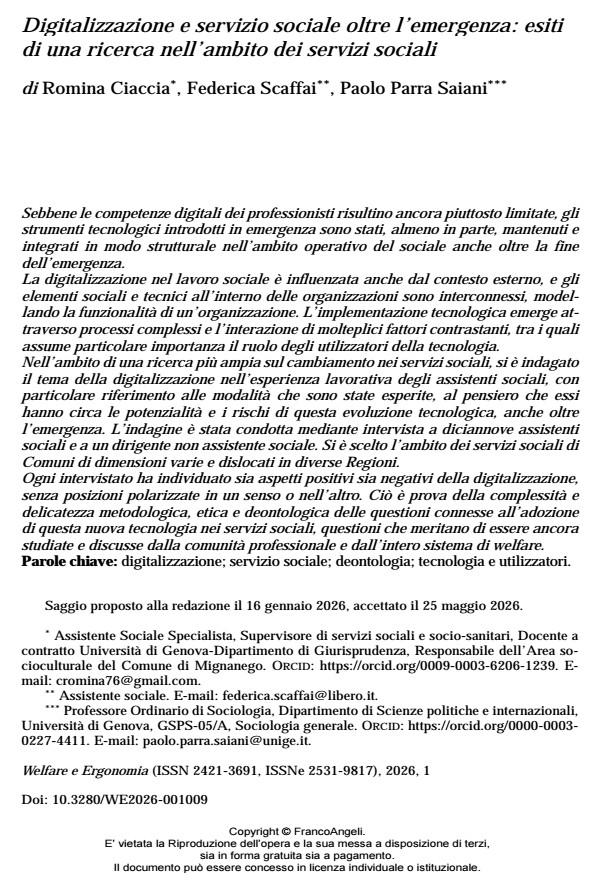
Sebbene le competenze digitali dei professionisti risultino ancora piuttosto limitate, gli strumenti tecnologici introdotti in emergenza sono stati, almeno in parte, mantenuti e integrati in modo strutturale nell’ambito operativo del sociale anche oltre la fine dell’emergenza. La digitalizzazione nel lavoro sociale è influenzata anche dal contesto esterno, e gli elementi sociali e tecnici all’interno delle organizzazioni sono interconnessi, modellando la funzionalità di un’organizzazione. L’implementazione tecnologica emerge attraverso processi complessi e l’interazione di molteplici fattori contrastanti, tra i quali assume particolare importanza il ruolo degli utilizzatori della tecnologia. Nell’ambito di una ricerca più ampia sul cambiamento nei servizi sociali, si è indagato il tema della digitalizzazione nell’esperienza lavorativa degli assistenti sociali, con particolare riferimento alle modalità che sono state esperite, al pensiero che essi hanno circa le potenzialità e i rischi di questa evoluzione tecnologica, anche oltre l’emergenza. L’indagine è stata condotta mediante intervista a diciannove assistenti sociali e a un dirigente non assistente sociale. Si è scelto l’ambito dei servizi sociali di Comuni di dimensioni varie e dislocati in diverse Regioni. Ogni intervistato ha individuato sia aspetti positivi sia negativi della digitalizzazione, senza posizioni polarizzate in un senso o nell’altro. Ciò è prova della complessità e delicatezza metodologica, etica e deontologica delle questioni connesse all’adozione di questa nuova tecnologia nei servizi sociali, questioni che meritano di essere ancora studiate e discusse dalla comunità professionale e dall’intero sistema di welfare.
Parole chiave:digitalizzazione; servizio sociale; deontologia; tecnologia e utilizzatori.
- Rosa H. (2010). Alienation and Acceleration: Towards a Critical Theory of Late-Modern Temporality. NSU Press.
- Argyris C. (1995). Action science and organizational learning. Journal of Managerial Psychology, 10(6): 20-26. DOI: 10.1108/02683949510093849
- Akrich M. and Latour B. (1992). A summary of convenient vocabulary for the semiotics of human and nonhuman assemblies. In: Bijker W. and Law J., a cura di. Shaping Technology / Building Society Studies in Sociotechnical Change, The MIT Press, pp. 259-264.
- Bauwens R., Batistic S. and Kilroy S. (2021). Digitalization and burnout in social work: Challenges and implications. Journal of Social Work, 21(4): 779-795. DOI: 10.1177/1468017320956060
- Cheung J. C.-S. (2022). Responses to COVID-19 in major social work journals: A systematic review of empirical studies, comments, and editorials. Research on Social Work Practice, 32(2): 168-185. DOI: 10.1177/10497315211046846
- Czarniawska B. and Joerges B. (1996). Travels of Ideas. In: Czarniawska B. and Sevón G., editors, Translating Organizational Change. Berlin, New York: De Gruyter, pp. 13-48. DOI: 10.1515/9783110879735.13
- European Commission: Directorate-General for Communications Networks, Content and Technology (2024). Digital Decade Country Report 2024: Italy, testo disponibile al sito: https://ec.europa.eu/newsroom/dae/redirection/document/106709, accesso effettuato il 4/6/2025.
- Fiorentino V., Romakkaniemi M., Harrikari T., Saraniemi S. and Tiitinen L. (2023). Towards digitally mediated social work – The impact of the COVID-19 pandemic on encountering clients in social work. Qualitative Social Work, 22(3): 448-464. DOI: 10.1177/14733250221075603
- Fletcher G. and Griffiths M. (2020). Digital transformation during COVID-19: A sociotechnical perspective. Information Systems Journal, 30(4): 551-559.
- Gillingham P. (2016). Technology con?guring the user: Implications for the redesign of electronic information systems in social work. The British Journal of Social Work, 46(2): 323-338.
- Halford S. and Savage M. (2010). Reconceptualizing Digital Social Inequality. Information, Communication & Society, 13(7): 937-955. DOI: 10.1080/1369118X.2010.499956
- Howcroft D. and Taylor P. (2023). Automation and the future of work: A social shaping of technology approach. New Technology, Work and Employment, 38(2): 351-370.
- Kline R. and Pinch T. (1996). Users as Agents of Technological Change: The Social Construction of the Automobile in the Rural United States. Technology and Culture, 37(4): 763-795.
- López Peláez A., Suh S., Zelenev S., a cura di (2024). Digital Transformation and Social Well-Being: Promoting an Inclusive Society. London: Routledge.
- López Peláez A., Pérez García R. and Aguilar-Tablada Massó M.V. (2017). e-Social work: building a new field of specialization in social work?. European Journal of Social Work, 21(6): 804-823. DOI: 10.1080/13691457.2017.1399256
- Mackay H., Carne C., Beynon-Davies P. and Tudhope D. (2000). Reconfiguring the User: Using Rapid Application Development. Social Studies of Science, 30(5): 737-757. DOI: 10.1177/030631200030005004
- Mackrill T. and Ebsen F. (2018). Key misconceptions when assessing digital technology for municipal youth social work. European Journal of Social Work, 21(6): 942-953. DOI: 10.1080/13691457.2017.1326878.
- Martire F., Parra Saiani P. and Cataldi S. (2023). La ricerca sociale e le sue pratiche. Roma: Carocci.
- Mesiäislehto M., Kivipelto M. and Hiilamo H. (2021). Social workers’ perceptions on clients’ service needs and social work practices during the COVID-19 pandemic. Journal of Comparative Social Work, 2: 9-35.
- Mishna F., Sanders J., Fantus S., Fang L., Greenblatt A., Bogo M. and Milne B. (2021). #socialwork: Informal use of information and communication technology in social work. Clinical Social Work Journal, 49(1): 85-99.
- Munro E. (2020). Promoting the welfare, protection and care of children during the coronavirus (COVID-19) pandemic. Journal of Children’s Services, 15(4): 177-184. DOI: 10.1108/JCS-12-2020-064
- OECD (2024). G7 Compendium of Digital Government Services, OECD Publishing, Paris.
- OECD (2021). Digital Government Index 2021. OECD Publishing.
- Oudshoorn N. and Pinch T.J., a cura di (2003). How users matter: The co-construction of users and technology. Cambridge: MIT Press.
- Parton N. (2008). Changes in the form of knowledge in social work: From the “Social” to the “Informational”?. The British Journal of Social Work, 38(2): 253-69.
- Sanfelici M., Nothdurfter U., Bilotti A., a cura di (2026). Tecnologie digitali nel Servizio Sociale - Apprendere dalla ricerca per orientare la pratica. Franco Angeli in collaborazione con Fondazione Nazionale Assistenti Sociali.
- Saukkonen P., Elovainio M., Salovaara S., Virtanen L., Kaihlanen A.-M., Kainiemi E., Vehko T. and Heponiemi T. (2024). Perceived effects of digitalization on social work in Finland: A network analysis approach. International Social Work, 67(6): 1464-1481. DOI: 10.1177/00208728241265015
- Sørensen K.H. (2023). Processes of incorporation. The relationship between socialisation and domestication of technoscience. In: Hartmann M., a cura di. The Routledge Handbook of Media and Technology Domestication. London: Routledge.
- Steiner O. (2021). Social Work in the Digital Era: Theoretical, Ethical and Practical Considerations. The British Journal of Social Work, 51(8): 3358-3374.
- Sullivan-Tibbs M.A., Rayner C.B., Crouch D.L., Peck L.A., Bell M.A., Hasting A.D., Nativo A.J. and Mallinger K.M. (2022). Social work’s response during the COVID-19 pandemic: A systematic literature review - balancing telemedicine with social work self-care during a pandemic. Social Work in Public Health, 37(6): 499-509. DOI: 10.1080/19371918.2022.2032904
- Trist E.L. and Bamforth K.W. (1951). Some social and psychological consequences of the longwall method of coal-getting: An examination of the psychological situation and defences of a work group in relation to the social structure and technological content of the work system. Human Relations, 4(1): 3-38. DOI: 10.1177/001872675100400101
- Walker G.H., Stanton N.A., Salmon P.M. and Jenkins D.P. (2008). A review of sociotechnical systems theory: A classic concept for new command and control paradigms. Theoretical Issues in Ergonomics Science, 9(6): 479-499. DOI: 10.1080/14639220701635470
- Wiener L., Fry A., Pelletier W., Cincotta N. and Jones B. (2021). The impact of COVID-19 on the professional and personal lives of paediatric oncology social workers. Journal of Psychosocial Oncology, 39(3): 428-444. DOI: 10.1080/07347332.2021.1912245
Romina Ciaccia, Federica Scaffai, Paolo Parra Saiani, Digitalizzazione e servizio sociale oltre l’emergenza: esiti di una ricerca nell’ambito dei servizi sociali in "WELFARE E ERGONOMIA" 1/2026, pp 117-128, DOI: 10.3280/WE2026-0001009