Quando la fame smette di essere una prova: GLP-1, volontà delegata e nuova morale del controllo alimentare
Titolo Rivista SALUTE E SOCIETÀ
Autori/Curatori Angelo Falzarano
Pubblicazione Online First 16/10/2026 Fascicolo 2026/Online First
Lingua Italiano Numero pagine 16 P. 1-16 Dimensione file 357 KB
DOI 10.3280/SES2026-22901
Il DOI è il codice a barre della proprietà intellettuale: per saperne di più
clicca qui
Qui sotto puoi vedere in anteprima la prima pagina di questo articolo.
Se questo articolo ti interessa, lo puoi acquistare (e scaricare in formato pdf) seguendo le facili indicazioni per acquistare il download credit. Acquista Download Credits per scaricare questo Articolo in formato PDF
FrancoAngeli è membro della Publishers International Linking Association, Inc (PILA), associazione indipendente e non profit per facilitare (attraverso i servizi tecnologici implementati da CrossRef.org) l’accesso degli studiosi ai contenuti digitali nelle pubblicazioni professionali e scientifiche.
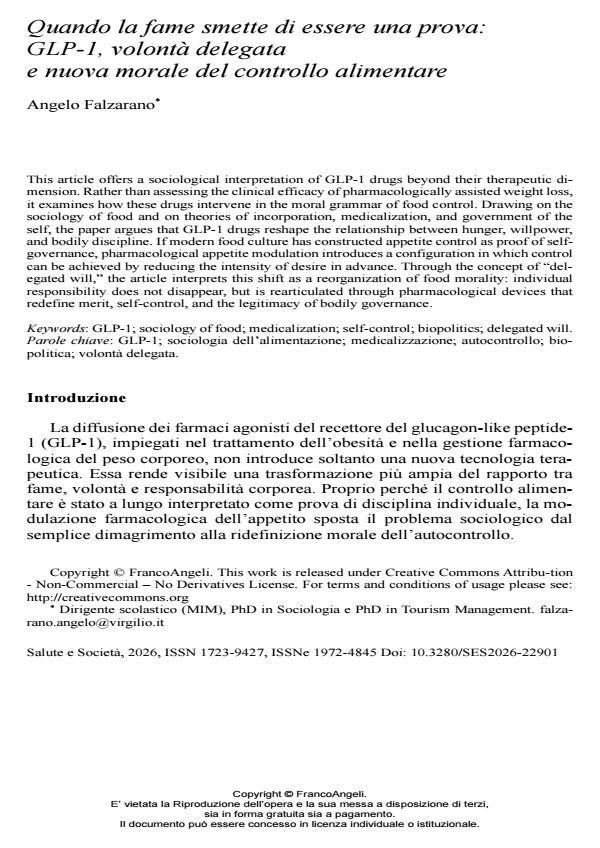
This article offers a sociological interpretation of GLP-1 drugs beyond their therapeutic di-mension. Rather than assessing the clinical efficacy of pharmacologically assisted weight loss, it examines how these drugs intervene in the moral grammar of food control. Drawing on the sociology of food and on theories of incorporation, medicalization, and government of the self, the paper argues that GLP-1 drugs reshape the relationship between hunger, willpower, and bodily discipline. If modern food culture has constructed appetite control as proof of self-governance, pharmacological appetite modulation introduces a configuration in which control can be achieved by reducing the intensity of desire in advance. Through the concept of “del-egated will,” the article interprets this shift as a reorganization of food morality: individual responsibility does not disappear, but is rearticulated through pharmacological devices that redefine merit, self-control, and the legitimacy of bodily governance.
Parole chiave:GLP-1; sociology of food; medicalization; self-control; biopolitics; delegated will. Parole chiave: GLP-1; sociologia dell’alimentazione; medicalizzazione; autocontrollo; bio-politica; volontà delegata.
- Saguy A.C. (2013). What’s Wrong with Fat?. Oxford: Oxford University Press.
- Sassatelli R. (2004). Consumo, cultura e società. Bologna: il Mulino.
- Scragg J., Koutoukidis D.A., Dirksen C., Heitmann B.L., Jebb S.A. (2025). The so-cietal implications of using glucagon-like peptide-1 receptor agonists for the treatment of obesity. Med, 6(9): 100805.
- Westbury S., Oyebode O., van Rens T., Barber T.M. (2023). Obesity stigma: causes, consequences, and potential solutions. Current Obesity Reports, 12(1): 10-23.
- Bordo S. (1993). Unbearable Weight: Feminism, Western Culture, and the Body. Berkeley: University of California Press.
- Conrad P. (1992). Medicalization and social control. Annual Review of Sociology, 18: 209-232.
- Conrad P. (2007). The Medicalization of Society: On the Transformation of Human Conditions into Treatable Disorders. Baltimore: Johns Hopkins University Press.
- Corposanto C., Molinari B. (2018). Superfood e nutraceutica: epistemologia della medicalizzazione del cibo. Salute e Società, 3: 24-39. DOI: 10.3280/SES2018-00300
- Corvo P., Fassino G. (2015). Quando il cibo si fa benessere: alimentazione e qualità della vita. Milano: FrancoAngeli.
- Crawford R. (1980). Healthism and the medicalization of everyday life. Interna-tional Journal of Health Services, 10(3): 365-388. DOI: 10.2190/3H2H-3XJN-3KAY-G9N
- Dhurandhar E.J., Maki K.C., Dhurandhar N.V., Kyle T.K., Yurkow S., Hawkins M.A.W., Agley J., Ho E.H., Cheskin L.J., Sørensen T.I.A., Wang X.R., Allison D.B. (2025). Food noise: definition, measurement, and future research directions. Nutrition & Diabetes, 15(1): 30.
- Douglas M. (1966). Purity and Danger: An Analysis of Concepts of Pollution and Taboo. London: Routledge.
- Elias N. (1939). Über den Prozess der Zivilisation. Basel: Haus zum Falken (trad. ingl.: The Civilizing Process. Oxford: Blackwell, 1994).
- Fischler C. (1980). Food habits, social change and the nature/culture dilemma. So-cial Science Information, 19(6): 937-953. DOI: 10.1177/05390184800190060
- Fischler C. (1988). Food, self and identity. Social Science Information, 27(2): 275-292. DOI: 10.1177/05390188802700200
- Fischler C. (1990). L’Homnivore. Paris: Odile Jacob.
- Foucault M. (1976). La volonté de savoir. Paris: Gallimard.
- Foucault M. (1984). Histoire de la sexualité II: L’usage des plaisirs. Paris: Gal-limard.
- Gard M., Wright J. (2005). The Obesity Epidemic: Science, Morality and Ideology. London: Routledge. DOI: 10.4324/978020361930
- Ghigi R., Sassatelli R. (2018). Corpo, genere e società. Bologna: il Mulino.
- Guthman J. (2011). Weighing In: Obesity, Food Justice, and the Limits of Capitalism. Berkeley: University of California Press.
- Heitmann B.L. (2025). The impact of novel medications for obesity on weight stigma and societal attitudes: a narrative review. Current Obesity Reports, 14(1): 18.
- Jensen S.D., Gualano B., Andreassen P., Scagliusi F.B., SturtzSreetharan C., Brewis A. (2025). Beyond the prescription: global observations on the social implica-tions of GLP-1 receptor agonists for weight loss. PLOS Global Public Health, 5(12): e0005516.
- Lupton D. (2018). Fat. London: Routledge.
- Maturo A. (2009). I mutevoli confini della medicalizzazione: prospettive e dilemmi del miglioramento umano. Salute e Società, 2: 17-35. DOI: 10.3280/SES2009-00200
- Meglio L. (2017). Sociologia del cibo e dell’alimentazione. Un’introduzione. Mi-lano: FrancoAngeli.
- Murray S. (2008). The ‘Fat’ Female Body. Basingstoke: Palgrave Macmillan.
- Poulain J.P. (2009). Sociologie de l’obésité. Paris: Presses Universitaires de France.
- Puhl R., Brownell K.D. (2001). Bias, discrimination, and obesity. Obesity Research, 9(12): 788-805.
- Puhl R.M., Heuer C.A. (2009). The stigma of obesity: a review and update. Obesity, 17(5): 941-964.
- Rose N. (2007). The Politics of Life Itself: Biomedicine, Power, and Subjectivity in the Twenty-First Century. Princeton: Princeton University Press.
Angelo Falzarano, Quando la fame smette di essere una prova: GLP-1, volontà delegata e nuova morale del controllo alimentare in "SALUTE E SOCIETÀ" Online First/2026, pp 1-16, DOI: 10.3280/SES2026-22901