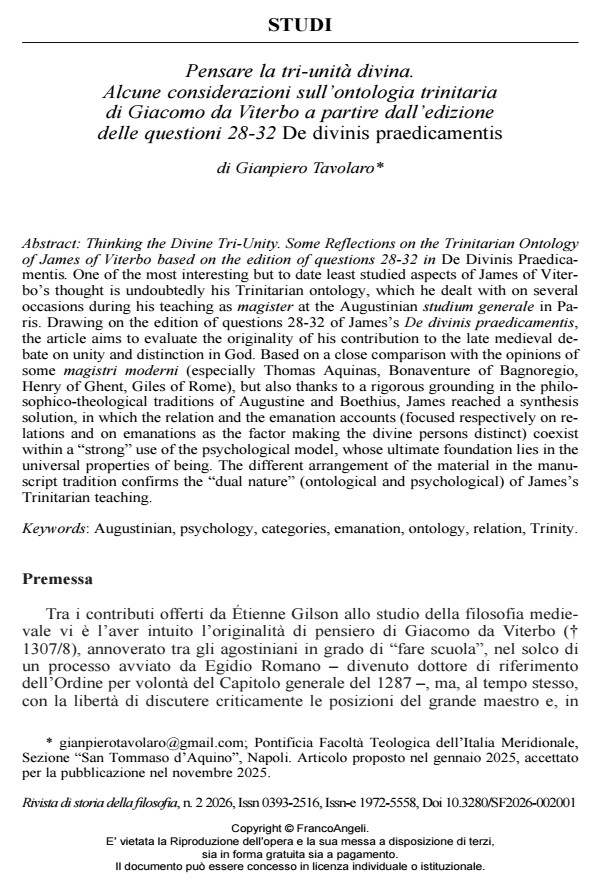
Pensare la tri-unità divina. Alcune considerazioni sull’ontologia trinitaria di Giacomo da Viterbo a partire dall’edizione delle questioni 28-32 De divinis praedicamentis
Titolo Rivista RIVISTA DI STORIA DELLA FILOSOFIA
Autori/Curatori Gianpiero Tavolaro
Anno di pubblicazione 2026 Fascicolo 2026/2
Lingua Italiano Numero pagine 26 P. 207-232 Dimensione file 218 KB
DOI 10.3280/SF2026-002001
Il DOI è il codice a barre della proprietà intellettuale: per saperne di più
clicca qui
Qui sotto puoi vedere in anteprima la prima pagina di questo articolo.
Se questo articolo ti interessa, lo puoi acquistare (e scaricare in formato pdf) seguendo le facili indicazioni per acquistare il download credit. Acquista Download Credits per scaricare questo Articolo in formato PDF
FrancoAngeli è membro della Publishers International Linking Association, Inc (PILA), associazione indipendente e non profit per facilitare (attraverso i servizi tecnologici implementati da CrossRef.org) l’accesso degli studiosi ai contenuti digitali nelle pubblicazioni professionali e scientifiche.
One of the most interesting but to date least studied aspects of James of Viterbo’s thought is undoubtedly his Trinitarian ontology, which he dealt with on several occasions during his teaching as magister at the Augustinian studium generale in Paris. Drawing on the edition of questions 28--32 of James’s De divinis praedicamentis, the article aims to evaluate the originality of his contribution to the late medieval debate on unity and distinction in God. Based on a close comparison with the opinions of some magistri moderni (especially Thomas Aquinas, Bonaventure of Bagnoregio, Henry of Ghent, Giles of Rome), but also thanks to a rigorous grounding in the philosophicotheological traditions of Augustine and Boethius, James reached a synthesis solution, in which the relation and the emanation accounts (focused respectively on relations and on emanations as the factor making the divine persons distinct) coexist within a “strong” use of the psychological model, whose ultimate foundation lies in the universal properties of being. The different arrangement of the material in the manuscript tradition confirms the “dual nature” (ontological and psychological) of James’s Trinitarian teaching.
Parole chiave:Augustinian, psychology, categories, emanation, ontology, relation, Trinity.
Gianpiero Tavolaro, Pensare la tri-unità divina. Alcune considerazioni sull’ontologia trinitaria di Giacomo da Viterbo a partire dall’edizione delle questioni 28-32 De divinis praedicamentis in "RIVISTA DI STORIA DELLA FILOSOFIA" 2/2026, pp 207-232, DOI: 10.3280/SF2026-002001