La dimensione etica dei compiti disciplinari nella contrapposizione tra valori non conciliabili
Journal title ARCHIVIO DI STUDI URBANI E REGIONALI
Author/s Francesco Lo Piccolo
Publishing Year 2013 Issue 2013/106
Language Italian Pages 7 P. 159-165 File size 89 KB
DOI 10.3280/ASUR2013-106015
DOI is like a bar code for intellectual property: to have more infomation
click here
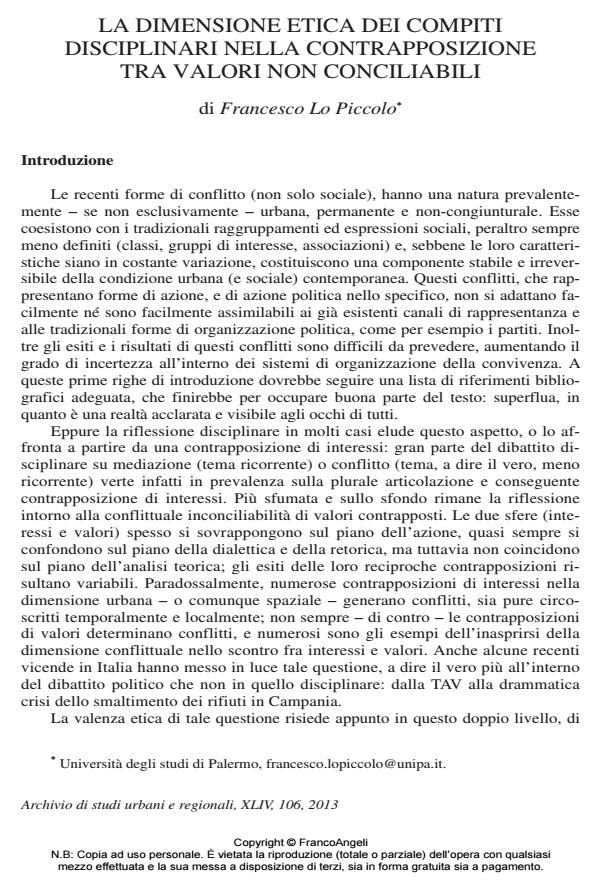
Below, you can see the article first page
If you want to buy this article in PDF format, you can do it, following the instructions to buy download credits
FrancoAngeli is member of Publishers International Linking Association, Inc (PILA), a not-for-profit association which run the CrossRef service enabling links to and from online scholarly content.
- Lo Piccolo F. e Thomas H. (2001). Legal discourse, the individual and the claim for equality in British planning. Planning Theory & Practice, 2, 2: 187-201. DOI: 10.1080/14649350120068795
- Mouffe C. (1993). The Return of the Political. London: Verso
- Mouffe C. (1999). Deliberative democracy or agonistic pluralism. Social Research, 66, 4: 745- 758.
- Mouffe C. (2000). The Democratic Paradox. London: Verso
- Mouffe C. (2005). On the Political. Abingdon and New York: Routledge
- Norval A. J. (2007). Aversive Democracy. Inheritance and Originality in the Democratic Tradition. Cambridge: Cambridge University Press. DOI: 10.1017/CBO9780511490316
- Pløger J. (2004). Strife: urban planning and agonism. Planning Theory, 3, 1: 71-92. DOI: 10.1177/1473095204042318
- Porter L. (2009). On having imperial eyes. In: Lo Piccolo F. e Thomas H., eds., Ethics and Planning Research. Farnham: Ashgate
- Purcell M. (2009). Resisting neoliberalization: communicative planning or counter-hegemonic movements? Planning Theory, 8, 2: 140-165. DOI: 10.1177/1473095209102232
- Sandercock L. (1998). Towards Cosmopolis. Planning for Multicultural Cities. Chichester: Wiley
- Sandercock L. (2003). Out of the closet: The importance of stories and storytelling in planning practice. Planning Theory & Practice, 4, 1: 11-28. DOI: 10.1080/1464935032000057209
- Young I. M. (1990). Justice and the Politics of Difference. Princeton: Princeton University Press
- Young I. M. (2000). Inclusion and Democracy. Oxford: Oxford University Press
- Benhabib S. (1992). Situating the Self. Gender, Community and Postmodernism in Contemporary Ethics. New York: Routledge
- Benhabib S., ed. (1996). Democracy and Difference. Contesting the Boundaries of the Political. Princeton: Princeton University Press
- Bonafede G. e Lo Piccolo F. (2010). Participative planning processes in the absence of the (public) space of democracy. Planning Practice and Research, 25, 3: 353-375. DOI: 10.1080/02697459.2010.503430
- Bond S. (2011). Negotiating a “democratic ethos”: moving beyond the agonistic – communicative divide. Planning Theory, 10, 2: 161-186. DOI: 10.1177/1473095210383081
- Brand R. e Gaffikin F. (2007). Collaborative planning in an uncollaborative world. Planning Theory, 6, 3: 282-313. DOI: 10.1177/1473095207082036
- Crosta P. L. (1998). Politiche. Quale conoscenza per l’azione territoriale. Milano: FrancoAngeli
- Forester J. (2006). Making participation work when interests conflict: From fostering dialogue and moderating debate to mediating disputes. Journal of the American Planning Association, 72, 4: 447-456. DOI: 10.1080/01944360608976765
- Forester J. (2009). Dealing with Differences. Dramas of Mediating Public Disputes. New York: Oxford University Press
- Forester J. e Laws D. (2009). Toward a naturalistic research ethic: Or how mediators must act well to learn, if they are to practice effectively. In: Lo Piccolo F. e Thomas H., eds., Ethics and Planning Research. Farnham: Ashgate
- Gunder M. (2003). Passionate planning for the others’ desire: An agonistic response to the dark side of planning. Progress in Planning, 60, 3: 235-319. DOI: 10.1016/S0305-9006(02)00115-0
- Hillier J. (2002). Shadows of Power. An Allegory of Prudence in Land-Use Planning. London and New York: Routledge
- Hillier J. (2003). “Agon”izing over consensus: Why Habermasian ideals cannot be “real”. Planning Theory, 2, 1: 37-59. DOI: 10.1177/1473095203002001005
- Innes J. E. (1996). Planning through consensus building: A new view of the comprehensive planning ideal. Journal of the American Planning Association, 62, 4: 460-472. DOI: 10.1080/01944369608975712
- Laclau E. e Mouffe C. (2001). Hegemony and Socialist Strategy: Towards a Radical Democratic Politics. 2nd ed. London: Verso.
- Lo Piccolo F. (2006). Colori. In: Indovina F., Fregolent L. e Savino M., a cura di, Nuovo Lessico Urbano. Milano: FrancoAngeli
- Lo Piccolo F. (2008). Il principio di cittadinanza attiva nella sua mutabilità interpretativa ed applicativa nell’ambito dei processi e degli strumenti di pianificazione. In: Lo Piccolo F. e Pinzello I., a cura di, Cittadini e cittadinanza. Palermo: Palumbo
- Lo Piccolo F. (2010). The planning research agenda: Plural cities, equity and rights of citizenship. Town Planning Review, 81, 6: I-VI. DOI: 10.3828/tpr.2010.31
- La violenza dello spazio allo zen di Palermo. un'analisi critica sull'urbanistica come strumento di giustizia Giuseppe Lo Bocchiaro, Simone Tulumello, in ARCHIVIO DI STUDI URBANI E REGIONALI 110/2015 pp.73
DOI: 10.3280/ASUR2014-110006 - Fear, Space and Urban Planning Simone Tulumello, pp.115 (ISBN:978-3-319-43936-5)
- Fear, Space and Urban Planning Simone Tulumello, pp.1 (ISBN:978-3-319-43936-5)
Francesco Lo Piccolo, La dimensione etica dei compiti disciplinari nella contrapposizione tra valori non conciliabili in "ARCHIVIO DI STUDI URBANI E REGIONALI" 106/2013, pp 159-165, DOI: 10.3280/ASUR2013-106015