Preventing and addressing gender-based violence in sport: meanings, limitations, and policy perspectives on safeguarding in Italy

Journal title WELFARE E ERGONOMIA
Author/s Alessia Tuselli, Giovanna Russo
Publishing Year 2026 Issue 2025/2
Language English Pages 13 P. 107-119 File size 76 KB
DOI 10.3280/WE2025-002008
DOI is like a bar code for intellectual property: to have more infomation click here

Below, you can see the article first page

If you want to buy this article in PDF format, you can do it, following the instructions to buy download credits
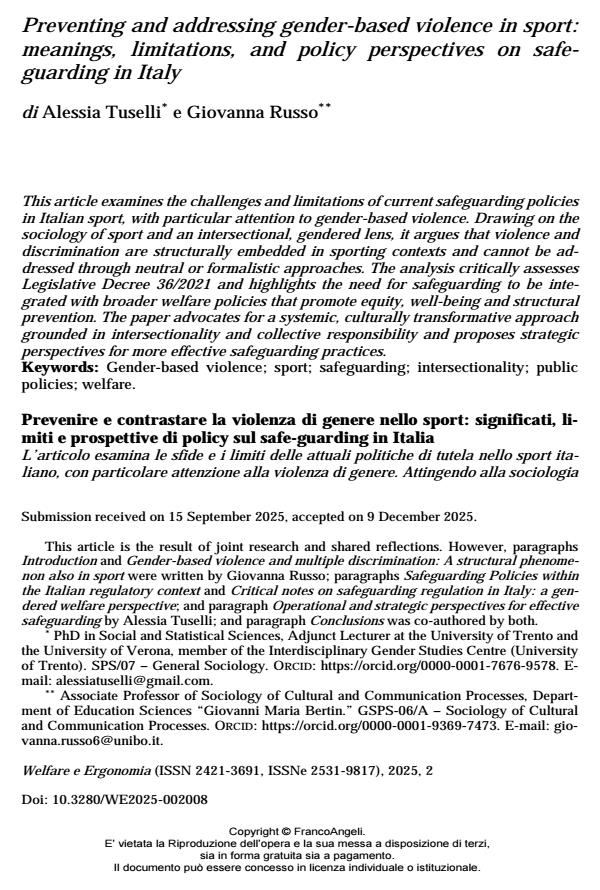
Article preview

FrancoAngeli is member of Publishers International Linking Association, Inc (PILA), a not-for-profit association which run the CrossRef service enabling links to and from online scholarly content.

This article examines the challenges and limitations of current safeguarding policies in Italian sport, with particular attention to gender-based violence. Drawing on the sociology of sport and an intersectional, gendered lens, it argues that violence and discrimination are structurally embedded in sporting contexts and cannot be addressed through neutral or formalistic approaches. The analysis critically assesses Legislative Decree 36/2021 and highlights the need for safeguarding to be integrated with broader welfare policies that promote equity, well-being and structural prevention. The paper advocates for a systemic, culturally transformative approach grounded in intersectionality and collective responsibility and proposes strategic perspectives for more effective safeguarding practices.

Keywords: Gender-based violence; sport; safeguarding; intersectionality; public policies; welfare.

  1. UN Women. (2021). Handbook: Addressing violence against women in sport. New York: UN Women.
  2. WHO – World Health Organization. (2012). Understanding and addressing violence against women. Geneva: WHO Press.
  3. AA.VV. (2024). Il ruolo del safeguarding ed il modello di gestione e controllo per prevenire abusi e violenze. Santarcangelo di Romagna: Maggioli Editore.
  4. Alldred P. (2023). Gender-Related Violence: What Can a Concept Do?. Social Sciences 12: 479.
  5. Appleby K.M. and Foster E. (2013). Gender and sport participation, In: Roper A. E., editors, Gender Relations in Sport, Rotterdam: Sense Publishers, 1-20.
  6. Bastianon S. (2024). Abuse in sport, child protection and safeguarding policies: a European comparative perspective. Rivista di Diritto ed Economia dello Sport, 20(1): 55-78.
  7. Bourdieu P. (1998). Il dominio maschile. Milano: Feltrinelli.
  8. Butler J. (1990). Gender Trouble: Feminism and the Subversion of Identity. New York: Routledge.
  9. Connell R.W. (2005). Masculinities (2nd ed.). Berkeley, CA: University of California Press.
  10. Corradi C. and Stöckl H. (2016). The lessons of history: The role of nation-states and the EU in the development of violence against women policies. Current Sociology, 64(4): 671-690.
  11. Council of Europe (2023). Safe Sport Toolkit – Child Safeguarding in Sport. Council of Europe Publishing. -- https://www.coe.int/en/web/sport/safe-sport-toolkit.
  12. Council of Europe (2011). Convention on preventing and combating violence against women and domestic violence. Istanbul
  13. Crenshaw K. (1989). Demarginalizing the intersection of race and sex: A Black feminist critique of antidiscrimination doctrine, feminist theory and antiracist politics. University of Chicago Legal Forum, (1): 139-167. -- Available at: http://chicagounbound.uchicago.edu/ uclf/vol1989/iss1/8.
  14. D.Lgs. 28 febbraio 2021, n. 36. Riordino e riforma delle disposizioni in materia di enti sportivi professionistici e dilettantistici, nonché di lavoro sportivo. (aggiornato al 24 luglio 2024).
  15. Faludi S. (1991). Backlash: The undeclared war against American women. New York, NY: Crown.
  16. Ferracuti S., Barchielli B., Hartill M. and Simonetti D. (2024). Interpersonal violence against children in sport in the Italian context: prevalence research. Maltrattamento e Abuso all’Infanzia, 25(3): 13-30. DOI: 10.3280/MAL2023-003002
  17. Forsdike K. and O’Sullivan G. (2024). Women’s experiences of gender-based interpersonal violence in sport: a qualitative meta-synthesis. Trauma, Violence & Abuse. DOI: 10.1177/15248380241244397
  18. Gaedicke S., Schäfer A., Hoffmann B., et al. (2021). Sexual violence and the coach-athlete relationship: a scoping review. Frontiers in Sports and Active Living, 3, 643707.
  19. Hartill M., Ferracuti S. and Barchielli B., editors (2023a). Athlete Culture & Climate Survey – Italia. Dipartimento per lo Sport – Presidenza del Consiglio dei Ministri.
  20. Hartill M., Lang M. and Swabey K. (2023b). Prevalence of interpersonal violence against children in sport: An international self-report study of former athletes. Child Abuse & Neglect, 143, 106204.
  21. Hearn J., Strid S., Husu L. and Verloo M. (2020). Violence, gender and power: Interrogating policy: gendered intersectionalities. Current Sociology, 64(4): 671-688.
  22. International Olympic Committee (2016). IOC consensus statement: Harassment and abuse (non-accidental violence) in sport. Lausanne: IOC. Retrieved from -- https://stillmed.olympic.org/media/Document%20Library/OlympicOrg/IOC/What-We-Do/protecting-clean-athletes/Safeguarding/EN-IOC-Consensus-Statement-Harassment-Abuse-in-Sport.pdf.
  23. Lang M. and Hartill M. (2015). Safeguarding, Child Protection and Abuse in Sport: International Perspectives in Research, Policy and Practice. Routledge.
  24. Lewis J. (1992). Gender and the development of welfare regimes. Journal of European Social Policy, 2(3): 159-173. DOI: 10.1177/095892879200200301
  25. MacKinnon C. (1989). Toward a feminist theory of the state. Cambridge, MA: Harvard University Press.
  26. Mestre i Mestre R. and De Vido S. (2024). Lesbianising the Istanbul Convention: Research on the Implementation of the Convention to Protect LBT Women. ELC – EuroCentralAsian Lesbian Community.
  27. Mountjoy M., Rhind D.J.A., Tiivas A. and Leglise M. (2015). Safeguarding the child athlete in sport: British Journal of Sports Medicine consensus. British Journal of Sports Medicine, 49(13): 883-886.
  28. Reale C.M. and Tuselli A. (2022). (Un)ruly Bodies: sex, gender, and race inter-actions in the sport field. About Gender. International Journal of Gender Studies, 11(22). DOI: 10.15167/2279-5057/AG2022.11.22.2040
  29. Russo G. (2013). Questioni di ben-essere. Pratiche emergenti di cultura, sport, consumi. Milano: FrancoAngeli.
  30. Sainsbury D., a cura di (1999). Gender and Welfare State Regimes. Oxford: Oxford University Press.
  31. Spivak G.C. (1988). Can the subaltern speak?. In: Nelson C. and Grossberg L., editors, Marxism and the Interpretation of Culture. Urbana: University of Illinois Press.
  32. Tuselli A. and Vingelli G. (2019). Il corpo nello sport: genere, controllo, potere. Studi Culturali, 3: 433-450.

Alessia Tuselli, Giovanna Russo, Preventing and addressing gender-based violence in sport: meanings, limitations, and policy perspectives on safeguarding in Italy in "WELFARE E ERGONOMIA" 2/2025, pp 107-119, DOI: 10.3280/WE2025-002008