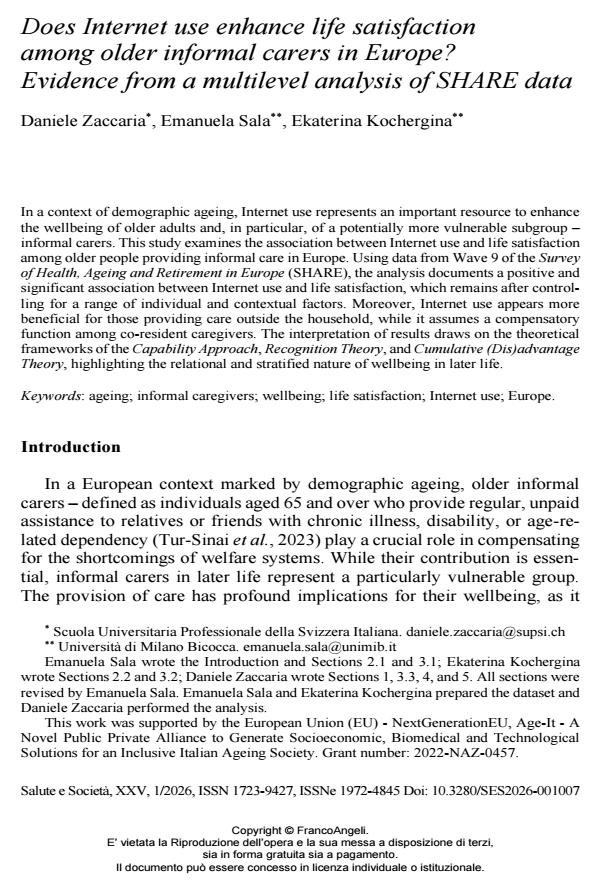
Does Internet use enhance life satisfaction among older informal carers in Europe? Evidence from a multilevel analysis of SHARE data

Journal title SALUTE E SOCIETÀ
Author/s Daniele Zaccaria, Emanuela Sala, Ekaterina Kochergina
Publishing Year 2026 Issue 2026/1
Language English Pages 14 P. 100-113 File size 323 KB
DOI 10.3280/SES2026-001007
DOI is like a bar code for intellectual property: to have more infomation click here

Below, you can see the article first page

If you want to buy this article in PDF format, you can do it, following the instructions to buy download credits
Article preview

FrancoAngeli is member of Publishers International Linking Association, Inc (PILA), a not-for-profit association which run the CrossRef service enabling links to and from online scholarly content.

In a context of demographic ageing, Internet use represents an important resource to enhance the wellbeing of older adults and, in particular, of a potentially more vulnerable subgroup – informal carers. This study examines the association between Internet use and life satisfaction among older people providing informal care in Europe. Using data from Wave 9 of the Survey of Health, Ageing and Retirement in Europe (SHARE), the analysis documents a positive and significant association between Internet use and life satisfaction, which remains after controlling for a range of individual and contextual factors. Moreover, Internet use appears more beneficial for those providing care outside the household, while it assumes a compensatory function among co-resident caregivers. The interpretation of results draws on the theoretical frameworks of the Capability Approach, Recognition Theory, and Cumulative (Dis)advantage Theory, highlighting the relational and stratified nature of wellbeing in later life.

Keywords: ageing; informal caregivers; wellbeing; life satisfaction; Internet use; Europe.

  1. Aparicio A., Inostroza-Correa M.A., Miranda P., Cisternas A., Rojas A., Vargas M. (2025). The impact of technology use for care by informal female caregivers on their well-being. Systematic Reviews, 14(1): 89.
  2. Bonini T., Treré E. (2024). Algorithms of resistance: The everyday fight against platform power. Mit Press.
  3. Damant J., Freddolino P., Dangoor M., Hu B., King D., Wittenberg R. (2024). Unpaid carers of people with dementia and information communication technology: Use, impact and ideas for the future. Dementia, 23(5): 779-799. DOI: 10.1177/1471301224124979
  4. Diener E., Suh E.M., Lucas R.E., Smith H.L. (1999). Subjective well-being: Three decades of progress. Psychological Bulletin, 125(2): 276-302. DOI: 10.1037/0033-2909.125.2.27
  5. Ferraro K.F., Shippee T.P. (2009). Aging and cumulative inequality: How does inequality get under the skin?. The Gerontologist, 49(3): 333-343.
  6. Furlan C., Meggiolaro S. (2025). Life satisfaction and internet use in later life in Italy: The role of online activities and living arrangements. Social Indicators Research, 177(3): 1007-1025.
  7. Gaia A., Sala A., Cerati G. (2021). Social networking sites use and life satisfaction: A quantitative study on older people living in Europe. European Societies, 23(1): 98-118. DOI: 10.1080/14616696.2020.176291
  8. Harris S.J., Dowson J.H. (1982). Recall of a 10-word list in the assessment of dementia in the elderly. British Journal of Psychiatry, 141(5): 524-527.
  9. Helliwell J.F., Layard R., Sachs J., De Neve J.-E., Eds. (2021). World happiness report 2021. New York: Sustainable Development Solutions Network.
  10. Hicks B., Gridley K., Dixon J., Jones D., Milne A., Clarke C. (2023). Using digital technologies to facilitate social inclusion during the COVID-19 pandemic: Experiences of co-resident and non-co-resident family carers of people with dementia from DETERMIND-C19. International Journal of Geriatric Psychiatry, 38(2).
  11. Honneth A. (1995). The struggle for recognition: The moral grammar of social conflicts. Cambridge: Polity Press.
  12. Kayaalp A., Page K.J., Rospenda K.M. (2020). Caregiver burden, work-family conflict, family-work conflict, and mental health of caregivers: A mediational longitudinal study. Work & Stress, 35(3): 217-240. DOI: 10.1080/02678373.2020.183260
  13. Lee S. (2023). Internet use and well-being of older adults before and during the COVID-19 pandemic: Findings from European Social Survey. Journal of Gerontological Social Work, 67(1): 96-113. DOI: 10.1080/01634372.2023.221768
  14. Li J., Liang N., Wu Y., Liu X., Wang M., Zhang H. (2024). Effect of internet usage on the life satisfaction of the elderly spousal caregivers of disabled elderly. Scientific Reports, 14(1): 22294.
  15. Lutz C. (2019). Digital inequalities in the age of artificial intelligence and big data. Human Behavior and Emerging Technologies, 1(2): 141-148.
  16. Neff G., Nagy P. (2018). Agency in the digital age: Using symbiotic agency to explain human–technology interaction. In: Papacharissi Z., ed., A networked self and human augmentics, artificial intelligence, sentience (pp. 97-107). Routledge.
  17. OECD (2013). How’s life? 2013: Measuring well-being. Paris: OECD Publishing.
  18. O’Leary D.E., Volkmer S.A. (2021). Are the negative effects of social networking a privilege of the rich? Social network usage and life satisfaction across European countries. Computers in Human Behavior Reports, 3: 100078.
  19. Pavot W., Diener E. (2008). The satisfaction with life scale and the emerging construct of life satisfaction. The Journal of Positive Psychology, 3(2): 137-152. DOI: 10.1080/1743976070175694
  20. Reinwand D.A., Crutzen R., Zank S. (2018). Online activities among elder informal caregivers: Results from a cross-sectional study. Digital Health, 4. DOI: 10.1177/205520761877971
  21. Rennoch G., Schlomann A., Zank S. (2023). The relationship between internet use for social purposes, loneliness, and depressive symptoms among the oldest old. Research on Aging, 45: 630-642. DOI: 10.1177/0164027522115001
  22. Sala E., Cerati G., Gaia A. (2023). Are social media users more satisfied with their life than non-users? A study on older Italians. Ageing and Society, 43(1): 76-88. DOI: 10.1017/S0144686X2100041
  23. Sala E., Cretazzo, F. (under review). Older informal carers and digital health service use: A scoping review. Manuscript submitted for publication.
  24. Sala E., Gaia A., Cerati G. (2022). The grey digital divide in social networking site use in Europe: Results from a quantitative study. Social Science Computer Review, 40(2): 328-345. DOI: 10.1177/089443932090950
  25. Sen A K. (1993). Capability and well-being. In: Nussbaum M.C., Sen A.K., Eds., The quality of life (pp. 30–53). Oxford: Clarendon Press.
  26. Sousa L., Freitas J., Pinto M., Lemos D., Tavares J. (2023). Influence of social media use among older adults in Portugal. Activities, Adaptation & Aging, 48(3): 473-489. DOI: 10.1080/01924788.2023.221951
  27. Tur-Sinai A., Teti A., Rommel A., Hlebec V., Yghemonos S., Lamura G. (2023). Cross-national data on informal caregivers of older people with long-term care needs in the European population: Time for a more coordinated and comparable approach. Journal of Biosocial Science, 55(2): 378-382. DOI: 10.1017/S002193202100074
  28. UNESCO (2003). International standard classification of education, ISCED 1997. In: Hoffmeyer-Zlotnik J.H.P., Wolf C., Eds., Advances in cross-national comparison. Boston, MA: Springer.
  29. Vanhoutte B. (2014). The multidimensional structure of subjective wellbeing in later life. Journal of Population Ageing, 7(1): 1-20.
  30. Veenhoven R. (2008). Sociological Theories of Subjective Well-Being. In: Eid M., Larsen R.J., Eds., The Science of Subjective Well-Being (pp. 44-61). Guilford Press.
  31. Viklund E.W.E., Forsman A.K. (2022). Exploring the nuanced links between internet use and subjective well-being among older adults: A Nordic population-based study. Frontiers in Psychology, 12.
  32. Wang J., Fu Y., Lou V., Tan S.Y., Chui E. (2021). A systematic review of factors influencing attitudes towards and intention to use the long-distance caregiving technologies for older adults. International Journal of Medical Informatics, 153.
  33. Zhang W., Rand S., Milne A., Collins G., Silarova B. (2022). The quality of life of older carers and the people they support: An international scoping review. Health & Social Care in the Community, 30(6): e3342-e3353.
  34. Zhang Y., Bennett M.R. (2024). Insights into informal caregivers’ well-being: A longitudinal analysis of care intensity, care location, and care relationship. The Journals of Gerontology: Series B, 79(2).
  35. Zhou Y., Bai Z., Wan K., Zhang X., Li L. (2024). Technology-based interventions on burden of older adults’ informal caregivers: A systematic review and meta-analysis of randomized controlled trials. BMC Geriatrics, 24(1): 398.
  36. Železná L. (2018). Care-giving to grandchildren and elderly parents: Role conflict or family solidarity?. Ageing and Society, 38(5): 974-994. DOI: 10.1017/S0144686X1600143

Daniele Zaccaria, Emanuela Sala, Ekaterina Kochergina, Does Internet use enhance life satisfaction among older informal carers in Europe? Evidence from a multilevel analysis of SHARE data in "SALUTE E SOCIETÀ" 1/2026, pp 100-113, DOI: 10.3280/SES2026-001007