Working in extreme heat: how the scientific community and trade unions build knowledge about climate risks

Journal title SOCIOLOGIA DEL LAVORO
Author/s Daniele Di Nunzio, Elisa Errico
Publishing Year 2026 Issue 2025/173
Language English Pages 21 P. 59-79 File size 248 KB
DOI 10.3280/SL2025-173004
DOI is like a bar code for intellectual property: to have more infomation click here

Below, you can see the article first page

If you want to buy this article in PDF format, you can do it, following the instructions to buy download credits
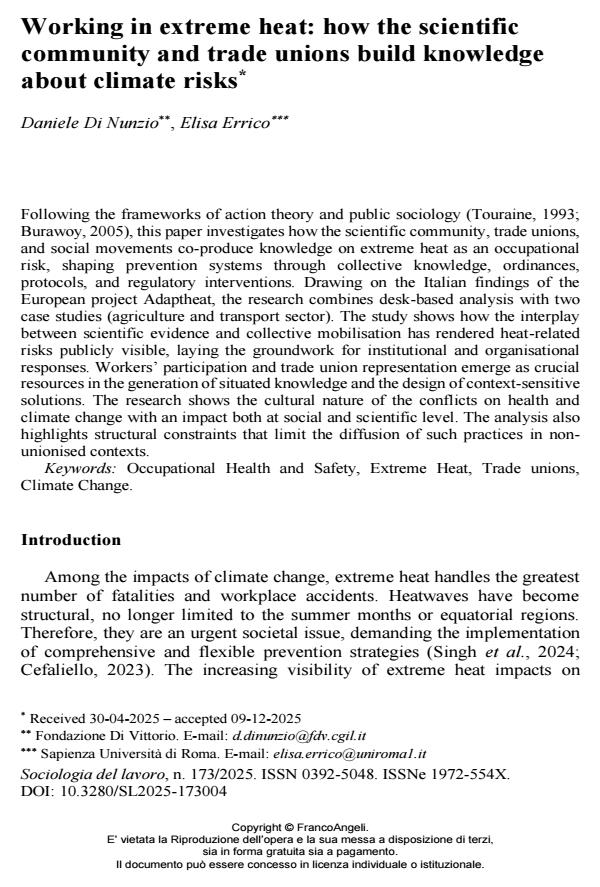
Article preview

FrancoAngeli is member of Publishers International Linking Association, Inc (PILA), a not-for-profit association which run the CrossRef service enabling links to and from online scholarly content.

Keywords: Occupational Health and Safety, Extreme Heat, Trade unions, Climate Change.

  1. Bartlett L. and Vavrus F. (2017). Comparative Case Studies. Educação & Realidade, Porto Alegre, 42 (3), 899-918. DOI: 10.1590/2175-62366863
  2. Burawoy M. (2005). For Public Sociology, American Sociological Review, 70(1), 4-28. DOI: 10.1177/00031224050700010
  3. Brissette E. and King M. (2023). Epistemologies of Struggle: Social Movement Theory and the Politics of Knowledge Production. Humanity & Society, 47(2), 139-153. DOI: 10.1177/0160597623115839
  4. Bruno I., Didier E. and Vitale T. (2014). Statactivism: forms of action between disclosure and affirmation. Partecipazione e conflitto. The Open Journal of Sociopolitical Studies, 7(2), 198-220.
  5. Cagliano R., Canterino F., Trucco P., Di Nunzio D., Arlati C., Bellomo S., Boccuni F., and Buresti G. (2024). Sistemi di prevenzione, partecipazione e rappresentanza dei lavoratori nel tempo della trasformazione digitale, Milano, Franco Angeli.
  6. Cefaliello A. (2023). Heat stress at work: not just a hot topic but a political emergency. Hesa Mag, 28, Etui.
  7. Chilvers, J., & Kearnes, M. (2019). Remaking Participation in Science and Democracy. Science, Technology, & Human Values, 45(3), 347-380. DOI: 10.1177/016224391985088
  8. Chilvers, J., & Longhurst, N. (2016). Participation in Transition(s): Reconceiving Public Engagements in Energy Transitions as Co-Produced, Emergent and Diverse. Journal of Environmental Policy & Planning, 18(5), 585–607. DOI: 10.1080/1523908X.2015.111048
  9. De Angelis G. and Di Nunzio D. (2021). Indagine sulle condizioni di salute delle lavoratrici e dei lavoratori nell'industria e nei servizi, Notiziario INCA, 4.
  10. Delaria I., Di Nunzio D. (2019). L’azione sindacale per la prevenzione: conoscenza, partecipazione e controllo nei contesti aziendali industriali”, in Stanzani C., a cura di, Il Centro Ricerche e Documentazione rischi e danni da lavoro (1974-1985). Uno studio storiografico, sociologico e giuridico di una stagione sindacale, Milano, Franco Angeli, pp. 85-114.
  11. della Porta D. and Pavan E. (2017). Repertoires of knowledge practices: social movements in times of crisis", Qualitative Research in Organizations and Management, 12(4), pp. 297-314.
  12. Di Nunzio D. and Manca F. (2024). La prevenzione e il risarcimento dei danni da lavoro: l’affermazione della salute come diritto individuale e legame sociale nella storia italiana e il ruolo della Cgil. In: Calleri S., Taranto S., a cura di, Vademecum Cgil per Rls e Rlst (eds.) Rafforzare il ruolo dei rappresentanti dei lavoratori per la sicurezza, Roma, Futura Editrice, pp. 13-43.
  13. Di Nunzio D. and Toscano T. (2024). Ricerca-intervento, sociologia dell’azione e processi di soggettivazione nelle trasformazioni del lavoro e della vita sociale, Sociologia del lavoro, 170, 166-186, DOI: 10.3280/SL2024-17001
  14. Errico E. and Di Nunzio D. (2024). Caldo estremo e salute e sicurezza sul lavoro: il ruolo del dialogo sociale, Working Paper n. 5, Roma, Fondazione Di Vittorio. DOI: 10.69092/FDV-1-WP5-202
  15. EU-OSHA (2023). Heat at Work- Guidance for workplaces. Online publication available at: https://osha.europa.eu/en/publications/heat-work-guidance-workplaces
  16. Fatima S.H., Rothmore P., Giles L.C., Varghese B.M. and Bi P. (2021). Extreme heat and occupational injuries in different climate zones: A systematic review and meta-analysis of epidemiological evidence. Environment international, 148, 106384.
  17. Feagin J., Orum A. and Sjoberg G. (1991). A case for case study. Chapel Hill, NC: University of North Carolina Press.
  18. Flouris A., Azzi M., Graczyk H., Nafradi B. and Scott N. (2024). Heat at Work: Implications for Safety and Health. A Global Review of the Science, Policy and Practice. ILO, ISBN 978-92-2-040505-5
  19. Foster J., Hodder S.G., Goodwin J., Havenith G. (2020). Occupational Heat Stress and Practical Cooling Solutions for Healthcare and Industry Workers During the COVID-19 Pandemic. Annals of work exposure and health, 64, 915–922,
  20. Gibbons M. (1999). Science's new social contract with society. Nature 402(6761), 81-84. DOI: 10.1038/3501157
  21. Gilles M. (2014). Recounting health at work counts: A Tale of Numbers and Their Uses. Partecipazione e Conflitto. The Open Journal of Sociopolitical Studies, 7(2), 278-293.
  22. Gomes de Matos C. (2015). Whose knowledge? Reflecting on the plurality of knowledge production in contentious politics. DIE ERDE – Journal of the Geographical Society of Berlin, 146(2-3), 175–188.
  23. Guo Y., Gasparrini A., Li S., Sera F., Vicedo-Cabrera A.M., Coelho M.S.Z.S, Saldiva P.H.N., Lavigne E., Tawatsupa B., Punnasiri K., Overcenco A., Correa P.M., Ortega N.V., Kan H., Osorio S., Jaakkola J.J.K., Ryti N.I.R., Goodman P.G., Zeka A., Michelozzi P., Scortichini M., Hashizume M., Honda Y., Seposo X., Kim H., Tobias A., Íñiguez C., Forsberg B., Åström D.O., Guo Y.L., Chen B., Zanobetti A., Schwartz J., Dang T.N., Do Van D., Bell M.L., Armstrong B., Ebi K.L. and Tong S. (2018). Quantifying excess deaths related to heatwaves under climate change scenarios: A multicountry time series modelling study, Plos Medicine, 15, e1002629,
  24. Gustavsen B. (2003). New forms of knowledge production and the role of action research. Action research, 1(2), 153-164. DOI: 10.1177/1476750303001200
  25. Leonardi L. (2023). La giusta transizione tra questione sociale e questione ambientale: il potenziale ecologico delle mobilitazioni operaie. Giornale di diritti del lavoro e delle relazioni industriali, 177/178 (1-2), 99-124.
  26. Marx W., Haunschild R. and Bornmann L. (2021). Heat waves: a hot topic in climate change research. Theoretical and Applied Climatology, 146, 781-800.
  27. McInnes J.A., Akram M., MacFarlane E.M., Keegel T., Sim M.R. and Smith P. (2017a). Association between high ambient temperature and acute work-related injury: a case-crossover analysis using workers' compensation claims data. Scandinavian journal of work, environment & health, 43(1), 86-94.
  28. McInnes J.A., MacFarlane E.M., Sim M.R. and Smith P. (2017b). Working in hot weather: a review of policies and guidelines to minimise the risk of harm to Australian workers. Injury prevention, 23(5), 334-339.
  29. Meardi G. (2013). Labour movements and labour unions. Emergence, institutionalization, crisis and revitalization of a social movement, Sociopedia (free online social science encyclopedia). DOI: 10.1177/2056846013
  30. Morris N.B., Piil J.F., Morabito M.,Messeri A., Levi M., Ioannou, L.G., Ciuha U., Pogacar T., Bogataj L.K., Kingma B., Casanueva A., Kotlarski S., Spirig C., Foster J., Havenith G., Sotto Mayor T., Flouris A.D. and Nybo L. (2021). The HEAT-SHIELD project — Perspectives from an inter-sectoral approach to occupational heat stress. Journal of Science and Medicine in Sport, 24(8), 747-755.
  31. Narocki C. (2021). Heatwaves as an occupational hazard. ETUI, The European Trade Union Institute. https://www.etui.org/publications/heatwaves-occupational-hazard
  32. Pulignano, V., Hauptmeier, M., and Frans, D. (2023). Determinants of union strategies towards the twin digital and green transitions in the German and Belgian automotive industry. Transfer, 29(1), 121-138. DOI: 10.1177/1024258923115806
  33. Regalia I. (2012). Italian Trade Unions: Still Shifting between Consolidated Organizations and Social Movements?, Management Revue, 23, (4), Special Issue: The Future of Trade Unions in Western Europe, Part II, pp. 386-407.
  34. Rugiero S. (2022). The social dimension of decarbonisation: the so-cio-ecological transition of the hard-to-abate industries in Italy. In Galgóczi B., Decarbonizing energy intensive industries: what are the risks and opportunities for jobs?, Bruxelles, Etui. https://www.etui.org/decarbonizing-energy-intensive-industries-what-are-risks-and-opportunities-jobs
  35. Singh C., Ramesh A., Hagenlocher M., Shekhar H., Siemons A.S.S., Okunola O.H. and Werners S.E. (2024). Applying recent advances in climate adaptation research to urban heat risk management. Wiley Interdisciplinary Reviews: Climate Change, 15(5), e901.
  36. Suzuki A. (2025). Social movements to ban asbestos in Japan: influence of trade unions and the late development of grassroots mobilization. Labor History, 1–13. DOI: 10.1080/0023656X.2024.244906
  37. Touraine A. (1993). Critica della modernità, Milano, Il Saggiatore.
  38. Xiang J., Bi P., Pisaniello D. and Hansen A. (2014). The impact of heatwaves on workers? health and safety in Adelaide, South Australia. Environmental Research, 133, 90-95,
  39. Yin R. (2014). Case Study Research: design and methods. Thousand Oaks, CA, Sage.
  40. Zuo J., Pullen S., Palmer J., Bennetts H., Chileshe N. and Ma T. (2015). Impacts of heat waves and corresponding measures: a review. Journal of Cleaner Production, 92, 1-12.

Daniele Di Nunzio, Elisa Errico, Working in extreme heat: how the scientific community and trade unions build knowledge about climate risks in "SOCIOLOGIA DEL LAVORO " 173/2025, pp 59-79, DOI: 10.3280/SL2025-173004