Measuring Labour Cost: Istat and Supranational Statistical Institutions in 1950s and 1960s Italy
Journal title ITALIA CONTEMPORANEA
Author/s Manfredi Alberti
Publishing Year 2026 Issue 2026/310
Language Italian Pages 19 P. 17-35 File size 196 KB
DOI 10.3280/IC2026-310002
DOI is like a bar code for intellectual property: to have more infomation
click here
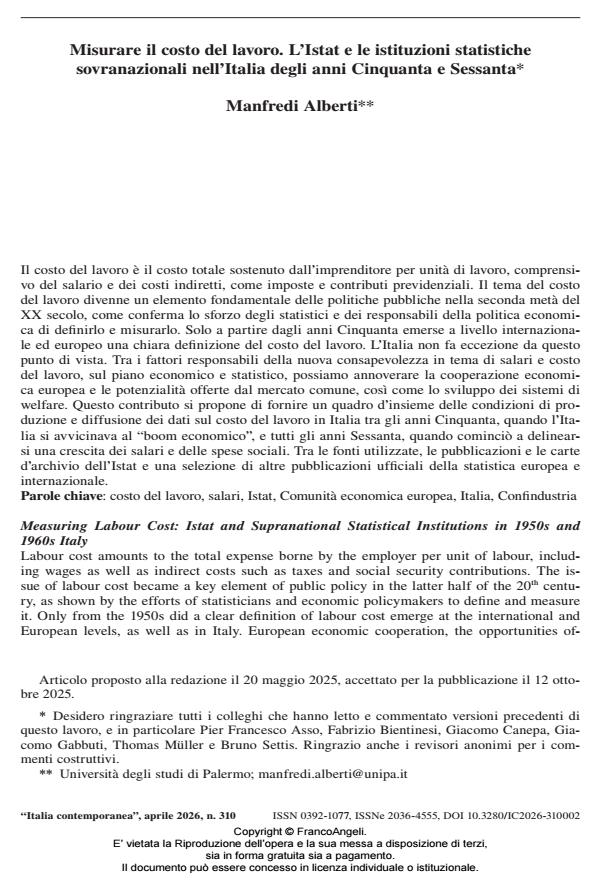
Below, you can see the article first page
If you want to buy this article in PDF format, you can do it, following the instructions to buy download credits
FrancoAngeli is member of Publishers International Linking Association, Inc (PILA), a not-for-profit association which run the CrossRef service enabling links to and from online scholarly content.
Labour cost amounts to the total expense borne by the employer per unit of labour, including wages as well as indirect costs such as taxes and social security contributions. The issue of labour cost became a key element of public policy in the latter half of the 20th century, as shown by the efforts of statisticians and economic policymakers to define and measure it. Only from the 1950s did a clear definition of labour cost emerge at the international and European levels, as well as in Italy. European economic cooperation, the opportunities offered by the common market, and the development of welfare systems determined a growing awareness of wages and the labour cost, both economically and statistically. This paper provides an overview of the conditions for producing and disseminating data on labour cost in Italy in the 1950s, when the country was approaching the “economic boom”, and the 1960s, when wage growth and social spending emerged. Sources include Istat publications and archival documents, along with a selection of other official European and international statistical publications.
Keywords: labour cost, wages, Istat, European Economic Community, Italy, Confindustria
Manfredi Alberti, Misurare il costo del lavoro. L’Istat e le istituzioni statistiche sovranazionali nell’Italia degli anni Cinquanta e Sessanta in "ITALIA CONTEMPORANEA" 310/2026, pp 17-35, DOI: 10.3280/IC2026-310002