Climate governance and sustainability: An international analysis of green investments
Journal title MANAGEMENT CONTROL
Author/s Michele Rubino, Ilaria Mastrorocco, Elisa Gerbasi
Publishing Year 2026 Issue 2026/1
Language Italian Pages 22 P. 67-88 File size 185 KB
DOI 10.3280/MACO2026-001004
DOI is like a bar code for intellectual property: to have more infomation
click here
Below, you can see the article first page
If you want to buy this article in PDF format, you can do it, following the instructions to buy download credits
FrancoAngeli is member of Publishers International Linking Association, Inc (PILA), a not-for-profit association which run the CrossRef service enabling links to and from online scholarly content.
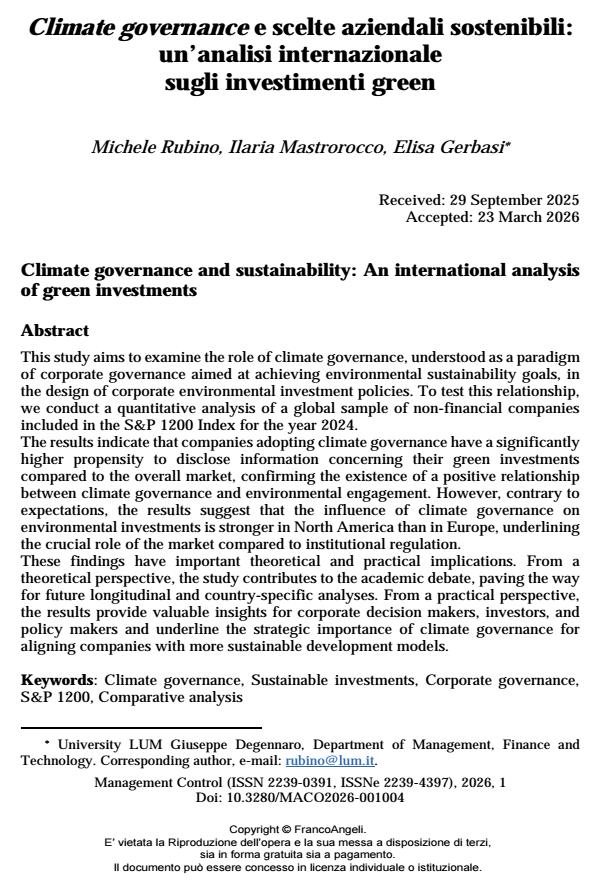
This study aims to examine the role of climate governance, understood as a paradigm of corporate governance aimed at achieving environmental sustainability goals, in the design of corporate environmental investment policies. To test this relationship, we conduct a quantitative analysis of a global sample of non-financial companies included in the S&P 1200 Index for the year 2024. The results indicate that companies adopting climate governance have a significantly higher propensity to disclose information concerning their green investments compared to the overall market, confirming the existence of a positive relationship between climate governance and environmental engagement. However, contrary to expectations, the results suggest that the influence of climate governance on environmental investments is stronger in North America than in Europe, underlining the crucial role of the market compared to institutional regulation. These findings have important theoretical and practical implications. From a theoretical perspective, the study contributes to the academic debate, paving the way for future longitudinal and country-specific analyses. From a practical perspective, the results provide valuable insights for corporate decision makers, investors, and policy makers and underline the strategic importance of climate governance for aligning companies with more sustainable development models.
Keywords: Climate governance, Sustainable investments, Corporate governance, S&P 1200, Comparative analysis
- Aguilera, R. V., Jackson, G. (2003), The cross-national diversity of corporate governance: Dimensions and determinants, Academy of management Review, 28(3), 447-465.
- Akhanolu, I. A., Benjamin, E., Adebayo, M., Bolanle, A. B., Bunmi-Alo, A. (2023), Carbon disclosure, board climate governance and financial performance of listed manufacturing firms in Nigeria, International Journal of Energy Economics and Policy, 13(4), 187-193.
- Alam, S. M., Costa, E. (2024), Conceptualising climate change governance and disclosure to enhance sustainability reporting, in Research Handbook on Sustainability Reporting, pp. 309-322. Doi. 10.4337/9781035316267.00028.
- Alam, M. M., Mohamad Tahir, Y., YH Saif-Alyousfi, A., Pahlevi, R. W. (2024), Climate change-induced firms’ initiatives and investors’ perceptions: evidence from Bursa Malaysia, Sustainability Accounting, Management and Policy Journal, 15(1), 232-261. DOI: 10.1108/SAMPJ-08-2021-0344
- Albitar, K., Al-Shaer, H., Liu, Y.S. (2023), Corporate commitment to climate change: the effect of eco-innovation and climate governance, Research Policy, 52(2), 1-17.
- Alessi, L., Cojoianu, T., Hoepner, A. G., Michelon, G. (2024), Accounting for the EU Geen Taxonomy: exploring its concept, data and analytics, Accounting Forum, 48 (3), 365-373. DOI: 10.1080/01559982.2024.2369343
- Al-Kubaisi, M. K., Abu Khalaf, B. (2025), Climate governance, ESG reporting, and the firm performance: does it matter more for Europe or the GCC?, Sustainability, 17(9), 1-21.
- Amran, A., Ooi, S. K., Wong, C. Y., Hashim, F. (2016), Business strategy for climate change: An ASEAN perspective, Corporate Social Responsibility and Environmental Management, 23(4), 213-227.
- Antonini, C., Gomez-Conde, J. (2024), Environmental management control systems and environmental innovation: Unintended consequences of the EU non-financial reporting directive, Management Accounting Research, 65, 1-18.
- Arena, C., Rubino, F., Veltri, S. (2025), Eco innovation disclosure in Italian firms: A content analysis approach, Management Control, 1, 39-58. DOI: 10.3280/MACO2025-001003
- Azevedo, G., Oliveira, J., Sousa, I., Borges, M. F., Tavares, M. C., Vale, J. (2025), Disclosure of Sustainability Information Under the Corporate Social Responsibility Directive: The Degree of Compliance of Portuguese Stock Index Companies. International Journal of Financial Studies, 13(1), 1-24.
- Bäckstrand, K., Kuyper, J.W., Linnér, B.O., Lövbrand, E. (2017), Non-state actors in global climate governance: from Copenhagen to Paris and beyond, Environmental Politics, 26(4), 561-579. DOI: 10.1080/09644016.2017.1327485
- Bedi, A., Sing, B. (2024), Climate governance and carbon emission disclosure, Social Responsibility Journal, 20(7), 1398-1412. DOI: 10.1108/SRJ-08-2023-0454
- Bernini, F., La Rosa, F. (2024), Research in the greenwashing field: concepts, theories, and potential impacts on economic and social value. Journal of Management and Governance, 28, 405-444.
- Berrone, P., Fosfuri, A., Gelabert, L., Gomez-Mejia, L.R. (2013), Necessity as the mother of ‘green’ inventions: Institutional pressures and environmental innovations, Strategic Management Journal, 34(8), 891-909.
- Berrone, P., Gelabert, L., Fosfuri, A., Gómez-Mejía, L.R. (2008), Can Institutional Forces Create Competitive Advantage? An Empirical Examination of Environmental Innovation, Academy of Management Proceedings, (1), 1-6.
- Breijer, R., Orij, R.P. (2022), The comparability of non-financial information: An exploration of the impact of the non-financial reporting directive (NFRD, 2014/95/EU), Accounting in Europe, 19(2), 332-361. DOI: 10.1080/17449480.2022.2065645
- Bui, B., Houqe, M.N., Zaman, M. (2020), Climate governance effects on carbon disclosure and performance, The British Accounting Review, 52(2), 1-16.
- Cantele, S., Valcozzena, S., Campedelli, B., de’Stefani, C., De Luca, M. (2024), The interaction of sustainability governance structure and sustainability management control systems: An Italian case study, Management Control, 2, 53-74. DOI: 10.3280/MACO2024-002-S1-004
- Charnock, R., Hoskin, K. (2020), SDG13 and the entwining of climate and sustainability metagovernance: an archaeological-genealogical analysis of goals-based climate governance, Accounting, Auditing & Accountability Journal, 33(7), 1731-1759. DOI: 10.1108/AAAJ-12-2018-3790
- Christensen, H.B., Hail, L., Leuz, C. (2021), Mandatory CSR and sustainability reporting: economic analysis and literature review, Review of Accounting Studies, 26, 1176-1248.
- Chung, J., Michaels, D. (2019), ESG funds draw SEC scrutiny, Wall Street Journal, 16.
- Commissione Europea (2020), A European Green Deal – Striving to be the first climate-neutral continent, -- disponibile su: https://commission.europa.eu/strategy-and-policy/priorities-2019-2024/european-green-deal_en.
- Cosma, S., Principale, S., Venturelli, A. (2022), Sustainable governance and climate-change disclosure in European banking: the role of the corporate social responsibility committee, Corporate Governance, 22(6), 1345-1369. DOI: 10.1108/CG-09-2021-0331
- Dahlmann, F., Branicki, L., Brammer, S. (2019), Managing Carbon Aspirations: The Influence of Corporate Climate Change Targets on Environmental Performance, Journal of Business Ethics, 158, 1-24.
- Dal Maso, L., Mazzi, F., Soscia, M., Terzani, S. (2018), The moderating role of stakeholder management and societal characteristics in the relationship between corporate environmental and financial performance, Journal of Environmental Management, 218, 322-332.
- Damert, M., Baumgartner, R. J. (2018), External pressures or internal governance – what determines the extent of corporate responses to climate change?, Corporate social responsibility and environmental management, 25(4), 473-488.
- Delmas, M., Toffel, M.W. (2004), Stakeholders and environmental management practices: an institutional framework, Business Strategy and the Environment, 13(4), 209-222.
- Dilling, P.F., Harris, P., Caykoylu, S. (2024), The impact of corporate characteristics on climate governance disclosure, Sustainability, 16(5), 1-31.
- Esposito, P., Doronzo, E., Riso, V., Tufo, M. (2025), Sustainability in Energy Companies Under the Lens of Cultural Pressures: When Do We Talk of Greenwashing?, Corporate Social Responsibility Environmental Management, 32, 3814-3831.
- Farooq, M., Muhammad, H. (2025), Climate governance and sustainability reporting, Corporate Social Responsibility and Environmental Management, 1-16.
- Fiandrino, S., Devalle, A., Cantino, V. (2019), Corporate governance and financial performance for engaging socially and environmentally responsible practices, Social Responsibility Journal, 15(2), 171-185. DOI: 10.1108/SRJ-12-2017-0276
- Freeman, R.E. (1984), Strategic Management: A Stakeholder Approach, Boston: Pitman.
- Frias-Aceituno, J.V., Rodríguez-Ariza, L., Garcia-Sánchez, I.M. (2014), Explanatory factors of integrated sustainability and financial reporting, Business Strategy and the Environment, 23(1), 56-72.
- Fu, H., Jiang, Q., Cifuentes-Faura, J., Chen, Q. (2025), Corporate environmental governance and firm value: beyond greenwashing for sustainable development, Environment, Development and Sustainability, 27, 21383-21400.
- García-Sánchez, I.M., Aibar-Guzmán, B., Raimo, N., Vitolla, F., Schiuma, G. (2024), Climate governance, growth opportunities, and innovation in addressing climate change: Empirical evidence from emerging countries, Finance Research Letters, 70, 1-12.
- García-Sánchez, I.M., Monteiro, S., Piñeiro-Chousa, J.R., Aibar-Guzmán, B. (2023), Climate change innovation: Does board gender diversity matter?, Journal of Innovation & Knowledge, 8(3), 1-14.
- Gebhardt, M., Schneider, A., Siedler, F., Ottenstein, P., Zülch, H. (2024), Climate reporting in the fast lane? The impact of corporate governance on the disclosure of climate-related risks and opportunities, Business Strategy and the Environment, 33(7), 7253-7272.
- Ghitti, M., Gianfrate, G., Palma, L. (2024), The agency of greenwashing, Journal of Management and Governance, 28, 905-941.
- Grewal, J., Serafeim, G., Yoon, A. (2016), Shareholder activism on sustainability issues, -- disponibile su SSRN, pp. 1-56.
- Gupta, A. (2008), Transparency under scrutiny: Information disclosure in global environmental governance, Global Environmental Politics, 8(2), 1-7.
- Gupta, A., Mason, M. (2016), Disclosing or obscuring? The politics of transparency in global climate governance, Current Opinion in Environmental Sustainability, 18, 82-90.
- Gyönyörová, L., Stachon, M., Stašek, D. (2021), ESG ratings: Relevant information or misleading clue? Evidence from the S&P Global 1200, Journal of Sustainable Finance & Investment, 13(2), 1075-1109. DOI: 10.1080/20430795.2021.1922062
- Hamim, M.T., Mollah, S. (2025), Corporate climate risk governance and environmental innovation, Business Strategy and the Environment, 34, 7112-7138.
- Hart, S.L. (1995), A natural-resource-based view of the firm, Academy of Management Review, 20(4), 986-1014.
- Held, D., Roger, C. (2018), Three models of global climate governance: From Kyoto to Paris and beyond, Global Policy, 9(4), 527-536. DOI: 10.1111/1758-5899.12617
- Hummel, K., Jobst, D. (2024), An overview of corporate sustainability reporting legislation in the European Union, Accounting in Europe, 21(3), 320-355. DOI: 10.1080/17449480.2024.2312145
- Ilhan, E., Krueger, P., Sautner, Z., Starks, L.T. (2023), Climate risk disclosure and institutional investors, The Review of Financial Studies, 36(7), 2617-2650.
- Jaaffar, A. H., Amran, A., Rajadurai, J. (2018), The impact of institutional pressures of climate change concerns on corporate environmental reporting practices: a descriptive study of Malaysia’s environmentally sensitive public listed companies, Sage Open, 8(2), 1-10. DOI: 10.1177/2158244018774839
- Krueger, P., Sautner, Z., Starks, L. T. (2020), The importance of climate risks for institutional investors, The Review of financial studies, 33(3), 1067-1111.
- Liesen, A., Hoepner, A.G., Patten, D.M., Figge, F. (2015), Does stakeholder pressure influence corporate GHG emissions reporting? Empirical evidence from Europe, Accounting, Auditing & Accountability Journal, 28(7), 1047-1074. DOI: 10.1108/AAAJ-12-2013-1547
- Liêu, M.L., Dao, T., Nguyen, T.H., Trinh, V.Q. (2024), Climate governance and carbon risk in the global energy sector: Insights into corporate environmental initiatives, Energy Economics, 137, 1-17.
- Luo, L., Tang, Q. (2023), The real effects of ESG reporting and GRI standards on carbon mitigation: International evidence, Business Strategy and the Environment, 32(6), 2985-3000.
- Mahajan, A., Majumdar, K. (2022), Environmental policy stringency and comparative advantage of environmental sensitive goods: a study of textile exports in G20 countries, Benchmarking: An International Journal, 29(9), 2924-2951. DOI: 10.1108/BIJ-06-2021-0304
- Mastrorocco, I., Rubino, M., Albergo, F., Gagliardi, A.R. (2025), Do environmental policies affect company financial performance? Evidence from the pharmaceutical and biotechnology industries, Measuring Business Excellence, 1-18. DOI: 10.1108/MBE-01-2025-0010
- Mayer, C., Zingales, L., Bolton, P., L’Helias, S., Holström, B., Polman, P., Gartenberg, C., Flammer, C., Henderson, R., Gual, J., Kingsmill, B.D., Maetzu, J., Viñals, J., Canals, J., Becht, M. (2021), IESE ECGI Conference on Corporate Purpose: Can Purpose Deliver Better Corporate Governance?, Journal of Applied Corporate Finance, 33(2), 41-49.
- Merikas, A., Merikas, A., Vozikis, G. S. (2003), “Mimickers” Of Corporate Insiders And Testing For Market Efficiency: The Case Of Greece, Journal of Applied Business Research (JABR), 19(3), 1-6.
- Michalisin, M., Stinchfield, B. (2010), Climate change strategies and firm performance: An empirical investigation of the natural resource-based view of the firm, Journal of Business Strategies, 27(2), 123-149.
- Mishra, G., Patro, A., Tiwari, A.K. (2024), Does climate governance moderate the relationship between ESG reporting and firm value? Empirical evidence from India, International Review of Economics and Finance, 91, 920-941.
- Moussa, T., Allam, A., Elbanna, S., Bani-Mustafa, A. (2020), Can board environmental orientation improve US firms’ carbon performance? The mediating role of carbon strategy, Business Strategy and the Environment, 29(1), 72-86.
- Myers, R.H. (1990), Classical and Modern Regression with Applications, 2nd ed., Duxbury Press.
- Netti, A., Intenza, M., Favino, C., Saraò, C.P. (2025), How Stakeholder Engagement Drives Environmental Innovation to Mitigate Climate Change: Evidence From European Small Caps, Business Strategy and the Environment, 1-22.
- Nicolò, G., Zampone, G., Sannino, G., Tiron-Tudor, A. (2023), Worldwide evidence of corporate governance influence on ESG disclosure in the utilities sector, Utilities Policy, 82, 1-14.
- Perina, D., Stachezzini, R. (2024), The adoption of the “EU Taxonomy”: Critical reporting and auditing challenges, Financial Reporting, 2, 193-203. DOI: 10.3280/FR2024-002008
- Qian, W., Schaltegger, S. (2017), Revisiting carbon disclosure and performance: Legitimacy and management views, The British Accounting Review, 49(4), 365-379.
- Rodrigue, M., Magnan, M., Cho, C. H. (2013), Is environmental governance substantive or symbolic? An empirical investigation, Journal of Business Ethics, 114(1), 107-129.
- Rubino, M., Mastrorocco, I., Gerbasi, E. (2024), Exploring influences on child labour disclosure: the role of sustainability policies and stakeholder engagement, Measuring Business Excellence, 1-16. DOI: 10.1108/MBE-07-2024-0108
- Rubino, M., Mastrorocco, I., Gerbasi, E. (2025), Driving the adoption of circular economy strategies: the role of diversity, inclusion and international standards in the European context, Equality, Diversity and Inclusion: An International Journal, 1-21. DOI: 10.1108/EDI-01-2025-0043
- Sikora, A. (2021), European Green Deal – legal and financial challenges of the climate change, ERA Forum, 21(4), 681-697.
- Stranadko, N. (2022), Global climate governance: rising trend of translateral cooperation, International Environmental Agreements: Politics, Law and Economics, 22, 639-657.
- Suchman, M.C. (1995), Managing legitimacy: Strategic and institutional approaches, Academy of Management Review, 20(3), 571-610. DOI: 10.2307/258788
- Tingbani, I., Chithambo, L., Tauringana, V., Papanikolaou, N. (2020), Board gender diversity, environmental committee and greenhouse gas voluntary disclosures, Business Strategy and the Environment, 29(6), 2194-2210.
- Tobón-Orozco, D., Pla-Barber, J., Alegre, J. (2025), Between substance and symbolism: how resources and organizational facades interact in voluntary climate commitments, Business Strategy and the Environment, 34(7), 9154-9168.
- Unione Europea (2022), Directive (EU) 2022/2464 of the European Parliament and of the Council of 14 December 2022 amending Regulation (EU) No 537/2014, Directive 2004/109/EC, Directive 2006/43/EC and Directive 2013/34/EU, as regards corporate sustainability reporting, Official Journal of the European Union, L 322, 15-60.
- Velte, P. (2022), Meta-analyses on Corporate Social Responsibility (CSR): a literature review, Management Review Quarterly, 72, 627-675.
- Villiers, C. (2022), New directions in the European Union’s regulatory framework for corporate reporting, due diligence and accountability: The challenge of complexity, European Journal of Risk Regulation, 13(4), 548-566.
- Wang, D., Dou, W. (2023), Research on the synergy mechanism of multiple subjects in global climate governance: Based on the perspective of the evolutionary game of carbon neutral strategy between China, the US, and the EU, Journal of Cleaner Production, 419, 1-16.
- Whitley, R. (1999), Divergent capitalisms: The social structuring and change of business systems, Oxford University Press.
- Widarwati, E., Rohmah, N.N., Wityasminingsih, E., Nurmalasari, N., Apriandi, D.W., Sopiawadi, M. (2024), Green investment and firm value: Does corporate governance matter?, Journal of Accounting and Investment, 25(3), 1156-1174.
- Zhang, B., Bi, J., Yuan, Z., Ge, J., Liu, B., Bu, M. (2008), Why do firms engage in environmental management? An empirical study in China, Journal of Cleaner Production, 16(10), 1036-1045.
- Zhang, Y., Chao, Q., Chen, Y., Zhang, J., Wang, M., Zhang, Y., Yu, X. (2021), China’s carbon neutrality: Leading global climate governance and green transformation, Chinese Journal of Urban and Environmental Studies, 9(3), 1-22. DOI: 10.1142/S23457481215
Michele Rubino, Ilaria Mastrorocco, Elisa Gerbasi, Climate governance e scelte aziendali sostenibili: un’analisi internazionale sugli investimenti green in "MANAGEMENT CONTROL" 1/2026, pp 67-88, DOI: 10.3280/MACO2026-001004