Non-Financial Reporting and the Internal Perspective in Social Economy Organisations
Journal title MANAGEMENT CONTROL
Author/s Laura Berardi, Maria Lucia Monaco, Piero Stanchi
Publishing Year 2026 Issue 2026/1
Language Italian Pages 27 P. 89-115 File size 157 KB
DOI 10.3280/MACO2026-001005
DOI is like a bar code for intellectual property: to have more infomation
click here
Below, you can see the article first page
If you want to buy this article in PDF format, you can do it, following the instructions to buy download credits
FrancoAngeli is member of Publishers International Linking Association, Inc (PILA), a not-for-profit association which run the CrossRef service enabling links to and from online scholarly content.
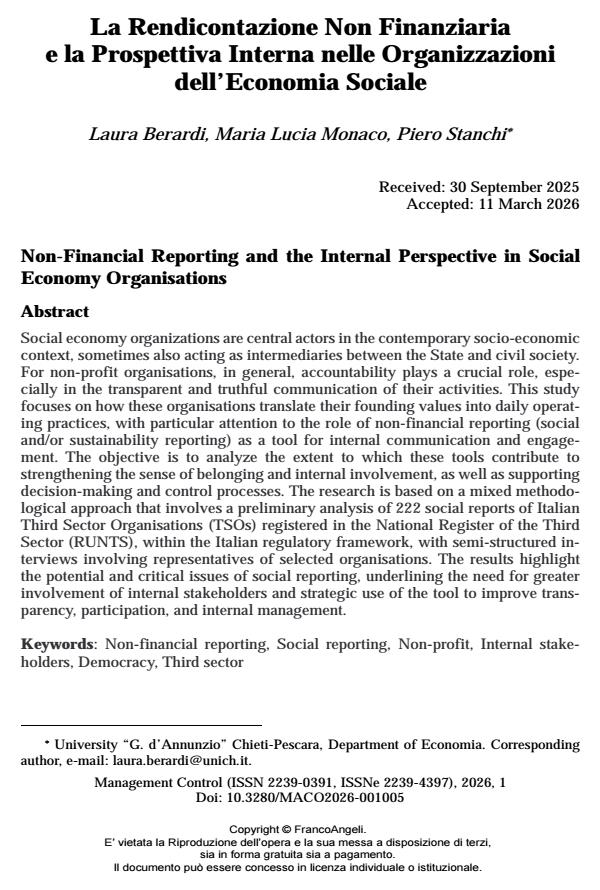
Social economy organizations are central actors in the contemporary socio-economic context, sometimes also acting as intermediaries between the State and civil society. For non-profit organisations, in general, accountability plays a crucial role, especially in the transparent and truthful communication of their activities. This study focuses on how these organisations translate their founding values into daily operating practices, with particular attention to the role of non-financial reporting (social and/or sustainability reporting) as a tool for internal communication and engagement. The objective is to analyze the extent to which these tools contribute to strengthening the sense of belonging and internal involvement, as well as supporting decision-making and control processes. The research is based on a mixed methodological approach that involves a preliminary analysis of 222 social reports of Italian Third Sector Organisations (TSOs) registered in the National Register of the Third Sector (RUNTS), within the Italian regulatory framework, with semi-structured interviews involving representatives of selected organisations. The results highlight the potential and critical issues of social reporting, underlining the need for greater involvement of internal stakeholders and strategic use of the tool to improve transparency, participation, and internal management.
Keywords: Non-financial reporting, Social reporting, Non-profit, Internal stakeholders, Democracy, Third sector
- Bagnoli, L., Chimirri, C., Nitti, C., Bellucci, M. (2019), Rendicontare l’impatto sociale: metodologie, indicatori e tre casi di sperimentazione in Toscana, Management Control, 3, 166-187. DOI: 10.3280/MACO2019-003009
- Bazeley, P. (2020), Qualitative data analysis: Practical strategies (2nd ed.), London: SAGE Publications.
- Bekkers, R., Chapman, C.M., Prosser, A., Wiepking, P., Meyer, M. (2025), Let us be Clear: Why and how to Demonstrate data and Methods Transparency in Nonprofit Research, VOLUNTAS: International Journal of Voluntary and Nonprofit Organizations, 1-10.
- Berardi, L., Rea, M.A., Mook, L. (2021), Third sector accounting reform and integrated social accounting for Italian social economy organizations, Management Control, Special issue 2, 165-188. DOI: 10.3280/MACO2021-002-S1008
- Bergfeld, A., Plagmann, C., Lutz, E. (2021), Know your counterparts: The importance of wording for stakeholder communication in social franchise enterprises, VOLUNTAS: International Journal of Voluntary and Nonprofit Organizations, 32(1), 104-119.
- Borzaga, C., Fazzi, L., Galera, G. (2016), Social enterprise as a bottom-up dynamic: part 1. The reaction of civil society to unmet social needs in Italy, Sweden and Japan, International Review of Sociology, 26(1), 1-18. DOI: 10.1080/03906701.2016.1148332
- Braun, V., Clarke, V. (2021), Thematic analysis: A practical guide, London: SAGE Publications.
- Broccardo, L., Mauro, S.G. (2024), The path towards sustainability: The role of internal stakeholders and management accounting in a dialogic perspective, Corporate Social Responsibility and Environmental Management, 31(3), 2496-2513.
- Calvo, N., Calvo, F. (2018), Corporate social responsibility and multiple agency theory: A case study of internal stakeholder engagement, Corporate Social Responsibility and Environmental Management, 25(6), 1223-1230.
- Canestrino, R., Cwiklicki, M., Magliocca, P., Pawelek, B. (2020), Understanding social entrepreneurship: A cultural perspective in business research, Journal of Business Research, 110, 132-143.
- Collier, P.M. (2008), Stakeholder accountability: A field study of the implementation of a governance improvement plan, Accounting, Auditing & Accountability Journal, 21(7), 933-954. DOI: 10.1108/09513570810907429
- Cornforth, C. (2004), The governance of cooperatives and mutual associations: A paradox perspective, Annals of Public and Cooperative Economics, 75(1), 11-32.
- Costa, E., Ramus, T., Andreaus, M. (2011), Accountability as a managerial tool in non-profit organizations: Evidence from Italian CSVs. VOLUNTAS: International Journal of Voluntary and Nonprofit Organizations, 22(3), 470-493.
- Costa, E., Goulart da Silva, G. (2019), Nonprofit accountability: The viewpoint of the primary stakeholders, Financial Accountability & Management, 35(1), 37-54.
- Coule, T.M. (2015), Nonprofit governance and accountability: Broadening the theoretical perspective, Nonprofit and Voluntary Sector Quarterly, 44(1), 75-97. DOI: 10.1177/0899764013503906
- Berardi, L., Stanchi, P., Monaco M.L.M. (2025), La rendicontazione sociale degli ETS abruzzesi, in Rea, M.A. (a cura di), Osservatorio sulla Rendicontazione di Sostenibilità delle Aziende abruzzesi (ORSA) - Rapporto 2025, Dipartimento di Economia - Università degli Studi “G. d’Annunzio” di Chieti-Pescara, Pescara, 2025.
- D’Onza, G., Greco, G. (2020), Dal controllo alla creazione del valore, Management Control: 2, 5-9. DOI: 10.3280/MACO2020-002001
- Ebrahim, A. (2003), Accountability in practice: Mechanisms for NGOs, World Development, 31(5), 813-829. DOI: 10.1016/S0305-750X(03)00014-7
- Esposito, P., Marrone, A., Pontrelli, V., Rella, A. (2025), Exploring drivers and factors of benefit impact reports quality: Retracing a stakeholder theory approach, Business Strategy and the Environment, 34(1), 555-569.
- Evers, A., Laville, J.L. (2004), Defining the third sector in Europe, in A. Evers, J.L. Laville (eds.), The third sector in Europe, pp. 11-42, Cheltenham, UK: Edward Elgar Publishing.
- Ferrero-Ferrero, I., Fernández-Izquierdo, M.Á., Muñoz-Torres, M.J., Bellés-Colomer, L. (2018), Stakeholder engagement in sustainability reporting in higher education: An analysis of key internal stakeholders’ expectations, International Journal of Sustainability in Higher Education, 19(2), 313-336. DOI: 10.1108/IJSHE-06-2016-0116
- Fici, A. (2018), La nuova disciplina dell’impresa sociale nella prospettiva dei suoi diversi stakeholder, Rivista Impresa Sociale, 11, 7-14. DOI: 10.7425/IS.2018.11.03
- Freeman, R.E. (1984), Strategic management: A stakeholder approach, Boston: Pitman.
- Freeman, R.E., Harrison, J., Wicks, A. (2007), Managing for stakeholders. Survival, reputation, and success, London, England: Yale University Press. DOI: 10.12987/9780300138498
- Freudenreich, B., Lüdeke-Freund, F., Schaltegger, S. (2020), A stakeholder theory perspective on business models: Value creation for sustainability, Journal of Business Ethics, 166(1), 3-18.
- GBS – Gruppo di Studio per il Bilancio Sociale (2020), Rendicontazione sociale nel nonprofit e riforma del Terzo settore: Documenti di ricerca n. 17. Milano: FrancoAngeli. -- https://gruppobilancisostenibilita.org/media/gbsupload/602-99Z_Book-Manuscript-3465-1-10-20201120.pdf.
- Gilchrist, D.J., West, A., Zhang, Y. (2023), Barriers to the usefulness of non-profit financial statements: Perspectives from key internal stakeholders, Australian Accounting Review, 33(2), 188-202.
- Gilstrap, C.A., Gilstrap, C.M., Holderby, K.N., Valera, K.M. (2016), Sensegiving, leadership, and nonprofit crises: How nonprofit leaders make and give sense to organizational crisis, VOLUNTAS: International Journal of Voluntary and Nonprofit Organizations, 27, 2787-2806.
- Goddard, A., Juma Assad, M. (2006), Accounting and navigating legitimacy in Tanzanian NGOs, Accounting, Auditing & Accountability Journal, 19(3), 377-404. DOI: 10.1108/09513570610670343
- Gray, R., Bebbington, J., Collison, D. (2006), NGOs, civil society and accountability: making the people accountable to capital, Accounting, Auditing & Accountability Journal, 19(3), 319-348. DOI: 10.1108/09513570610670325
- Guthrie, J., Petty, R., Yongvanich, K., Ricceri, F. (2004), Using content analysis as a research method to inquire into intellectual capital reporting, Journal of intellectual capital, 5(2), 282-293. DOI: 10.1108/14691930410533704
- Harrison, J.S., Bosse, D.A., Phillips, R.A. (2010), Managing for stakeholders, stakeholder utility functions, and competitive advantage, Strategic Management Journal, 31(1), 58-74. DOI: 10.2307/27735509
- Kassier, L. (2024), Identifying transitions in corporate sustainability reporting: a content analysis of JSE/FTSE multinational sustainability reports from 2016 to 2021, International Journal of Corporate Social Responsibility, 9(1), 12.
- Khan, M., Lockhart, J., Bathurst, R. (2018), Content analysis of corporate social responsibility disclosures: an assessment of approaches, in Proceedings of the 32nd Australian and New Zealand Academy of Management Conference, Auckland, pp. 4-7.
- Krippendorff, K. (2018), Content Analysis: An Introduction to Its Methodology, 4th ed., Thousand Oaks: Sage.
- López-Arceiz, F. J., Bellostas, A. J. (2020), Nonprofit governance and outside corruption: The role of accountability, stakeholder participation, and management systems, Nonprofit Management and Leadership, 31(2), 311-333.
- Manetti, G., Toccafondi, S. (2014), Defining the content of sustainability reports in nonprofit organizations: do stakeholders really matter?, Journal of Nonprofit & Public Sector Marketing, 26(1), 35-61. DOI: 10.1080/10495142.2013.857498
- Marchi, L. (2011), L’evoluzione del controllo di gestione nella prospettiva informativa e gestionale esterna, Management Control, 3, 5-16. DOI: 10.3280/MACO2011-003001
- Marchi, L. (2020), Dalla crisi allo sviluppo sostenibile: il ruolo dei sistemi di misurazione e controllo. Management Control, 3, pp. 5-16. DOI: 10.3280/MACO2020-003001
- Marrone, A., Oliva, L., Pontrelli, V., Rella, A. (2024), L’impatto delle caratteristiche del Consiglio di Amministrazione sulla disclosure del beneficio comune: un’analisi empirica nelle aziende benefit, Management Control, 2. DOI: 10.3280/MACO2024-002003
- Marrone, A., Pontrelli, V., Oliva, L. (2023), Boards of directors and high-tech sectors affect ESG disclosure quality: an empirical analysis of global firms, International Journal of Business and Management, 18(6), 97.
- Marrone, A., Pontrelli, V., Oliva, L. (2025), Diversity, Equity, and Inclusion in Environmental Social and Governance Disclosure: An Empirical Analysis of Governance Determinants, in Agostini, M., Beretta, V., Demartini, M. C., Ghio, A., Trucco, S. (eds.), Diversity and Equity in Accounting: Emerging Issues, Challenges and opportunities, Cham: Springer Nature Switzerland, pp. 83-95.
- Matacena, A. (2017), Le cooperative imprese “Altere”: Mission, governance e accountability, Milano: FrancoAngeli.
- Mitchell, R.K., Agle, B.R., Wood, D.J. (1997), Toward a theory of stakeholder identification and salience: Defining the principle of who and what really counts, Academy of Management Review, 22(4), 853-886. DOI: 10.2307/259247
- O’Dwyer, B. (2004), Stakeholder democracy: Challenges and contributions from social accounting, Business Ethics: A European Review, 14(1), 28-41.
- Paulus, T., Lester, J.N. & Dempster, P.G. (2014), Digital Tools for Qualitative Research, London: Sage. DOI: 10.4135/9781473957671
- Pilon, M., Brouard, F. (2023), Accountability theory in nonprofit research: Using governance theories to categorize dichotomies, VOLUNTAS: International Journal of Voluntary and Nonprofit Organizations, 34(3), 585-599.
- Pontrelli, V., Rella, A., Oliva, L., Marrone, A. (2025), Governing for sustainability: board characteristics and SDG disclosure level in Italian benefit corporations, Measuring Business Excellence. DOI: 10.1108/MBE-09-2024-0144
- Rea, M.A., Berardi, L. (2020), La riforma dell’economia sociale in Italia. Brevi riflessioni in una prospettiva economico-aziendale, in Aziende pubbliche e imprenditorialità sociale, Milano: FrancoAngeli, pp. 389-402.
- Ruhnke, K., Schmidt, M. (2016), Changing the institutional framework of statutory audit: Internal stakeholders’ perceptions of the associated benefit and costs, European Accounting Review, 25(1), 59-79. DOI: 10.1080/09638180.2014.939683
- Salamon, L.M., Anheier, H K. (1997), Defining the Nonprofit Sector: A Cross-national Analysis. Manchester University Press.
- Salamon, L.M., Sokolowski, S.W. (2016), Beyond nonprofits: Re-conceptualizing the third sector, VOLUNTAS: International Journal of voluntary and nonprofit organizations, 27, 1515-1545.
- Stocker, F., de Arruda, M.P., de Mascena, K.M., Boaventura, J.M. (2020), Stakeholder engagement in sustainability reporting: A classification model, Corporate Social Responsibility and Environmental Management, 27(5), 2071-2080.
- Stubbs, W., Higgins, C. (2014), Integrated reporting and internal mechanisms of change, Accounting, auditing & accountability journal, 27(7), 1068-1089. DOI: 10.1108/AAAJ-03-2013-1279
- Terzieva, B., Burkart, C., Maier, F., Meyer, M. (2024), Democracy and management: Organizational practices and nonprofits’ contributions to society, Nonprofit and Voluntary Sector Quarterly. DOI: 10.1177/08997640241267861
- Unerman, J., Guthrie, J. (2007), UK preparers’ perspectives on intellectual capital reporting media, Paper presented to the EAA Congress, Lisbon, 2007.
- Van Puyvelde, S., Caers, R., Du Bois, C., Jegers, M. (2012), The governance of nonprofit organizations: Integrating agency theory with stakeholder and stewardship theories, Nonprofit and voluntary sector quarterly, 41(3), 431-451. DOI: 10.1177/0899764011409757
- Wang, R. (2022), Organizational commitment in the nonprofit sector and the underlying impact of stakeholders and organizational support, VOLUNTAS: International Journal of Voluntary and Nonprofit Organizations, 33(3), 538-549.
- Woods, M., Paulus, T., Atkins, D.P., Macklin, R. (2016), Advancing qualitative research using qualitative data analysis software (QDAS), Social Science Computer Review, 34(5), 597-617.
- Yin, R.K. (2018), Case Study Research: Design and Methods, 5th ed., Thousand Oaks: Sage Publications.
Laura Berardi, Maria Lucia Monaco, Piero Stanchi, La Rendicontazione Non Finanziaria e la Prospettiva Interna nelle Organizzazioni dell’Economia Sociale in "MANAGEMENT CONTROL" 1/2026, pp 89-115, DOI: 10.3280/MACO2026-001005