Intergenerational solidarity and ambivalence in migration. A qualitative analysis of transnational relations and practices between Muslim grandchildren in Italy and grandparents at homeland

Journal title MONDI MIGRANTI
Author/s Martina Crescenti
Publishing Year 2026 Issue 2026/1
Language Italian Pages 20 P. 135-154 File size 218 KB
DOI 10.3280/MM2026-001007
DOI is like a bar code for intellectual property: to have more infomation click here

Below, you can see the article first page

If you want to buy this article in PDF format, you can do it, following the instructions to buy download credits
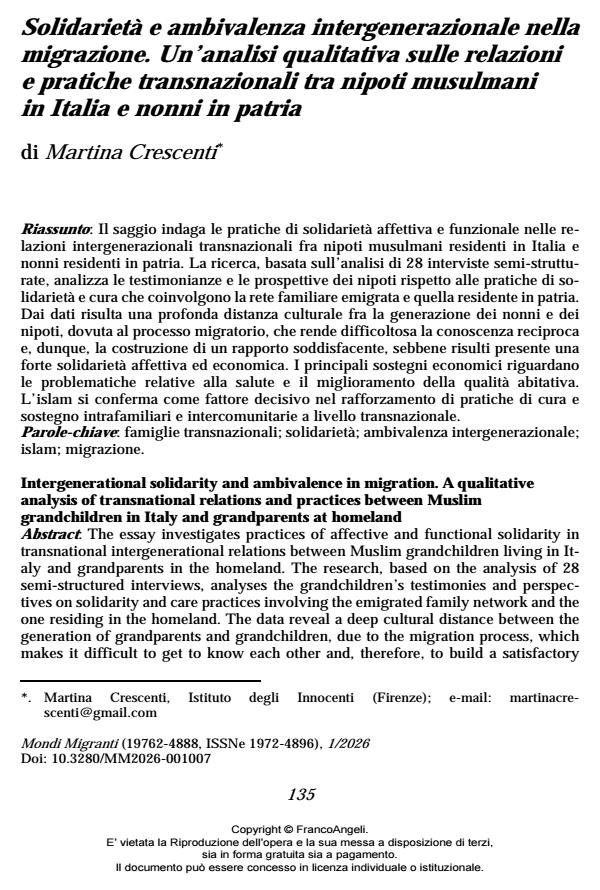
Article preview

FrancoAngeli is member of Publishers International Linking Association, Inc (PILA), a not-for-profit association which run the CrossRef service enabling links to and from online scholarly content.

The essay investigates practices of affective and functional solidarity in transnational intergenerational relations between Muslim grandchildren living in Italy and grandparents in the homeland. The research, based on the analysis of 28 semi-structured interviews, analyses the grandchildren’s testimonies and perspectives on solidarity and care practices involving the emigrated family network and the one residing in the homeland. The data reveal a deep cultural distance between the generation of grandparents and grandchildren, due to the migration process, which makes it difficult to get to know each other and, therefore, to build a satisfactory relationship, although a strong affective and economic solidarity is present. The main economic support mainly concerns health issues and the improvement of housing quality. Islam is confirmed as a decisive factor in the strengthening of intrafamilial and intercommunal care and support practices at the transnational level.

Keywords: transnational families; solidarity; intergenerational ambivalence; Islam; migration.

  1. Bonizzoni P. (2008). Catene d’oro, sangue e amore: famiglie migranti e vita economica tra dimensione locale e transnazionale. Mondi Migranti, 3: 1-24; DOI: 10.3280/MM2008-003003
  2. Acocella I. e Pepicelli R. (2015). Giovani musulmane in Italia. Percorsi biografici e pratiche quotidiane. Bologna: il Mulino.
  3. Ahaddour C., Van den Branden S. e Broeckaert B. (2018). “What goes around comes around”: Attitudes and practices regarding ageing and care for the elderly among Moroccan Muslim women living in Antwerp (Belgium). Journal of Religion and Health, 59, 2: 986-1012;
  4. Ambrosini M. (2007). Prospettive transnazionali. Un nuovo modo di pensare le migrazioni? Mondi Migranti, 2: 1-48; DOI: 10.1400/8114
  5. Ambrosini M. e Molina S., a cura di (2004). Seconde generazioni: un’introduzione al futuro dell’immigrazione in Italia. Torino: Edizioni della Fondazione Giovanni Agnelli.
  6. Antman F.M. (2013). The impact of migration on family left behind. In: Constant A. F. and Zimmermann K., a cura di, International Handbook on the Economics of Migration. Northampton: Edward Elgar Publishing.
  7. Baldassar L. e Merla L. (2014). Transnational Families, Migration and Circulation of Care. Understanding Mobility and Absence in Family Life. New York: Routledge.
  8. Barros C. (2023). Connection in Transnational Families. Face-to-Face and Digital Spaces in Portuguese Emigrants. Trends In Psychology, 1-20;
  9. Baym N.K. (2015). Personal connections in the digital age. Malden: Polity.
  10. Bengtson V.L. e Roberts R.E. (1991). Intergenerational solidarity in aging families: An example of formal theory construction. Journal of Marriage and the Family, 53, 4: 856-870; DOI: 10.2307/352993/
  11. Bengtson V. L., Roberts R.E. e Richards L.N. (1991). Intergenerational solidarity in families: untangling the ties that bind. Marriage & Family Review, 16, 1-2: 11-46;
  12. Bensaid B. e Grine F. (2014). Old age and elderly care: An Islamic perspective. Cultura, 11, 1: 141-163;
  13. Blumer H. (1954). What is Wrong with Social Theory? American Sociological Review, 19: 3-10.
  14. Boccagni P. (2009). Come fare le madri da lontano? Percorsi, aspettative e pratiche della maternità transnazionale dall’Italia. Mondi Migranti, 1:45-66; DOI: 10.3280/MM2009-001003
  15. Bonizzoni P. (2007). Famiglie transnazionali e ricongiunte: per un approfondimento nello studio delle famiglie migranti. Mondi Migranti, 2: 91-108.
  16. Bryceson D. e Vuorela U., a cura di (2020). The transnational family: New European frontiers and global networks. London: Routledge.
  17. Carling J. (2014). Scripting Remittances: Making Sense of Money Transfers in Transnational Relationships. International Migration Review, 48, 1: 218-262;
  18. Chun J. e Lee J. (2006). Intergenerational solidarity in Korean immigrant families. Journal of Intergenerational Relationships, 4, 2: 6-21.
  19. Cipriani R. (2002). Religione invisibile o religione diffusa in Italia? Studi Di Sociologia, 40, 3: 231-247; DOI: 10.2307/23004983
  20. Crescenti M. (2021). Giovani musulmani italiani: appartenenza religiosa, socializzazione e agenzie socializzative. Culture e Studi del Sociale, 6, 1: 35-50.
  21. Crespi I. e Crescenti M. (2020). Famiglie e migrazioni: percorsi, progetti e strategie. In: Crespi I. e Zanier M.L., Migrazioni, processi educativi e percorsi di cittadinanza: sfide per una società inclusiva. Milano: Mimesis.
  22. De Luca D. (2014). Transnazionalismo al femminile oltre i legami familiari. Mondi migranti, 2: 129-151; DOI: 10.3280/MM2014-002007
  23. Donati P. e Di Nicola P. (2004). Lineamenti di sociologia della famiglia. Roma: Carocci.
  24. Duflos M. e Giraudeau C. (2021). Using the intergenerational solidarity framework to understand the grandparent-grandchild relationship: a scoping review. European Journal of Ageing, 19, 2: 233-262;
  25. Even-Zohar A. e Sharlin S. (2009). Grandchildhood: Adult grandchildren’s perception of their role towards their grandparents from an intergenerational perspective. Journal of Comparative Family Studies, 40, 2: 167-185;
  26. Faist T. (2000). The volume and dynamics of international migration and transnational social spaces. Oxford: Oxford University Press.
  27. Floridi L. (2015). The onlife manifesto: Being human in a hyperconnected era. Cham: Springer.
  28. Frisina A. (2005). Musulmani e italiani, tra le altre cose. Tattiche e strategie identitarie di giovani figli di immigrati. In: Cesari J. e Pacini A., Giovani Musulmani in Europa. Torino: Edizioni della Fondazione Giovanni Agnelli.
  29. Goldring L. (2004). Family and collective remittances to Mexico: a multidimensional typology. Development and Change, 35, 4: 800-84;
  30. Guarnizo L.E. (2003). The economics of transnational living. International migration Review, 37, 3: 666-699;
  31. Heider F. (1958). The psychology of interpersonal relations. New York: John Wiley & Sons.
  32. Hochschild A.R. (2015). Global care chains and emotional surplus value. In: Hochschild A.R., a cura di, Justice, politics, and the family. London: Routledge.
  33. Homans G.C. (1950). The human group. San Diego: Harcourt.
  34. Lüscher K. e Hoff A. (2013). Intergenerational ambivalence: beyond solidarity and conflict. In: Albert I. e Ferring D., a cura di, Intergenerational relations: European perspectives in family and society. Bristol: Policy Press.
  35. Lüscher K. and Pillemer K. (1998). Intergenerational ambivalence: A new approach to the study of parent-child relations in later life. Journal of Marriage and the Family, 60, 2: 413-425; DOI: 10.2307/353858
  36. Madianou M. (2016). Ambient co-presence: transnational family practices in polymedia environments. Global networks, 16, 2: 183-201;
  37. Mantzaris E.A. (1988). Religion as a factor affecting the attitudes of South African Indians towards family solidarity and older persons. South African Journal of Sociology, 19, 3: 111-116; DOI: 10.1080/02580144.1988.10558383
  38. Merla L. (2014). La circulación de cuidados en las familias transnacionales. Revista CIDOB d’Afers Internacionals, 106-107: 85-104.
  39. Merla L., Kilkey M. e Baldassar L. (2020). Examining transnational care circulation trajectories within immobilizing regimes of migration: Implications for proximate care. Journal of Family Research, 32, 3: 514-536;
  40. Morgan D. (1996). Family Connections: An Introduction to Family Studies. Oxford-New York: Cambridge Polity.
  41. O’reilly K. (2015). Migration theories: A critical overview. In: Triandafyllidou, A., edited by, Routledge Handbook of Immigration and Refugee Studies. Abingdon, Oxford: Routledge.
  42. Pace E. (2004). Sociologia dell’islam. Roma: Carocci.
  43. Phillips D. (2009). Creating home spaces: young British Muslim women’s identity and conceptualisations of home. In: Hopkins P. and Gale R., a cura di, Muslims in Britain: Race, place and identities. Edinburgh: Edinburgh University Press.
  44. Piperno F. (2010). Dalla catena della cura al welfare globale: l’impatto delle migrazioni sui regimi di cura nei contesti di origine e le nuove sfide per una politica di co-sviluppo sociale. Mondi Migranti, 3: 47-61; DOI: 10.3280/MM2010-003004
  45. Portes A., a cura di (1995). The economic sociology of immigration: Essays on networks, ethnicity, and entrepreneurship. New York: Russell Sage Foundation.
  46. Turkle S. (1997). Life on Screen: Identity in the age of the Internet. New York: Simon & Schuster.
  47. Van Hook J. e Glick J.E. (2020). Spanning borders, cultures, and generations: A decade of research on immigrant families. Journal of Marriage and Family, 82, 1: 224-243;
  48. Vertovec S. (2009). Transnationalism. London: Routledge.
  49. Xu Y. e Harrison T.M. (2023). Socioemotional and behavioral problems of grandchildren raised by grandparents: the role of grandparent-grandchild relational closeness and conflict. Children, 10, 10: 16-23;

Martina Crescenti, Solidarietà e ambivalenza intergenerazionale nella migrazione. Un’analisi qualitativa sulle relazioni e pratiche transnazionali tra nipoti musulmani in Italia e nonni in patria in "MONDI MIGRANTI" 1/2026, pp 135-154, DOI: 10.3280/MM2026-001007