Two or three things sociology can do for One Health
Journal title SALUTE E SOCIETÀ
Author/s Antonio Maturo
Publishing Year 2026 Issue 2026/2
Language English Pages 14 P. 33-46 File size 349 KB
DOI 10.3280/SES2026-002004
DOI is like a bar code for intellectual property: to have more infomation
click here
Below, you can see the article first page
If you want to buy this article in PDF format, you can do it, following the instructions to buy download credits
FrancoAngeli is member of Publishers International Linking Association, Inc (PILA), a not-for-profit association which run the CrossRef service enabling links to and from online scholarly content.
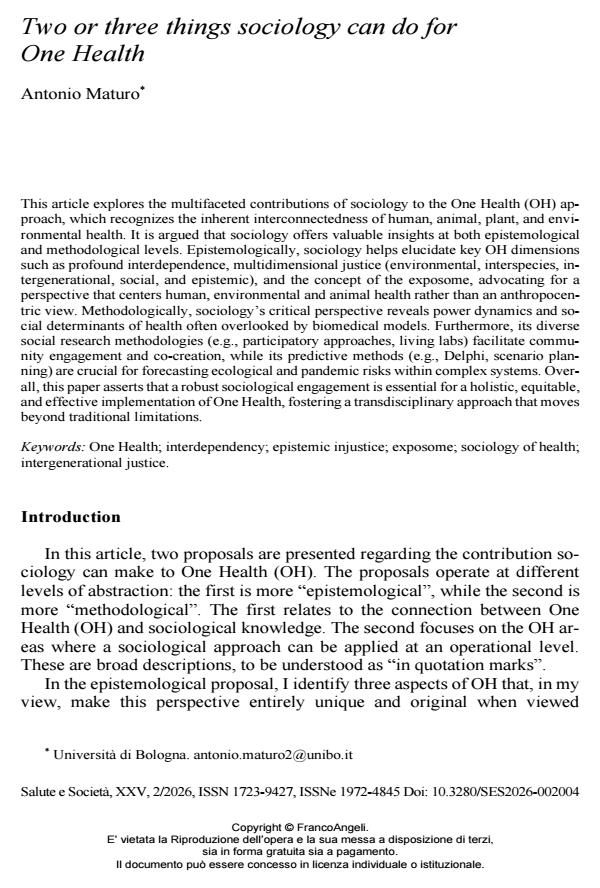
This article explores the multifaceted contributions of sociology to the One Health (OH) approach, which recognizes the inherent interconnectedness of human, animal, plant, and environmental health. It is argued that sociology offers valuable insights at both epistemological and methodological levels. Epistemologically, sociology helps elucidate key OH dimensions such as profound interdependence, multidimensional justice (environmental, interspecies, intergenerational, social, and epistemic), and the concept of the exposome, advocating for a perspective that centers human, environmental and animal health rather than an anthropocentric view. Methodologically, sociology's critical perspective reveals power dynamics and social determinants of health often overlooked by biomedical models. Furthermore, its diverse social research methodologies (e.g., participatory approaches, living labs) facilitate community engagement and co-creation, while its predictive methods (e.g., Delphi, scenario planning) are crucial for forecasting ecological and pandemic risks within complex systems. Overall, this paper asserts that a robust sociological engagement is essential for a holistic, equitable, and effective implementation of One Health, fostering a transdisciplinary approach that moves beyond traditional limitations.
Keywords: One health; Interdependency; Epistemic injustice; Exposome; Sociology oh Health; Intergenerational justice.
- Balduzzi G., Favretto A.R. (2023). Giving Meaning to Action and Research: Notes on the “One Health” Approach from a Sociological Perspective. Development, 66: 226232.
- European Union agencies (EU) (2026). Crossagency One Health task force framework for action. Available in pdf: https://www.ecdc.europa.eu/sites/default/files/documents/crossagencyonehealth.pdf (30/03/2026).
- FAO/UNEP/WHO/WOAH (2022). One Health Joint Plan of Action (2022–2026). Working together for the health of humans, animals, plants and the environment. DOI: 10.20506/9789295121430.(30/03/2026
- Traore T., Shanks S., Haider N. et al. (2023). How prepared is the world? Identifying weaknesses in existing assessment frameworks for global health security through a One Health approach. The Lancet, 401: 673687. DOI: 10.1016/S01406736(22)01589
- UN (2025). Progress towards the Sustainable Development Goals: report of the SecretaryGeneral. Available in pdf: https://digitallibrary.un.org/record/4082649 (30/03/2026).
- WHO (2023). A guide to implementing the One Health Joint Plan of Action at national level. Available in pdf: https://www.who.int/publications/i/item/9789240082069 (30/03/2026).
- Winkler A., Brux C., Carabin H. et al. (2025). The Lancet One Health Commission: harnessing our interconnectedness for equitable, sustainable, and healthy socioecological systems. The Lancet, 406: 501570. DOI: 10.1016/S01406736(25)00627
Antonio Maturo, Two or three things sociology can do for One Health in "SALUTE E SOCIETÀ" 2/2026, pp 33-46, DOI: 10.3280/SES2026-002004