Community development and health. Intertwining health promotion and prevention

Journal title PSICOLOGIA DI COMUNITA’
Author/s Norma De Piccoli, Alda Cosola
Publishing Year 2026 Issue 2024/2
Language Italian Pages 13 P. 56-68 File size 51 KB
DOI 10.3280/PSC2024-002005
DOI is like a bar code for intellectual property: to have more infomation click here

Below, you can see the article first page

If you want to buy this article in PDF format, you can do it, following the instructions to buy download credits
Article preview

FrancoAngeli is member of Publishers International Linking Association, Inc (PILA), a not-for-profit association which run the CrossRef service enabling links to and from online scholarly content.

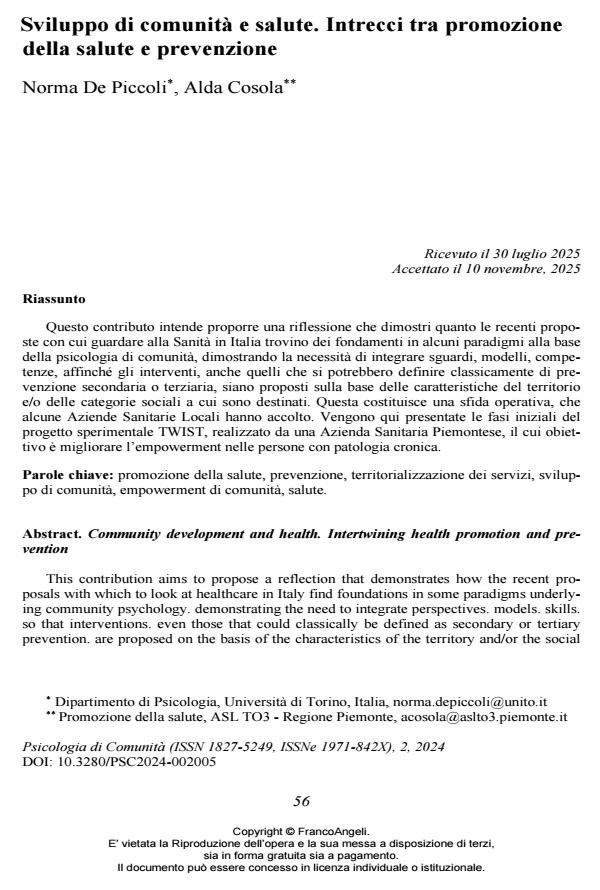
This contribution aims to propose a reflection that demonstrates how the recent proposals with which to look at healthcare in Italy find foundations in some paradigms underlying community psychology. demonstrating the need to integrate perspectives. models. skills. so that interventions. even those that could classically be defined as secondary or tertiary prevention. are proposed on the basis of the characteristics of the territory and/or the social categories for which they are intended. This constitutes an operational challenge. which some Local Health Authorities have accepted. The initial phases of the TWIST experimental project. carried out by a Piedmontese healthcare service. whose objective is to improve empowerment in people with chronic pathologies. are described here.

Keywords: health promotion, prevention, territorialization of services, community development, community empowerment, health.

  1. AGENAS [Agenzia Nazionale per i servizi sanitari regionali] (2022). Documento di indirizzo per il Metaprogetto della Casa di Comunità. Quaderno di Monitor, supplemento alla rivista semestrale.
  2. De Piccoli, N. & Gattino, S. (2020). Sviluppo di comunità per la promozione della salute. Psicologia di Comunità, 2, 5-11. DOI: 10.3280/PSC2020-002001
  3. De Piccoli, N. (a cura di) (2014). Salute e qualità della vita nella società del benessere. Carocci.
  4. Di Clemente, C. C., & Prochaska, J. O. (1982). Self change and therapy change of smoking behavior: A comparison of processes of change of cessation and maintenance. Addictive Behavior, 7, 133- 142. DOI: 10.1016/0306-4603(82)90038-7
  5. Dors (2022). Glenn Laverack commenta la Carta di Ginevra (OMS) sulle Società promotrici di benessere sostenibile. https://www.dors.it/2022/02/glenn-laverack-commenta-la-carta-di-ginevra-oms-sulle-societa-promotrici-di-benessere-sostenibile/
  6. European Social Network (n.d.). https://www.esn-eu.org/policy/integrated-community-care#
  7. Fetterman, D. M., & Wandersman, A. (2005). Empowerment Evaluation Principles in Practice. Guilford Press.
  8. Kaneklin, C. (2010). Il gruppo in teoria e in pratica. Cortina.
  9. Laverack, G. (2007). Health Promotion Practice. McGraw-Hill.
  10. Laverack, G. (2020). Salute pubblica. Potere, empowerment e pratica professionale. Il Pensiero Scientifico Editore.
  11. Lemma, P. (2006). Promuovere la salute nell’era della globalizzazione: una nuova sfida per “antiche” professioni. Unicopli.
  12. Martini, E. R., & Torti, A. (2003). Fare lavoro di comunità – Riferimenti teorici e strumenti operativi. Carocci.
  13. Migliardi, A., Zengarini, N., Gnavi, R. & Costa, G. (2024). Health Action Zone (HAZ) per le priorità di azione: uno strumento equitativo per il Piano regionale di prevenzione piemontese. Bollettino Epidemiologico Nazionale, 5(2), 1-7. DOI: 10.53225/BEN_086
  14. Ministero della Salute, Direzione Generale della Prevenzione Sanitaria – Ufficio 8. Documento di traduzione operativa dell’indicatore HEA nei Piani Regionali della Prevenzione.
  15. OMS [Organizzazione Mondiale della Sanità]. Carta di Ottawa. http://www.retehphitalia.it/ carta-di-ottawa-promozione-della-salute/
  16. Prochaska, J. O., & Di Clemente, C. C. (1982). Transtheoretical therapy: Toward a more integrative model of change. Psychotherapy: Theory, Research & Practice, 19(3), 276–288.
  17. Stanford Patient Education Research Center (1999). Chronic Disease Self-Management Leader’s Manual (Revised). Stanford University.
  18. Wagner, E. H. (2000). The role of patient care teams in chronic disease management. BMJ, 320, 569-72.
  19. Wagner, E. H., Austin, B. T., Davis, C., Hindmarsh, M., Schaefer, J., & Bonomi, A. (2001). Improving chronic illness care: translating evidence into action. Health affairs, 20(6), 64-78.
  20. Zani, B. (2007). La salute come bene comune relazionale: significati e strumenti per una psicologia della salute di comunità. Psicologia di Comunità, 1, 13-28.

Norma De Piccoli, Alda Cosola, Sviluppo di comunità e salute. Intrecci tra promozione della salute e prevenzione in "PSICOLOGIA DI COMUNITA’" 2/2024, pp 56-68, DOI: 10.3280/PSC2024-002005