hubs in Italy: Strengthening local ties and meeting community needs

Journal title PSICOLOGIA DI COMUNITA’
Author/s Ginevra Pacciani, Elisa Libratti, Marta Gaboardi, Alessio Vieno
Publishing Year 2026 Issue 2024/2
Language Italian Pages 20 P. 88-107 File size 118 KB
DOI 10.3280/PSC2024-002007
DOI is like a bar code for intellectual property: to have more infomation click here

Below, you can see the article first page

If you want to buy this article in PDF format, you can do it, following the instructions to buy download credits
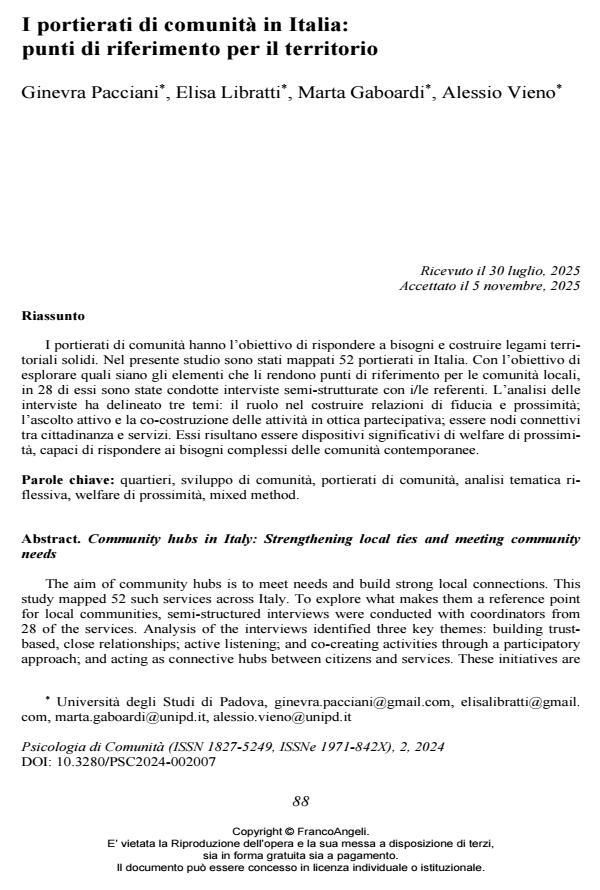
Article preview

FrancoAngeli is member of Publishers International Linking Association, Inc (PILA), a not-for-profit association which run the CrossRef service enabling links to and from online scholarly content.

The aim of community hubs is to meet needs and build strong local connections. This study mapped 52 such services across Italy. To explore what makes them a reference point for local communities, semi-structured interviews were conducted with coordinators from 28 of the services. Analysis of the interviews identified three key themes: building trust-based, close relationships; active listening; and co-creating activities through a participatory approach; and acting as connective hubs between citizens and services. These initiatives are significant tools for proximity-based welfare, capable of responding to the complex needs of contemporary communities.

Keywords: neighborhoods, community development, community hubs, reflective thematic analysis, local welfare, mixed method.

  1. McKnight, J., & Kretzmann, J. (1993). Building communities from the inside out: A path toward finding and mobilizing a community’s assets. ACTA Publications.
  2. Arvanitis, K. A., Holenstein, M., & Schriber, L. (2023). Bottom-Up Resilience: How Civic Bottom-Up Initiatives Contribute to Community Resilience. Yearbook of Swiss Administrative Sciences, 14(1), 58–72.
  3. Bernardi, M. (2019). Portinerie di quartiere: innovazione sociale tra digitale e locale. In G. Nuvolati, Enciclopedia sociologica dei luoghi (pp. 335-351). Ledizioni.
  4. Bortoli, B., & Folgheraiter, F. (2002), Voce «Empowerment», Lavoro Sociale, 2(2), 273-281.
  5. Bragaglia, F. (2021). L’innovazione sociale tra pratiche e politiche: il caso della portineria di comunità di Porta Palazzo. In C. Perrone, B. Masiani, & F. Tosi, Una geografia delle politiche urbane tra possesso e governo. Sfide e opportunità nella transizione (pp. 24-30). Urban@it
  6. Braun, V., & Clarke, V. (2006). Using thematic analysis in psychology. Qualitative Research in Psychology, 3(2), 77–101.
  7. Braun, V., & Clarke, V. (2019). Reflecting on reflexive thematic analysis. Qualitative Research in Sport, Exercise and Health, 11(4), 589–597. DOI: 10.1080/2159676X.2019.162880
  8. Cacioppo, J. T., & Hawkley, L. C. (2009). Perceived social isolation and cognition. Trends in cognitive sciences, 13(10), 447-454.
  9. Chatzidakis, A., Hakim, J., Litter, J., & Rottenberg, C. (2020). The care manifesto: The politics of interdependence. Verso Books.
  10. Cicognani, E., Pirini, C., Keyes, C., Joshanloo, M., Rostami, R., & Nosratabadi, M. (2008). Social participation, sense of community and social well being: A study on American, Italian and Iranian university students. Social indicators research, 89(1), 97-112.
  11. Diez Roux, A. V., & Mair, C. (2010). Neighborhoods and health. Annals of the New York academy of sciences, 1186(1), 125-145.
  12. Donati, P. (2015). Beyond the Welfare State: Trajectories Towards the Relational State. In G. Bertin & S. Campostrini, Equiwelfare and social innovation. An European perspective: An European perspective (pp. 13-49). FrancoAngeli.
  13. Euricse (2022). Le Comunità Intraprendenti in Italia, Euricse Research Reports, n. 23|2022. Autori: J. Sforzi, C. Burini, C. De Benedictis, L. Bettani, D. Gaudioso. Trento: Euricse.
  14. Ferrera, M., & Maino, F. (2011). Il “secondo welfare” in Italia: sfide e prospettive. Italianieuropei, 2011(3), 17-22.
  15. Fisher, A. T., Sonn, C. C., & Bishop, B. J. (Eds.). (2002). Psychological sense of community: Research, applications, and implications. Kluwer Academic/Plenum Publishers.
  16. Freedman, A., & Nicolle, J. (2020). Social isolation and loneliness: the new geriatric giants: approach for primary care. Canadian Family Physician, 66(3), 176-182.
  17. Freire, P. (1971). La pedagogia degli oppressi. Mondadori.
  18. Gardner, P. J. (2011). Natural neighborhood networks—Important social networks in the lives of older adults aging in place. Journal of aging studies, 25(3), 263-271.
  19. Granovetter, M. S. (1973). The strength of weak ties. American journal of sociology, 78(6), 1360-1380.
  20. Holt-Lunstad, J., Smith, T. B., Baker, M., Harris, T., & Stephenson, D. (2015). Loneliness and social isolation as risk factors for mortality: a meta-analytic review. Perspectives on psychological science, 10(2), 227-237. DOI: 10.1177/174569161456835
  21. Huxhold, O., Fiori, K. L., Webster, N. J., & Antonucci, T. C. (2020). The strength of weaker ties: An underexplored resource for maintaining emotional well-being in later life. The Journals of Gerontology: Series B, 75(7), 1433-1442.
  22. Lansing, A. E., Romero, N. J., Siantz, E., et al. (2023). Building trust: Leadership reflections on community empowerment and engagement in a large urban initiative. BMC Public Health, 23, Article 1252.
  23. Jeffres, L. W., Bracken, C. C., Jian, G., & Casey, M. F. (2009). The impact of third places on community quality of life. Applied research in quality of life, 4, 333-345.
  24. Killgore, W. D., Cloonan, S. A., Taylor, E. C., & Dailey, N. S. (2020). Loneliness: A signature mental health concern in the era of COVID-19. Psychiatry research, 290, 113117.
  25. Kirby, N., Stasiak, D., & von Schneidemesser, D. (2025). Community resilience through bottom–up participation: when civil society drives urban transformation processes. Community Development Journal, 60(3), 528-547.
  26. Magro-Montañés, B., Pabón-Carrasco, M., Romero-Castillo, R., Ponce-Blandón, J. A., & Jiménez-Picón, N. (2024). The relationship between neighborhood social capital and health from a biopsychosocial perspective: a systematic review. Public Health Nursing, 41(4), 845-861.
  27. Martini, E. R. (2019). BuonAbitare: il lavoro psicologico nei contesti abitativi per fornire servizi alle persone e promuovere comunità di vicinato. Psicologia di comunità: gruppi, ricerca azione e modelli formativi, 2, 113-118.
  28. Martini, E. R., & Torti, A. (2003). Fare lavoro di comunità: riferimenti teorici e strumenti operativi. Carocci Faber.
  29. Ménascé, D., Vincent, C. E., & Martin Moreau, M. (2017). Smart Cities and new forms of employment. Field Actions Science Reports. The journal of field actions (Special Issue 16), 16-21.
  30. Mohnen, S. M., Groenewegen, P. P., Völker, B., & Flap, H. (2011). Neighborhood social capital and individual health. Social science & medicine, 72(5), 660-667.
  31. Oldenburg, R. (1999). The great good place: Cafes, coffee shops, bookstores, bars, hair salons, and other hangouts at the heart of a community. Da Capo Press.
  32. Pace, E. M., & Aiello, P. (2022). Interventi comunitari strengths-based per promuovere l’inclusione per il benessere: alla (ri)scoperta delle risorse individuali e collettive. Italian journal of special education for inclusion, 10(2), 160-168.
  33. Pike, A., Rodríguez-Pose, A., & Tomaney, J. (2007). What kind of local and regional development and for whom?. Regional studies, 41(9), 1253-1269. DOI: 10.1080/0034340070154335
  34. Prezza, M., Amici, M., Roberti, T., & Tedeschi, G. (2001). Sense of community referred to the whole town: Its relations with neighboring, loneliness, life satisfaction, and area of residence. Journal of Community Psychology, 29(1), 29–52.
  35. Putnam, R. D. (2000). Bowling Alone: The Collapse and Revival of American Community. Simon and Schuster.
  36. Ripamonti, E. (2013). Il lavoro di rete. In M. Santinello & A. Vieno, Metodi di intervento in psicologia di comunità (pp. 175-195). il Mulino.
  37. Samuels, H. C., & Jeong, A. (2025). Protecting Against Loneliness: The Mediating Role of Sense of Community. Journal of Community Psychology, 53(1), e23167.
  38. Smith, B. J., & Lim, M. H. (2020). How the COVID-19 pandemic is focusing attention on loneliness and social isolation. Public health research & practice, 30(2), 3022008.
  39. Taglialatela, V., Vieno, A., Santinello, M., & Gaboardi, M. (2023). Sviluppo di comunità e partecipazione in quartieri multiculturali: uno studio qualitativo nel quartiere Arcella di Padova. Psicologia di comunità: gruppi, ricerca azione e modelli formativi, 2, 7-24.
  40. Tricarico, L., & Leone, M. I. (2022). Can Social Innovation and Proximity Save Our Cities?: Reflections on the “Accelerator for the Local Economy” Case in Milan. LUISS.
  41. Tricarico, L., & De Vidovich, L. (2021). Proximity and post-COVID-19 urban development: Reflections from Milan, Italy. Journal of Urban Management, 10(3), 302-310.
  42. Twelvetrees, A. (2006). Il lavoro sociale di comunità. Come costruire progetti partecipati. Edizioni Erickson.
  43. Vieno, A. & Santinello, M. (2013). Come progettare un intervento in ambito psicosociale. In M. Santinello & A. Vieno, Metodi di intervento in psicologia di comunità (pp. 175-195). Società editrice il Mulino spa.
  44. Vieno, A., & Santinello, M. (2006). Il capitale sociale secondo un’ottica di psicologia di comunità. Giornale italiano di psicologia, 33(3), 481-500.
  45. Wolleb, E. (2016). La portineria di quartiere. Spazi della socialità per il Nolo Social District [Tesi di Laurea Magistrale, Politecnico di Milano, Scuola del Design] https://www.politesi.polimi.it/retrieve/a81cb05c-5c60-616b-e053-1605fe0a889a/2017_4_Wolleb.pdf

Ginevra Pacciani, Elisa Libratti, Marta Gaboardi, Alessio Vieno, I portierati di comunità in Italia: punti di riferimento per il territorio in "PSICOLOGIA DI COMUNITA’" 2/2024, pp 88-107, DOI: 10.3280/PSC2024-002007