Beyond the Green Classroom. Climate Migration in European Schools: Student Perceptions and Educational Challenges

Journal title PRISMA Economia - Società - Lavoro
Author/s Gabriele Sospiro, Bianca Lombardi
Publishing Year 2026 Issue 2025/2
Language Italian Pages 29 P. 67-95 File size 383 KB
DOI 10.3280/PRI2025-002006
DOI is like a bar code for intellectual property: to have more infomation click here

Below, you can see the article first page

If you want to buy this article in PDF format, you can do it, following the instructions to buy download credits
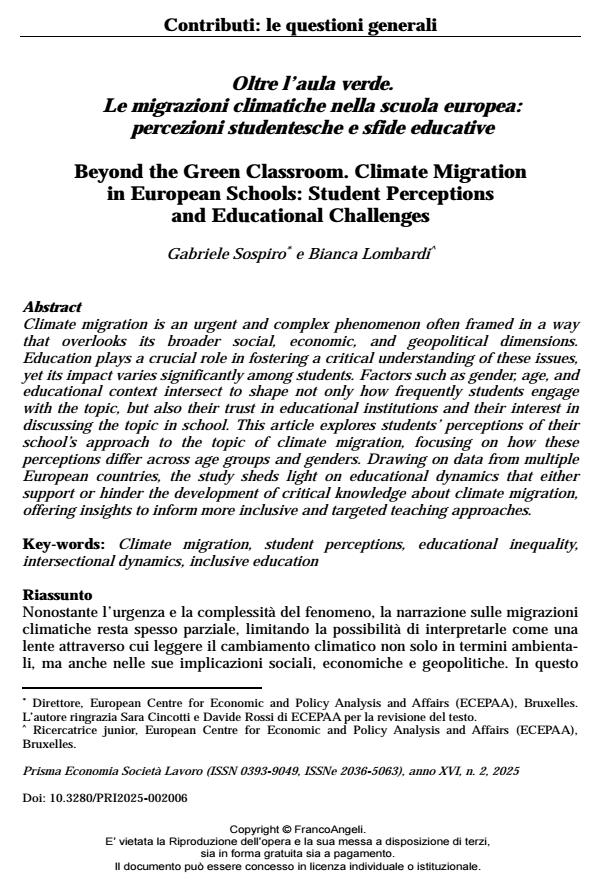
Article preview

FrancoAngeli is member of Publishers International Linking Association, Inc (PILA), a not-for-profit association which run the CrossRef service enabling links to and from online scholarly content.

Climate migration is an urgent and complex phenomenon often framed in a way that overlooks its broader social, economic, and geopolitical dimensions. Education plays a crucial role in fostering a critical understanding of these issues, yet its impact varies significantly among students. Factors such as gender, age, and educational context intersect to shape not only how frequently students engage with the topic, but also their trust in educational institutions and their interest in discussing the topic in school. This article explores students’ perceptions of their school’s approach to the topic of climate migration, focusing on how these perceptions differ across age groups and genders. Drawing on data from multiple European countries, the study sheds light on educational dynamics that either support or hinder the development of critical knowledge about climate migration, offering insights to inform more inclusive and targeted teaching approaches.

Keywords: Climate migration, student perceptions, educational inequality, intersectional dynamics, inclusive education

  1. Geraci, A. et al (2024), “Psychological dimensions associated with youth engagement in climate change issues: a person-centered approach”, Current Psychology.
  2. Aminrad, Z., Zakariya, S. Z. S., & Hadi, A. S. (2014), “Environmental perceptions of teenagers: The effects of family income and parents’ education”, International Journal in Physical & Applied Sciences.
  3. Bettini, G. (2013), “Climate barbarians at the gate? A critique of apocalyptic narratives on ‘climate refugees’”. Geoforum, 45, 63-72.
  4. Beyer, S., & Bowden, E. M. (1997), “Gender differences in self-perceptions: Convergent evidence from three measures of accuracy and bias”, Personality and Social Psychology Bulletin, 23(2), 157-172.
  5. Campbell, J., Smith, D., Boulton-Lewis, G., Lunn Brownlee, J., Burnett, P., Carrington, S., & Purdie, N. (2001), Students’ perceptions of teaching and learning: The influence of students’ approaches to learning and teachers’ approaches to teaching. Teachers and Teaching: Theory and Practice.
  6. Carballo-Losada, M., Collado, S., Rodríguez-Rey, R., Brown, A., & Evans, G. (2025), “Young children’s global climate change salience and comprehension: The effect of parental perception and communication”, Journal of Environmental Psychology, 105.
  7. Clark, H. F. (2024), “Critical climate awareness as a science education outcome”, Science Education, 108, 1670-1697.
  8. Clayton, S. D., Pihkala, P., Wray, B., & Marks, E. (2023), “Psychological and emotional responses to climate change among young people worldwide: Differences associated with gender, age, and country”, Sustainability, 15(4), 3540.
  9. Competente, R. J. T. (2022), “Pre-service teachers’ inclusion of climate change education”, International Journal of Evaluation and Research in Education, 11(4), 1779-1787. -- https://ijere.iaescore.com/index.php/IJERE/article/view/1692.
  10. Corner, A., Roberts, O., Chiari, S., Völler, S., Mayrhuber, E., Mandl, S., & Monson, K. (2015), “How do young people engage with climate change? The role of knowledge, values, message framing, and trusted communicators”, Wiley Interdisciplinary Reviews: Climate Change, 6(5), 523-534.
  11. Correa-González, J., López-Díez, A., Díaz-Pacheco, J., & Martín-Raya, N. (2023), “Climate change and sustainability in Spanish classrooms: State of the art and didactic proposal”, Social Sciences, 12, 108.
  12. Coyle, K. (2004). Understanding environmental literacy in America: And making it a reality. National Environmental Education and Training Foundation.
  13. Dabla-Norris, E., et al. (2023). Public perceptions of climate mitigation policies: Evidence from cross-country surveys (Staff Discussion Note SDN2023/002). International Monetary Fund.
  14. Dawson, V., Venville, G., Ulriksen, L., Soobard, R., & Taber, F. (2022), “A cross-country comparison of climate change in middle school science and geography curricula”, International Journal of Science Education, 44(9), 1379-1398.
  15. Dos-Santos, M., & Mata, F. (2024), “Attitudes of European citizens towards climate change: A gender analysis”, European Conference on Management Leadership and Governance, 20, 133-138.
  16. Einarsdóttir, S., & Rounds, J. (2009), “Gender bias and construct validity in vocational interest measurement: Differential item functioning in the Strong Interest Inventory”, Journal of Vocational Behavior, 74(3), 295-307.
  17. Folajogun, V. F., & Okwilagwe, E. (2016), “Assessing the senior school students’ knowledge, attitude, and practices related to climate change: Implications for curriculum review and teacher preparation”, Journal of the International Society for Teacher Education, 20(1), 43-53.
  18. GANATSA, M., Tsakaldimi, M., & Ganatsas, P. (2021), “Factors affecting attitudes and behavior of Greek secondary school students on current environmental issues”, Review of International Geographical Education Online.
  19. García Vinuesa, A., Carvalho, S., & Meira Cartea, P. Á. (in press), “Cambio climático en educación secundaria: La representación social del alumnado portugués”, Enseñanza de las Ciencias, 1-19.
  20. Georgiou, Y., Hadjichambis, A. C., & Hadjichambi, D. (2021), “Teachers’ perceptions on environmental citizenship: A systematic review of the literature”, Sustainability, 13(5), 2622.
  21. Gracia Ordóñez, J., Alcántara Manzanares, J., & Torres Porras, J. (2023), “Análisis de la concienciación de la juventud de zonas vulnerables sobre el futuro del cambio climático”, Revista Eureka sobre Enseñanza y Divulgación de las Ciencias, 21(1), 1502.
  22. Hamid, I., Himat, H., Hidari, U., Waheed, A., & Azimee, M. (2024), “Climate change education in Afghanistan high school curriculum: Depictions of the causes, impacts and solutions”, Nangarhar University International Journal of Biosciences, 3.
  23. Höhnle, S., Velling, H., & Schubert, J. (2024), “Students’ perspectives on climate change: Unveiling gender-interest associations in climate change beliefs”, International Research in Geographical and Environmental Education, 1-18.
  24. IDMC (2025), Global report on internal displacement 2025. Internal Displacement Monitoring Centre.
  25. Kumari Rigaud, K., de Sherbinin, A., Jones, B., Bergmann, J., Clement, V., Ober, K., Schewe, J., Adamo, S., McCusker, B., Heuser, S., & Midgley, A. (2018), Groundswell: Preparing for internal climate migration. The World Bank.
  26. Lee, K., Gjersoe, N., O’Neill, S., & Barnett, J. (2020), “Youth perceptions of climate change: A narrative synthesis”, Wiley Interdisciplinary Reviews: Climate Change, 11(3).
  27. Liarakou, G., Athanasiadis, I., & Gavrilakis, C. (2011), “What Greek secondary school students believe about climate change?”, International Journal of Environmental & Science Education, 6(1), 79-98.
  28. Meehan, C. R., Levy, B. L. M., & Collet-Gildard, L. (2018), “Global climate change in U.S. high school curricula: Portrayals of the causes, consequences, and potential responses”, Educational Theory and Practice Faculty Scholarship, 30.
  29. Monroe, M. C., Plate, R. R., Oxarart, A., Bowers, A., & Chaves, W. A. (2017), “Identifying effective climate change education strategies: A systematic review of the research”, Environmental Education Research, 23(6), 791-812.
  30. Morote, Á.-F., & Hernández, M. (2022), “What Do School Children Know about Climate Change? A Social Sciences Approach”, Social Sciences, 11(4), 179.
  31. Moshou, H., & Drinia, H. (2023), “Climate change education and preparedness of future teachers - A review: The case of Greece. Sustainability, 15, 1177.
  32. Pawluk-Skrzypek, A., & Jurewicz, M. (2024), “Importance of environmental education as perceived by secondary school students”, Communications of International Proceedings, (4).
  33. Punter, P., Ochando-Pardo, M., & García, J. (2011), “Spanish secondary school students' notions on the causes and consequences of climate change”, International Journal of Science Education, 33(3), 447-464.
  34. Randall, A. (2017), Engaging the media on climate-linked migration, in B. Mayer & F. Crépeau (Eds.), Research handbook on climate change, migration and the law (pp. 331-344). Edward Elgar Publishing.
  35. Sakellari, M. (2019), “Climate change and migration in the UK news media: How the story is told”, International Communication Gazette, 83(1), 63-80.
  36. Sakellari, M. (2023), “Key opinion shapers’ perceptions of climate migration: Why and how to put climate justice at the centre of climate change education”, Open Research Europe, 3, 213.
  37. Scannell, L., & Gifford, R. (2013), “Personally relevant climate change: The role of place attachment and local versus global message framing in engagement”, Environment and Behavior, 45(1), 60-85.
  38. Smith, L., & Reise, S. (1998), “Gender differences on negative affectivity: An IRT study of differential item functioning on the Multidimensional Personality Questionnaire Stress Reaction Scale”, Journal of Personality and Social Psychology, 75(5), 1350-1362.
  39. Stapleton, S. R. (2018), “A case for climate justice education: American youth connecting to intragenerational climate injustice in Bangladesh”, Environmental Education Research, 25(5), 732-750.
  40. Sund, L., & Öhman, J. (2014), “On the need to repoliticise environmental and sustainability education: Rethinking the post-political consensus”, Environmental Education Research, 20(5), 639-659.
  41. Tesfai, M., Nagothu, U., Šimek, J., & Fucík, P. (2016), “Perceptions of secondary school students towards environmental services: A case study from Czechia”, International Journal of Environmental and Science Education, 11(17), 5533-5553.
  42. UNESCO (2024), Global Education Monitoring Report - Education and Climate Change.
  43. Westheimer, J., & Kahne, J. (2004), “What kind of citizen? The politics of educating for democracy”, American Educational Research Journal, 41(2), 237-269.
  44. Winter, V., Kranz, J., & Mölle, A. (2022), “Climate change education challenges from two different perspectives of change agents: Perceptions of school students and pre-service teachers”, Sustainability, 14, 6081. -- https://www.mdpi.com/2071-1050/14/10/6081

Gabriele Sospiro, Bianca Lombardi, Oltre l’aula verde. Le migrazioni climatiche nella scuola europea: percezioni studentesche e sfide educative in "PRISMA Economia - Società - Lavoro" 2/2025, pp 67-95, DOI: 10.3280/PRI2025-002006