A “Spoon River” for Accountants: Gravestones as an Archival Source
Journal title CONTABILITÀ E CULTURA AZIENDALE
Author/s Giovanni Borghini , Alessandro Lai, Riccardo Stacchezzini
Publishing Year 2026 Issue 2025/1
Language English Pages 21 P. 43-63 File size 88 KB
DOI 10.3280/CCA2025-001003
DOI is like a bar code for intellectual property: to have more infomation
click here
Below, you can see the article first page
If you want to buy this article in PDF format, you can do it, following the instructions to buy download credits
FrancoAngeli is member of Publishers International Linking Association, Inc (PILA), a not-for-profit association which run the CrossRef service enabling links to and from online scholarly content.
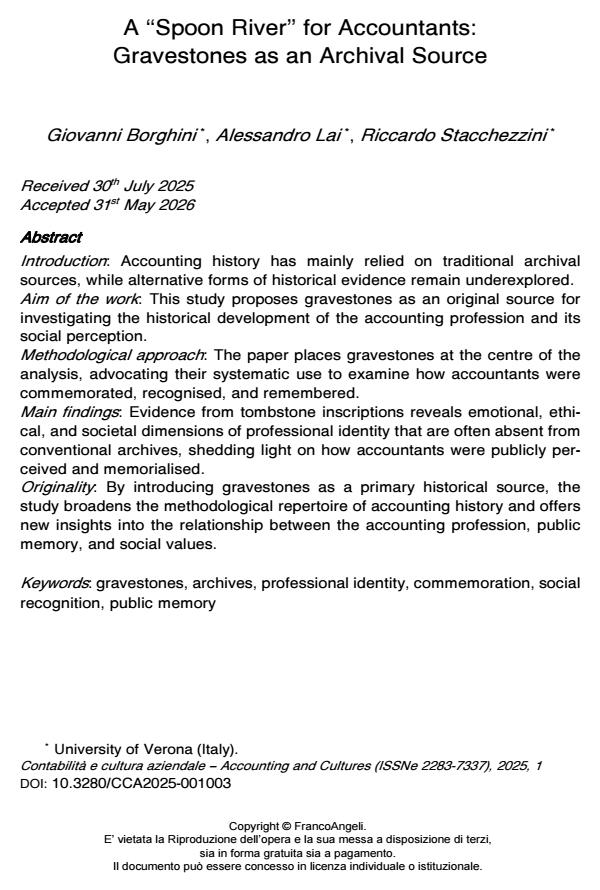
Introduction: Accounting history has mainly relied on traditional archival sources, while alternative forms of historical evidence remain underexplored. Aim of the work: This study proposes gravestones as an original source for investigating the historical development of the accounting profession and its social perception. Methodological approach: The paper places gravestones at the centre of the analysis, advocating their systematic use to examine how accountants were commemorated, recognised, and remembered. Main findings: Evidence from tombstone inscriptions reveals emotional, ethical, and societal dimensions of professional identity that are often absent from conventional archives, shedding light on how accountants were publicly perceived and memorialised. Originality: By introducing gravestones as a primary historical source, the study broadens the methodological repertoire of accounting history and offers new insights into the relationship between the accounting profession, public memory, and social values.
Keywords: gravestones, archives, professional identity, commemoration, social recognition, public memory
Giovanni Borghini , Alessandro Lai, Riccardo Stacchezzini, A “Spoon River” for Accountants: Gravestones as an Archival Source in "CONTABILITÀ E CULTURA AZIENDALE" 1/2025, pp 43-63, DOI: 10.3280/CCA2025-001003