Emotional dependence and parenting. An exploratory analysis from a systemic-relational perspective
Journal title TERAPIA FAMILIARE
Author/s Lucia Porcedda, Sara Ninu
Publishing Year 2026 Issue 2026/140
Language Italian Pages 22 P. 97-118 File size 210 KB
DOI 10.3280/TF2026-140006
DOI is like a bar code for intellectual property: to have more infomation
click here
Below, you can see the article first page
If you want to buy this article in PDF format, you can do it, following the instructions to buy download credits
FrancoAngeli is member of Publishers International Linking Association, Inc (PILA), a not-for-profit association which run the CrossRef service enabling links to and from online scholarly content.
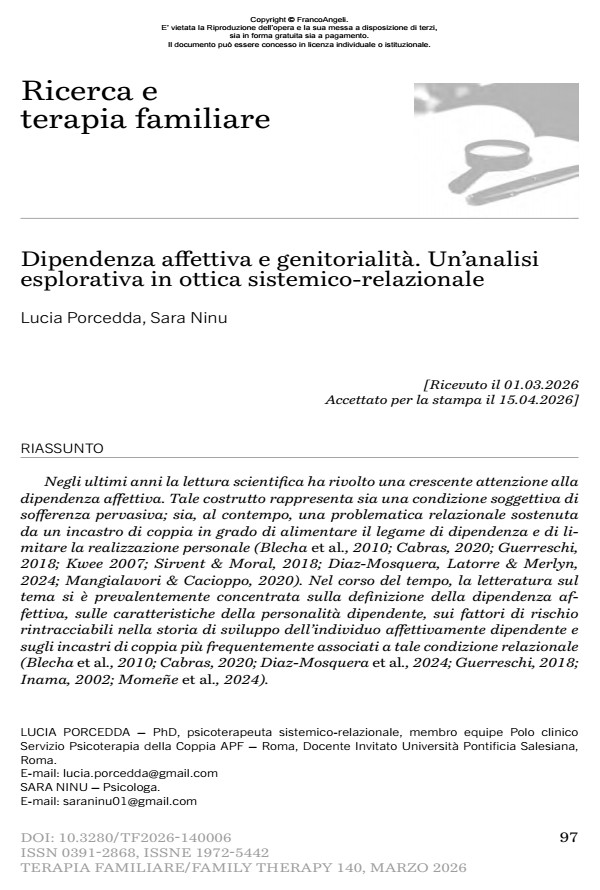
In recent years, scientific literature has increasingly focused on emotional dependence. This construct represents a subjective distress. Concurrently, it exemplifies a relational issue sustained by dysfunctional couple dynamics that reinforce the dependency bond and limit the personal fulfilment (Blecha et al., 2010; Cabras, 2020; Guerreschi, 2018; Kwee 2007; DiazMosquera, Latorre & Merlyn, 2024; Mangialavori & Cacioppo, 2020). Over time, the literature on this topic has mainly focused on: its definition, dependent personality traits, risk factors in the developmental history of the emotionally dependent individuals, and the most common couple dynamics associated with this relational condition (Blecha et al., 2010; Cabras, 2020; DiazMosquera et al., 2024; Guerreschi, 2018; Inama, 2002; Momeñe et al., 2024). The objective of the present exploratory and qualitative study is to examine whether the emotional dependence condition within the parental couple represents a risk factor in the exercise of parenting. This clinicianreport study has gathered the indirect perspectives of expert psychotherapists (n = 54) regarding the phenomenon under investigation, through the voluntary and anonymous completion of a questionnaire. The following article will offer a detailed presentation of this questionnaire, specifically structured to explore the parental dimensions under study, along with the associated results. Despite the exploratory nature of the study and the related absence of generalizable results, the data obtained confirm the necessity for further methodologically rigorous investigations. This necessity arises from the responses provided by the expert informants, which appear to converge towards the presence of meaningful patterns capable of highlighting risk and protective factors in the exercise of parenting functions.
Keywords: emotional dependence, parenting, couple dynamics, parenting styles, family boundaries, parental risk factors.
- American Psychological Association (2018). Acting out. APA Dictionary of Psychology. Dsponibile su: dictionary.apa.org/actingout.
- Andolfi M. & Mascellani A. (2019). Intimità di coppia e trame familiari. Milano: Raffaello Cortina Editore.
- Andolfi M. (2015). La terapia familiare multigenerazionale: Strumenti e risorse del terapeuta. Milano: Raffaello Cortina Editore.
- Andolfi M., Mascellani A. & Salerno A. (2022). La magia del bambino in terapia familiare. Roma: Accademia Press.
- Benedetto L. & Ingrassia M. (2015). What connections between marital conflict and parenting quality? Evidence from parent’s gender in spillover effects. Mediterranean Journal of Clinical Psychology, 3(2): 122. DOI: 10.6092/22821619/2015.3.1066
- Berástegui A., MozasAlonso M. & Oliver J. (2022). Differentiation of self and its relationship with marital satisfaction and parenting styles in a Spanish sample of adolescents’ parents. PLOS One, 17(3): 116.
- Berti A.E. & Bombi A.S. (2013). Corso di psicologia dello sviluppo. Bologna: il Mulino.
- Blecha L., Benyamina A., Karila L. & Reynaud M. (2010). Is love passion an addictive disorder? American Journal of Drug & Alcohol Abuse, 36(5): 261267. DOI: 10.3109/00952990.2010.495183
- Bombi A.S. & Cannoni E. (2014). Bambini e salute: Psicologia dello sviluppo per le professioni sanitarie. Bologna: il Mulino.
- Bowen M. (1978). Family therapy in clinical practice. Lanham: Jason Aronson Publishers (trad. it.. Dalla famiglia all’individuo. La differenziazione del sé nel sistema familiare, Roma: Astrolabio, 1979).
- Cabras E. (2020). La personalità del dipendente affettivo: L’uomo maltrattato. In: Cabras E. & Saladino V. (a cura di), La dipendenza affettiva: Testimonianze e casi di manipolazione e violenza (pp. 1328). Roma: Carocci Editore.
- Canovi A.G. (2024). Dentro di me c’è un posto bellissimo: Imparare a volersi bene affinché l’amore accada. Milano: Vallardi.
- Canovi A.G. (2022). Di troppo amore: Fuori dal labirinto della dipendenza affettiva. Milano: Sperling & Kupfer.
- Coe J.L., Davies P.T. & SturgeApple M.L. (2018). Family cohesion and enmeshment moderate associations between maternal relationship instability and children’s externalizing problems. Journal of Family Psychology, 32(3): 289298.
- Colapinto J. (2016). Structural family therapy. In: Sexton T. & Lebow J. (a cura di), Handbook of family therapy (pp. 121133). New York: Routledge.
- Covini P. (2022). I figli nella terapia con le coppie: Lavorare con le coppie e “averli ben in testa”. Terapia familiare, 130(45): 519. DOI: 10.3280/TF2022130001
- De Sousa M.L., Peixoto M.M. & Cruz S.F. (2021). The association between externalizing and internalizing problems with bullying engagement in adolescents: The mediating role of social skills. International Journal of Environmental Research and Public Health, 18(19): 10444.
- DìazMosquera E., Latorre G. & Merlyn M.F. (2024). Types of attachment as predictors of emotional dependence in couples. International Journal of Advanced and Applied Sciences 11(8): 178186.
- Elder C.R. & Miller E.A. (2024). Balanced parenting: Proposing a differentiationbased parenting approach informed by Bowen family systems theory. Family Process, 64(1): e13092.
- Formella z. & Ricci A. (2010). Educare insieme: Aspetti psicoeducativi nella relazione genitorifigli. Torino: Elledici.
- Ghezzani N. (2021). L’amore impossibile: Affrontare la dipendenza affettiva maschile e femminile. Milano: FrancoAngeli.
- Guerreschi C. (2018). La dipendenza affettiva: Ma si può morire anche d’amore? Milano: FrancoAngeli.
- Hooper L.M. (2007). The application of Attachment Theory and Family Systems Theory to the phenomena of parentification. The Family Journal, 15(3): 217 223. DOI: 10.1177/1066480707301290
- Hooper L.M. (2008). Defining and understanding parentification: Implications for all counselors. Alabama Counseling Association Journal, 34(1): 3443.
- Inama L. (2002). Liberarsi dal troppo amore: Per le donne che vogliono uscire da una dipendenza affettiva. Trento: Erickson.
- Iwaniec D., Larkin E. & McSherry D. (2007). Emotionally harmful parenting. Child Care in Practice, 13(3): 203220. DOI: 10.1080/13575270701353531
- Jandric S. & Kurtovic A. (2021). Parenting sense of competence in parents of children with and without intellectual disability. Europe’s journal of psychology, 17(2): 7591.
- Kaasbøll J., Thaulow K. & Reedtz C. (2024). Parenting sense of competence and associated factors among parents facing adversity in Norway: A crosssectional study. Children and Youth Service Review, 163.
- KuerstenHogan R. (2010). Cos’è la cogenitorialità e perché è così importante. In: McHale J.P. (a cura di), La sfida della cogenitorialità (pp. 122). Milano: Raffaello Cortina Editore.
- Lambruschi F. & Lionetti F. (2015). Genitorialità: Tra valutazione, sostegno e buone prassi. In: Lambruschi F. & Lionetti F. (a cura di), La genitorialità: Strumenti di valutazione e interventi di sostegno (pp. 1536). Roma: Carocci Editore.
- Loriedo C. & Strom P. (1999). I processi di trasmissione transgenerazionale nelle coppie e il trattamento delle problematiche connesse alle famiglie di origine. In: Andolfi M. (a cura di), La crisi della coppia: Una prospettiva sistemicorelazionale (pp. 311328). Milano: Raffaello Cortina Editore.
- Mangialavori S. & Cacioppo M. (2020). Dipendenza affettiva, stili di attaccamento, cure parentali ricevute in infanzia e in adolescenza e qualità della relazione di coppia: quale relazione? LIRPA International Journal, 4(1): 160168. DOI: 10.48237/LIJ_030
- Minuchin S. (1977). Famiglie e terapia della famiglia. Roma: Astrolabio.
- Momeñe J., Estévez A., Griffiths M.D., Macía P., Herrero M., Olave L. & Iruarrizaga
- I. (2024). The impact of insecure attachment on emotional dependence on a partner: The mediating role of negative emotional rejection. Behavioral Sciences, 14(10): 909.
- Napoli L. (2018). Dipendenza affettiva: Diagnosi e psicoterapia. Formazione Continua in Psicologia. Disponibile su: formazionecontinuainpsicologia.it/ wpcontent/uploads/2018/09/EbookgratuitoDipendenzaaffettiva.pdf.
- Nichols M.P. & Schwartz R.C. (2004). Family therapy: Concepts and methods. Boston: Allyn & Bacon.
- Olave L., Iruarrizaga I., Herrero M., Macía P., Momeñe J., Macía L., Muñiz J.A. & Estevez A. (2024). Exercise addiction and intimate partner violence: The role of impulsivity, selfesteem, and emotional dependence. Behavioral Sciences, 14(5): 420.
- Petruccelli F., Diotaiuti P., Verrastro V., Petruccelli I., Federico R., Martinotti G., Fossati A., Di Giannantonio M. & Janiri L. (2014). Affective dependence and aggression: An exploratory study. BioMed Research International, 2014. DOI: 10.1155/2014/805469
- Santrock J.W., DeaterDeckard K., Lansford J. & Rollo D. (2021). Psicologia dello sviluppo. New York: McGraw Hill.
- Secci E.M. (2014). I narcisisti perversi e le unioni impossibili: Sopravvivere alla dipendenza affettiva a ritrovare se stessi. Lecce: Youcanprint.
- ?i?oiu A. & Pâni?oara G. (2023). The emotional intelligence of today’s parents: Influences on parenting style and parental competence. Frontiers in Public Health, 11: 1120994.
- Tang Y., Li S., Ma L., zheng Y. & Li Y. (2023). The effects of motherfather relationships on children’s socialemotional competence: The chain mediating model of parental emotional expression and parentchild attachment. Children and Youth Services Review, 155.
- Thompson M.J., Platts C.R. & Davies P.T. (2024). Parentchild boundary dissolution and children’s psychological difficulties: A metaanalytic review. Psychological bulletin, 150(7): 873919.
- Wittkowski A., Garrett C., Calam R. & Weisberg D. (2017). Selfreport measures of parental selfefficacy: A systematic review of the current literature. Journal of child and family studies, 26(11): 29602978. Psychology in the Schools, 61(8): 31933211.
- zhylin M., Mendelo V., Hrytsuk O., Kononenko T. & Shamalo S. (2024). Correlation between students emotional intelligence and emotional dependency. Revista Eduweb, 18(3): 193203.
- zitzmann J., RomboldGeorge L., Rosenbach C. & Renneberg B. (2024). Emotion regulation, parenting, and psychopathology: A systematic review. Clinical Child and Family Psychology Review, 27(1): 122.
Lucia Porcedda, Sara Ninu, Dipendenza affettiva e genitorialità. Un’analisi esplorativa in ottica sistemico-relazionale in "TERAPIA FAMILIARE" 140/2026, pp 97-118, DOI: 10.3280/TF2026-140006