Managing disability, creating value: The role of the disability manager in organizations
Journal title STUDI ORGANIZZATIVI
Author/s Sara Lombardi, Niccolò Ciatta, Deborah Gervasi
Publishing Year 2026 Issue 2026/1
Language Italian Pages 26 P. 121-146 File size 247 KB
DOI 10.3280/SO2026-001005
DOI is like a bar code for intellectual property: to have more infomation
click here
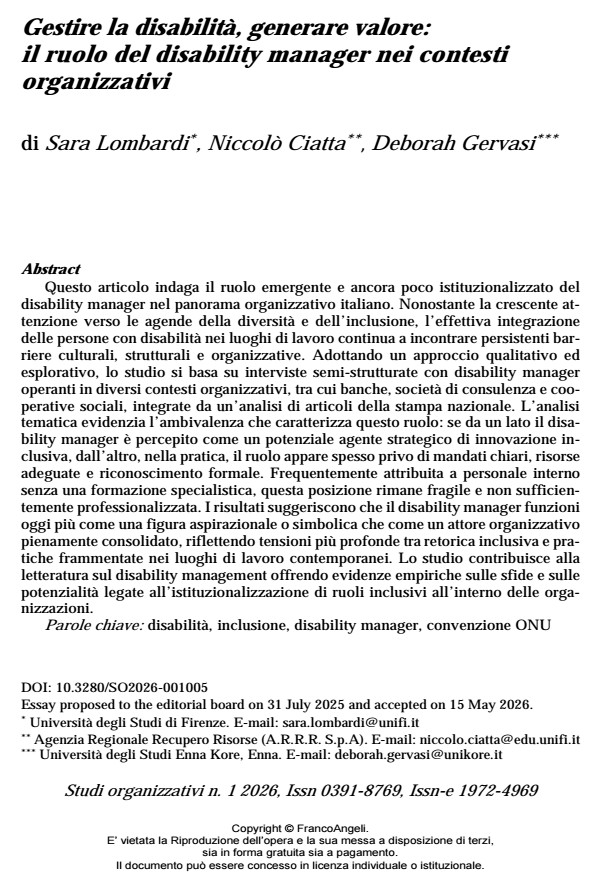
Below, you can see the article first page
If you want to buy this article in PDF format, you can do it, following the instructions to buy download credits
FrancoAngeli is member of Publishers International Linking Association, Inc (PILA), a not-for-profit association which run the CrossRef service enabling links to and from online scholarly content.
This article investigates the emerging and still under-institutionalized role of the disability manager within the Italian organizational landscape. Despite growing attention to diversity and inclusion agendas, the effective integration of people with disabilities in the workplace continues to face persistent cultural, structural, and organizational barriers. Adopting a qualitative and exploratory approach, the study draws on semi-structured interviews with disability managers operating in diverse organizational contexts (including banking, consulting, and social cooperatives), complemented by an analysis of national press articles. Thematic analysis reveals the ambivalence characterizing this role: while the disability manager is perceived as a potentially strategic agent of inclusive innovation, in practice the role often lacks clear mandates, adequate resources, and formal recognition. Frequently assigned to internal staff without specialized training, the position remains fragile and insufficiently professionalized. The findings suggest that the disability manager currently functions more as an aspirational or symbolic figure than as an established organizational actor, reflecting deeper tensions between inclusive rhetoric and fragmented practices in contemporary workplaces. The study contributes to the literature on disability management by offering empirical insights into the challenges and potentials of institutionalizing inclusive roles within organizations.
Keywords: Work, disability, inclusion, disability manager, UN convention.
- Avery, D.R., & McKay, P.F. (2010), “Doing diversity right: An empirically based approach to effective diversity management”, International Review of Industrial and Organizational Psychology, 25: 227-252.
- Azungah, T. (2018), “Qualitative research: Deductive and inductive approaches to data analysis”, Qualitative Research Journal, 18(4): 1-19. DOI: 10.1108/QRJ-D-18-00035
- Baldridge, D.C., Kulkarni, M. (2017), “The shaping of sustainable careers post hearing loss: Toward greater understanding of adult onset disability, disability identity, and career transitions,” Human Relations, 70(10): 1217-1236. DOI: 10.1177/0018726716687388
- Balistreri, S., Agostini, M., Vecchio, G. (2020), Il disability management nella gestione delle risorse umane, Aracne.
- Ball, P., Monaco, G., Schmeling, J., Schartz, H., Blanck, P. (2005), “Disability as diversity in Fortune 100 companies”, Behavioral Sciences & the Law, 23(1): 97-121.
- Barbabella, F., Cela, E., Socci, M., Lucantoni, D., Zannella, M., Principi, A. (2022), “Active ageing in Italy: A systematic review of national and regional policies”, International Journal of Environmental Research and Public Health, 19(1): 600.
- Beatty J.E., Baldridge, D.C., Boehm, S.A., Kulkarni, M., Colella, A.J. (2019), “On the treatment of persons with disabilities in organizations: A review and research agenda”, Human Resource Management, 58(2): 119–137.
- Bellou, V. (2007), “Identifying employees’ perceptions on organizational obligations: A comparison between the Greek public and private sector”, International Journal of Public Sector Management, 20(7): 608-621. DOI: 10.1108/09513550710823515
- Biyiklar, M.A., & Balcioglu, Y.S. (2025), “Breaking the Silence: Women’'s reproductive health in the workplace through collective voice”, Gender, Work & Organization, 32(6): 2353-2368.
- Braun, V., Clarke, V. (2006), “Using thematic analysis in psychology”, Qualitative Research in Psychology, 3(2): 77-101.
- Braun, V., Clarke, V., Hayfield, N., Davey, L., Jenkinson, E. (2023), “Doing reflexive thematic analysis”, Bager-Charleson, S., McBeath, A., (Eds.), Supporting Research in Counselling and Psychotherapy: Qualitative, Quantitative, and Mixed Methods Research. Cham: Springer International Publishing, pp.19-38.
- Brizio, G.E., Paolino, C. (2025), “Gender and disability in Italy: Disabled women activists between identity and body politics”, Organization, 13505084251343663. DOI: 10.1177/13505084251343663
- Chan, X.W., Hutchings, K. (2025), “Exploring the careers of women with disabilities: a systematic review and implications for human resource management”, Personnel Review, 54(5): 1202-1251. DOI: 10.1108/PR-01-2024-0086
- Cho, S., Kim, A., Mor Barak, M.E. (2017), “Does diversity matter? Exploring workforce diversity, diversity management, and organizational performance in social enterprises”, Asian Social Work and Policy Review, 11(3): 193-204.
- Dalla Mora, R., Aimone, P.M., Caristi, M., Marzano, N., Mattana, V. (2020), Manifesto del disability manager, Il Prato Publishing House Srl.
- Dwertmann, D.J.G. (2016), “Management research on disabilities: Examining methodological challenges and possible solutions”, The International Journal of Human Resource Management, 27(14): 1477–1509. DOI: 10.1080/09585192.2015.1137614
- Edge, C.E., & Bacci, G. (2024)., “‘You feel a little bit invisible really’: A thematic analysis exploring self-perceptions and stereotypes experienced by working women aged 60 and over with a focus on lower paid roles”, Current Issues in Personality Psychology, 13(2): 82-89.
- Ferrucci, F. (2014), “Disability and work inclusion in Italy: Between unfulfilled promises and new disability culture”, Modern Italy, 19(2): 183-197. DOI: 10.1080/13532944.2014.910507
- FISH (1/05/2023), 1 maggio, persone con disabilità escluse dal mondo del lavoro, FISH Onlus in https://www.fishonlus.it/1-maggio-persone-con-disabilita-escluse-da-mondo-lavoro/.
- Gensby, U., Labriola, M., Irvin, E., Amick III, B.C., Lund, T. (2014), “A classification of components of workplace disability management programs: Results from a systematic review”, Journal of Occupational Rehabilitation, 24(2): 220-241.
- Gilbert, J.A., Stead, B.A., Ivancevich, J.M. (1999), “Diversity management: A new organizational paradigm”, Journal of Business Ethics, 21(1): 61-76. DOI: 10.1023/A:1005907602028
- Gioia, D.A., Corley, K.G., & Hamilton, A.L. (2013)., “Seeking qualitative rigor in inductive research: Notes on the Gioia methodology”, Organizational Research Methods, 16(1): 15-31. DOI: 10.1177/1094428112452151
- Hall, E., Wilton, R. (2011), “Alternative spaces of ‘work’ and inclusion for disabled people”, Disability & Society, 26(7): 867-880. DOI: 10.1080/09687599.2011.618742
- Jammaers, E., Zanoni, P., Hardonk, S. (2016), “Constructing positive identities in ableist workplaces: Disabled employees’ discursive practices engaging with the discourse of lower productivity”, Human Relations, 69(6): 1365–1386. DOI: 10.1177/0018726715612901
- Kersten, A., Van Woerkom, M., Geuskens, G.A., Blonk, R.W. (2023), “Organisational policies and practices for the inclusion of vulnerable workers: A scoping review of the employer’s perspective”, Journal of Occupational Rehabilitation, 33(2): 245-266.
- Kulkarni, M., Lengnick-Hall, M.L. (2014), “Obstacles to success in the workplace for people with disabilities: A review and research agenda”, Academy of Management Proceedings, 13(2): 158–180. DOI: 10.1177/1534484313485229
- La Torre, G., De Giusti, M., Mannocci, A., De Waure, C., Agostinelli, A., Schena, S., Capelli, G., Ricciardi, W., Boccia, A., (2009), “Disability management: The application of preventive measures, health promotion and case management in Italy”, Management, 7, 8.
- Lawrence, P.R., Lorsch, J.W. (1967), “Differentiation and integration in complex organizations”, Administrative Science Quarterly, 1-47. DOI: 10.2307/2391211
- Lindsay, S., Fuentes, K., Tomas, V., Hsu, S. (2023), “Ableism and workplace discrimination among youth and young adults with disabilities: A systematic review”, Journal of Occupational Rehabilitation, 33(1): 20-36.
- Maccheroni, C., Mignolli, N., Pace, R., Venere, G. (2025), “Older adult surge and social welfare inequalities in Italy: The impact of population ageing on pensions and the welfare system”, Populations, 1(2): 9.
- Mik-Meyer, N. (2016), “Disability and ‘care’: Managers, employees and colleagues with impairments negotiating the social order of disability”, Work, Employment and Society, 30(6): 984-999. DOI: 10.1177/0950017015617677
- Moscatelli, M., Pavesi, N., Ferrari, C. (2024), “Targeted placement for people with disabilities in Italy: a perspective from Lombardian companies”, Equality, Diversity and Inclusion: An International Journal, 43(9): 1-17. DOI: 10.1108/EDI-07-2023-0228
- Organizzazione Mondiale della Sanità (2001), Classificazione Internazionale del Funzionamento. della Disabilità e della Salute, Erickson in https://iris.who.int/bitstream/handle/10665/42417/9788879466288_ita.pdf;jsessionid=D7069201C4C82BFDB2FEEB4499E9087C?sequence=4.
- Ravazzani, S. (2016), “Understanding approaches to managing diversity in the workplace: An empirical investigation in Italy”, Equality, Diversity and Inclusion: An International Journal, 35(2): 154-168. DOI: 10.1108/EDI-08-2014-0062
- Ruwanpura, K.N. (2008), “Multiple identities, multiple-discrimination: A critical review”, Feminist Economics, 14(3): 77-105. DOI: 10.1080/13545700802035659
- Santuzzi, M., Martinez, A., Keating, R.T. (2022), “The benefits of inclusion for disability measurement in the workplace”, Equality, Diversity and Inclusion: An International Journal, 41(3): 474-490. DOI: 10.1108/EDI-06-2020-0167
- Schur, L., Kruse, D., Blasi, J., Blanck, P. (2009), “Is disability disabling in all workplaces? Workplace disparities and corporate culture”, Industrial Relations: A Journal of Economy and Society, 48(3): 381–410.
- Sheppard, C. (2011), “Multiple discrimination in the world of work”, International Labour Organization, Global Report on Equality at Work, Working Paper No. 66.
- Shrey, D.E. (1996), “Disability management in industry: The new paradigm in injured worker rehabilitation”, Disability and Rehabilitation, 18(8): 408-414. DOI: 10.3109/09638289609165904
- Snyder, L.A., Carmichael, J.S., Blackwell, L.V., Cleveland, J.N., Thornton, G.C. (2010), “Perceptions of discrimination and justice among employees with disabilities”, Employee Responsibilities and Rights Journal, 22(1): 5–19.
- Söderlund, J., Borg, E. (2018), “Liminality in management and organization studies: Process, position and place”, International Journal of Management Reviews, 20(4): 880-902.
- Stone, D.L., Colella, A. (1996), “A framework for studying the effects of disability on work experiences”, Academy of Management Review, 21(2): 352–401. DOI: 10.2307/258666
- Sutcliffe, K.M., Huber, G.P. (1998), “Firm and industry as determinants of executive perceptions of the environment”, Strategic Management Journal, 19(8): 793-807.
- Thanem, T. (2008), “Embodying disability in diversity management research”, Equal Opportunities International, 27(7): 581-595. DOI: 10.1108/02610150810904292
- Thompson, J.D. (1967), Organizations in action: Social science bases of administrative theory. New York, NY: McGraw-Hill.
- Wandycz-Mejías, J., Lopez-Cabrales, A. (2025), “On the road to workplace accountability: a qualitative analysis framed by self-determination theory”, International Journal of Organization Theory & Behavior. DOI: 10.1108/IJOTB-02-2024-0019
- Westphal, J.D., Zajac, E.J. (2001), “Decoupling policy from practice: The case of stock repurchase programs”, Administrative Science Quarterly, 46(2): 202-228. DOI: 10.2307/2667086
- Worren, N., Pope, S. (2024), “Connected but conflicted: Separating incompatible roles in organizations”, Academy of Management Review, 49(1): 6-31.
- Xie, X.Y., Ye, C., Hu, Q., He, W., Dai, H. (2025), “Cross-functional coordination, status–authority asymmetry, and contingent exploitation of digital technology”, Management and Organization Review, 1-25.
Sara Lombardi, Niccolò Ciatta, Deborah Gervasi, Gestire la disabilità, generare valore: il ruolo del disability manager nei contesti organizzativi in "STUDI ORGANIZZATIVI " 1/2026, pp 121-146, DOI: 10.3280/SO2026-001005