Labour, well-being and sustainable development: The 2030 Agenda and the role of business. The Barilla case
Journal title QUADERNI DI ECONOMIA DEL LAVORO
Author/s Azio Barani
Publishing Year 2026 Issue 2023/117
Language Italian Pages 44 P. 91-134 File size 1149 KB
DOI 10.3280/QUA2023-117005
DOI is like a bar code for intellectual property: to have more infomation
click here
Below, you can see the article first page
If you want to buy this article in PDF format, you can do it, following the instructions to buy download credits
FrancoAngeli is member of Publishers International Linking Association, Inc (PILA), a not-for-profit association which run the CrossRef service enabling links to and from online scholarly content.
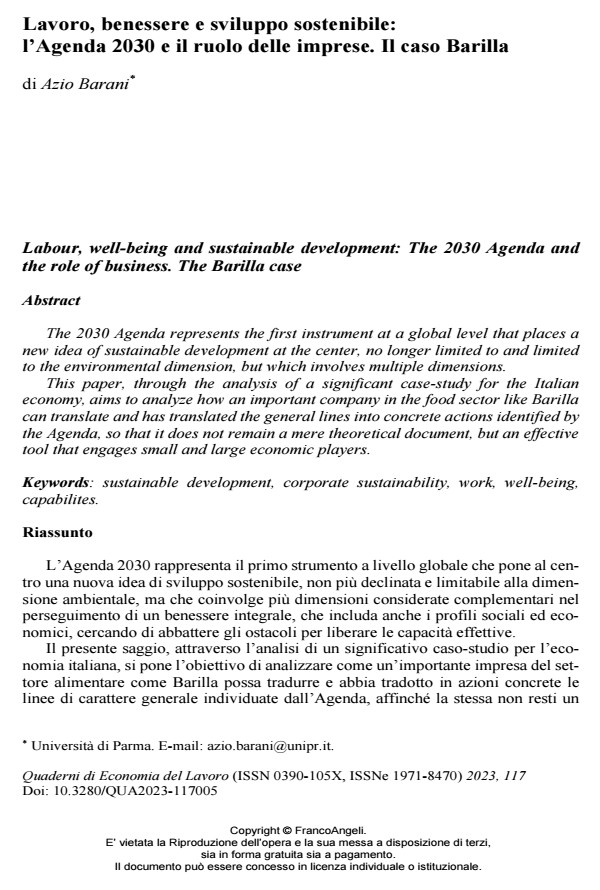
The 2030 Agenda represents the first instrument at a global level that places a new idea of sustainable development at the center, no longer limited to and limited to the environmental dimension, but which involves multiple dimensions. This paper, through the analysis of a significant case-study for the Italian economy, aims to analyze how an important company in the food sector like Barilla can translate and has translated the general lines into concrete actions identified by the Agenda, so that it does not remain a mere theoretical document, but an effective tool that engages small and large economic players.
Keywords: sustainable development, corporate sustainability, work, well-being, capabilites.
- Bauman Z. (2002). Modernità liquida. Bari: Laterza.
- Bauman Z. (2006). Vita liquida. Bari: Laterza.
- Commissione Europea (2001). Carta dei diritti fondamentali dell’Unione Europea.
- Giorgi F. (2020). Il diritto e la sfida dei cambiamenti climatici. In: Zanichelli M., a cura di, Il diritto visto da fuori. Scienziati, intellettuali, artisti si interrogano sul senso della giuridicità oggi. Milano: FrancoAngeli.
- Perez C.C. (2020). Invisibili. Torino: Einaudi.
- Patnaik S. e Pandey S.C. (2019), Case Study Research. In: Subudhi R.N. e Mishra S., a cura di, Methodological Issues in Management Research: Advances, Challenges, and the Way Ahead, pp. 163-179. Bingley: Emerald Publishing Limited.
- Sen A. (2000). Lo sviluppo è libertà. Perché non c’è crescita senza democrazia. Milano: Mondadori.
- Sen A. (2001). Etica ed economia. Bari: Laterza.
- Sen A. (2010). L’idea di giustizia. Milano: Mondadori.
- Sen A. (2011). La libertà individuale come impegno sociale. Bari: Laterza.
- Sobrero R. (2017). In viaggio verso la sostenibilità. Promuovere gli obiettivi di Sviluppo Sostenibile dell’Agenda 2030: il ruolo della comunicazione sociale. Milano: Pubblicità Progresso.
- Yin R.K. (2018). Case study research and applications: Design and methods (6th ed.). Thousand Oaks, CA: Sage Publications.
- Zanichelli M. (2012). Persone prima che disabili. Brescia: Querniana.
Azio Barani, Lavoro, benessere e sviluppo sostenibile: l’Agenda 2030 e il ruolo delle imprese. Il caso Barilla in "QUADERNI DI ECONOMIA DEL LAVORO" 117/2023, pp 91-134, DOI: 10.3280/QUA2023-117005