Urban Policies for Mooca, Sa.o Paulo: challenges for a postindustrial metropolis planning
Journal title TERRITORIO
Author/s Eduardo Alberto Cusce Nobre
Publishing Year 2026 Issue 2025/112-113
Language English Pages 10 P. 44-53 File size 940 KB
DOI 10.3280/TR2025-112004
DOI is like a bar code for intellectual property: to have more infomation
click here
Below, you can see the article first page
If you want to buy this article in PDF format, you can do it, following the instructions to buy download credits
FrancoAngeli is member of Publishers International Linking Association, Inc (PILA), a not-for-profit association which run the CrossRef service enabling links to and from online scholarly content.
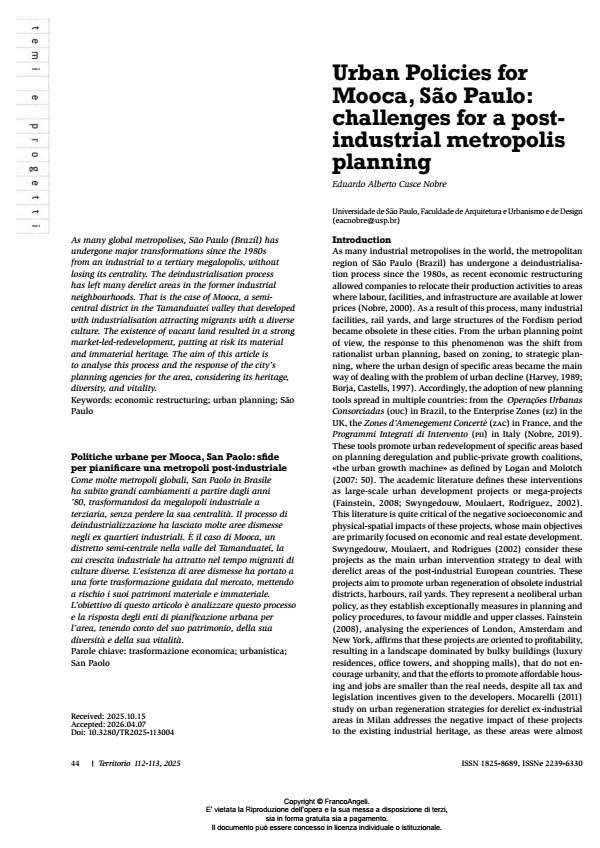
As many global metropolises, São Paulo (Brazil) has undergone major transformations since the 1980s from an industrial to a tertiary megalopolis, without losing its centrality. The deindustrialisation process has left many derelict areas in the former industrial neighbourhoods. That is the case of Mooca, a semi central district in the Tamanduateí valley that developed with industrialisation attracting migrants with a diverse culture. The existence of vacant land resulted in a strong marketledredevelopment, putting at risk its material and immaterial heritage. The aim of this article is to analyse this process and the response of the city’s planning agencies for the area, considering its heritage, diversity, and vitality.
Keywords: economic restructuring; urban planning; São Paulo
- Associação Amo a Mooca, 2024, Quem somos. https://amoamooca.com. br/quemsomos/ (access: 2024.09.08).
- Bolaffi G.,1992. «Urban Planning in Brazil: Past Experiences, Current Trends». Habitat International, 16, 2: 99111. DOI: 10.1016/01973975(92)900406
- Borja J., Castells M., 1997, Local & Global: the management of cities in the information age. London: Earthscan. Brazil, 1988, «Constituição da República Federativa do Brasil de 1988». Diário O?cial da União, Anex.
- Brazil, 2001, «Lei nº 10.257, de 10 de julho de 2001. Regulamenta os arts. 182 e 183 da Constituição Federal, estabelece diretrizes gerais da política urbana e dá outras providências». Diário O?cial da União. Brasília, 11 July 2001: 15.
- Bruzzese A., Montedoro L., 2015, «Urban design: la via italiana». In: Balducci A., Gaeta L., L’urbanistica italiana nel mondo: Contributi e debiti culturali. Roma: Donzelli, 201209.
- City of São Paulo, 2002, «Lei nº 13.430, de 13 de setembro de 2002. Institui o Plano Diretor Estratégico do Município de São Paulo e dá outras providências». Diário O?cial do Município de São Paulo. São Paulo, 14 September 2002: 113.
- City of São Paulo, 2007, Resolução nº 14 / CONPRESP / 2007 Tombamento Galpões da Mooca. https://drive.prefeitura.sp.gov.br/cidade/ upload/8b69c_14_T_Galpoes_da_Mooca.pdf (access: 2025.07.22).
- City of São Paulo, 2014, «Lei nº 16.050, de 31 de julho de 2014. Aprova a Política de Desenvolvimento Urbano e o Plano Diretor Estratégico do Município de São Paulo». Diário O?cial da Cidade de São Paulo. São Paulo, 1 August 2014: 1352.
- City of São Paulo, 2015, Operação Urbana Consorciada Bairros do Tamanduateí: Projeto de Lei n. 723/2015. São Paulo: Secretaria Municipal de Desenvolvimento Urbano, SP Urbanismo.
- City of São Paulo, 2016, Resolução nº 30 / CONPRESP / 2016 Tombamento da Vila Andrea Rauci. https://drive.prefeitura.sp.gov.br/cidade/ upload/Re3016TombamentoVilaAndreaRaucciPDF_1482495868.pdf (access: 2025.07.22).
- City of São Paulo, 2021, Info Cidade: Relação de Área de Terreno, Área Construída e Nº de Lotes por Tipologia de Uso. https://drive.prefeitura.sp.gov.br/cidade/secretarias/upload/chamadas/rea_de_terreno,_rea_construda_e_n_de_lotes_por_unidades_territoriais_2021_1648133996.htm (access: 2025.07.21). City of São Paulo, 2022, Info Cidade: População e taxas anuais de crescimento, Município de São Paulo [...]. https://drive.prefeitura.sp.gov.br/ cidade/secretarias/upload/chamadas/31402_censo_r5subdistr_popabs_varrel_19502022_final_1715805137.htm (access: 2025.07.21).
- City of São Paulo, 2024, «Lei nº18.079, de 11 de janeiro de 2024. Aprova o Projeto de Intervenção Urbana para o perímetro do Arco Tamanduateí [...]». Diário O?cial da Cidade de São Paulo. São Paulo, 12 January 2024, 310.
- De Luccia O., 2017, «O rio Tamanduateí como eixo de reestruturação urbana do centro de São Paulo». In: Messias A.S., Costa L. (eds.), Rios urbanos limpos: possibilidades e desa?os. Recife: Unicap, 8494. Fainstein S.S., 2008, «Megaprojects in New York, London and Amsterdam». International Journal of Urban and Regional Research, 32: 768 785.
- Gagliardi C.M., Carvalho M., 2020, «Devir da fábrica: patrimônio industrial em disputa na zona leste de São Paulo». Anais do Museu Paulista: História e Cultura Material, 28, 17: 131.
- Harvey D., 1989, The Condition of Postmodernity: an Enquire into the Origins of Cultural Change. Oxford: Blackwell.
- IBGE, 2021, Produto Interno Bruto dos Municípios – 2021. https://sidra. ibge.gov.br/pesquisa/pibmunic/tabelas (access: 2024.08.23).
- IBGE, 2022, Censo Demográ?co 2022. https://censo2022.ibge.gov.br/(access: 2024.08.23).
- Logan J.R., Molotch H.R., 2007, Urban Fortunes: The Political Economy of Place. Oakland: University of California Press.
- Miranda R.H., 2017, «Architecture of workingclass like ‘row houses’ in São Paulo and future projects: the use of georeferenced cartography». Proceedings of the 24th ISUF International Conference, City and territory in the globalization age, Valencia, 2729 September 2017. Valencia: Universidad Politecnica de Valencia, 345. DOI: 10.4995/ISUF2017.2017.7017
- Miranda R.H., Garcia H., Maranca I., Silva D., Pacheco M., 2019, «A presença das vilas operárias na construção da morfologia urbana dos bairros centrais de São Paulo». Anais do 3º Simpósio Científico do icomos Brasil, Autenticidade em risco, Belo Horizonte, 810 May 2019. Belo Horizonte: UFMG, ICOMOS, 121. DOI: 10.29327/15175
- Mocarelli L., 2011, «Le aree dismesse milanesi o della cancelazione del patrimonio industriale: il caso della Bicocca». Patrimonio Industriali, 5, 7: 6975.
- Nobre E.A.C., 2000, Reestruturação Econômica e Território: expansão recente do terciário na marginal do rio Pinheiros. PhD Thesis, Doctorate in Architecture and Urbanism, Faculty of Architecture and Urbanism, University of Sao Paulo.
- Swyngedouw E., Moulaert F., Rodriguez A., 2002, «Neoliberal Urbanization in Europe: LargeScale Urban Development Projects and the New Urban Policy. Antipode, 34, 3: 542577.
- Villaça F., 1999, «Uma contribuição para a história do planejamento urbano no Brasil». In: Deák C., Schiffer S.R. (eds.), O processo de urbanização no Brasil. São Paulo: EDUSP, 169243.
- Westin R., 20 June 2017. Senado Notícias: Há 100 anos, greve geral parou São Paulo. www12.senado.leg.br/noticias/especiais/arquivos/ha100anosgrevegeralparousaopaulo (access: 2025.08.22).
Eduardo Alberto Cusce Nobre, Urban Policies for Mooca, Sa.o Paulo: challenges for a postindustrial metropolis planning in "TERRITORIO" 112-113/2025, pp 44-53, DOI: 10.3280/TR2025-112004