Workers' villages as spaces of resistance to contemporary urban market dynamics
Journal title TERRITORIO
Author/s Busra Ince, Giulia Oldani, Xiangxiang Zhu
Publishing Year 2026 Issue 2025/112-113
Language English Pages 7 P. 76-82 File size 439 KB
DOI 10.3280/TR2025-112008
DOI is like a bar code for intellectual property: to have more infomation
click here
Below, you can see the article first page
If you want to buy this article in PDF format, you can do it, following the instructions to buy download credits
FrancoAngeli is member of Publishers International Linking Association, Inc (PILA), a not-for-profit association which run the CrossRef service enabling links to and from online scholarly content.
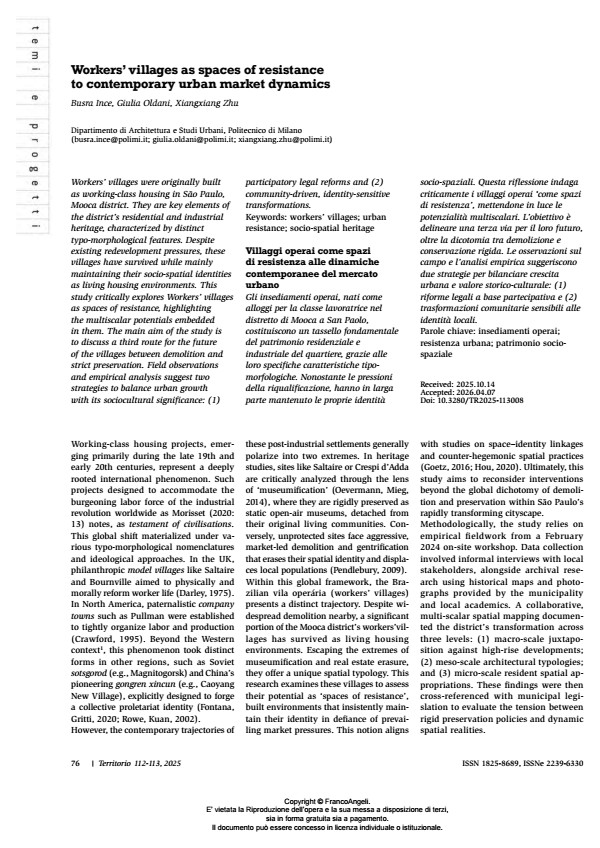
Workers’ villages were originally built as workingclass housing in São Paulo, Mooca district. They are key elements of the district’s residential and industrial heritage, characterized by distinct typomorphological features. Despite existing redevelopment pressures, these villages have survived while mainly maintaining their sociospatial identities as living housing environments. This study critically explores Workers’ villages as spaces of resistance, highlighting the multiscalar potentials embedded in them. The main aim of the study is to discuss a third route for the future of the villages between demolition and strict preservation. Field observations and empirical analysis suggest two strategies to balance urban growth with its sociocultural signi?cance: (1) participatory legal reforms and (2) communitydriven, identitysensitive transformations.�
Keywords: workers’ villages; urban resistance; sociospatial heritage
- Madanipour A., 2003, Public and private spaces of the city. London: Routledge. DOI: 10.4324/9780203402856
- Benclowicz C.M., 1989, Prelúdio modernista: Construindo a habitação operária em São Paulo. Master’s dissertation, Faculdade de Arquitetura e Urbanismo, Universidade de São Paulo.
- Blay E., 1985, Eu não tenho onde morar: Vilas operárias na cidade de São Paulo. São Paulo: Nobel.
- Bonduki N., 2014, a cura di, Os pioneiros da habitação social Vol. 1: Cem anos de construção de política pública no Brasil. São Paulo: Editora UNESP; Editora SESC.
- Bryman A., 1999, «The Disneyization of society». Sociological Review, 47, 1: 2547. DOI: 10.1111/1467954X.00161
- Caldeira T.P.R., 2000, City of walls: Crime, segregation, and citizenship in São Paulo. Berkeley: University of California Press.
- Carmona M., 2010, «Contemporary public space: Critique and classification, part one: Critique». Journal of Urban Design, 15, 1: 123148. DOI: 10.1080/13574800903435651
- Crawford M., 1995, Building the workingman’s paradise: The design of American company towns. London: Verso.
- Darley G., 1975, Villages of vision: A study of strange utopias. London: Architectural Press. Empresa Municipal de Urbanização [EMURB], Prefeitura Municipal de São Paulo [PMSP], 1978, Vilas e conjuntos habitacionais: Área
- Cura Brás Bresser Relatório III. São Paulo. Fontana G.L., Gritti A., 2020, a cura di, Architecture at Work: Towns and Landscapes of Industrial Heritage. Firenze: Forma Edizioni.
- Goetz E., 2016, «Resistance to social housing transformation». Cities, 57: 15.
- Grostein M.D., 1998, «Expansão urbana e habitação da classe trabalhadora: Da vila operária ao lote popular». In: Sampaio M.R.A. (ed.), Habitação e cidade. São Paulo: Fundação Editora da UNESP, 103120.
- Guerrand R., 1992, «Espaços privados». In: Perrot M. (ed.), História da vida privada. V. 4: Da Revolução Francesa à Primeira Guerra. São Paulo: Companhia das Letras, 325411.
- Hou J., 2020, «Guerrilla Urbanism: Urban design and the practices of resistance». Urban Design International, 25: 117125.
- Low S.M., 2003, Behind the gates: Life, security, and the pursuit of happiness in fortress America. New York: Routledge. DOI: 10.4067/S025071612003008700008
- Low S., Smith N., 2006, The politics of public space. New York: Routledge. DOI: 10.4324/9780203390306
- Miranda R.H., 2002, Mooca: Lugar de fazer casa. Doctoral dissertation, Universidade de São Paulo.
- Miranda R.H., 2015, Renovação urbana em São Paulo: Mooca, lugar de fazer casa. Novas Edições Acadêmicas.
- Miranda R.H., Sá H., Rister I., Alves D., Pacheco M.K., 2019, «A presença das vilas na construção da morfologia urbana dos bairros operários centrais de São Paulo». Atti del 3º Simpósio Cientí?co do ICOMOS Brasil, Belo Horizonte. UFMG.
- Morisset L.K., 2020, «From work to territory». In: Fontana G.L., Gritti A. (eds.), Architecture at Work: Towns and Landscapes of Industrial Heritage. Firenze: Forma Edizioni, 13.
- Oevermann H., Mieg H.A., 2014, eds., Industrial Heritage Sites in Transformation: Clash of Discourses. London: Routledge. DOI: 10.4324/9781315797991
- Pendlebury J., 2009, Conservation in the Age of Consensus. London: Routledge. DOI: 10.4324/9780203892343
- Poulios I., 2014, «Discussing strategy in heritage conservation: Living heritage approach as an intersection of economic development and conservation». Journal of Cultural Heritage Management and Sustainable Development, 4, 1: 5476. DOI: 10.1108/JCHMSD1020120048
- Rowe P.G., Kuan S., 2002, Architectural encounters with essence and form in Modern China. Cambridge: MIT Press.
- Scuderi G., 2019, «Designing flexibility and adaptability: The answer to integrated residential building retrofit». Designs, 3, 1: 3.
- Smith N., 2002, «New Globalism, New Urbanism: Gentrification as Global Urban Strategy». Antipode, 34, 3: 427450. DOI: 10.1111/14678330.00249
- Tramontano M.C., 1998, Novos modos de vida, novos espaços de morar. Doctoral dissertation, Universidade de São Paulo.
Busra Ince, Giulia Oldani, Xiangxiang Zhu, Workers' villages as spaces of resistance to contemporary urban market dynamics in "TERRITORIO" 112-113/2025, pp 76-82, DOI: 10.3280/TR2025-112008