An analysis of ASN (2021-2023) and its impact on academic recruitment in public economics
Journal title ECONOMIA PUBBLICA
Author/s Roberto Dell’Anno
Publishing Year 2026 Issue 2026/2
Language English Pages 57 P. 163-219 File size 1238 KB
DOI 10.3280/EP2026-002001
DOI is like a bar code for intellectual property: to have more infomation
click here
Below, you can see the article first page
If you want to buy this article in PDF format, you can do it, following the instructions to buy download credits
FrancoAngeli is member of Publishers International Linking Association, Inc (PILA), a not-for-profit association which run the CrossRef service enabling links to and from online scholarly content.
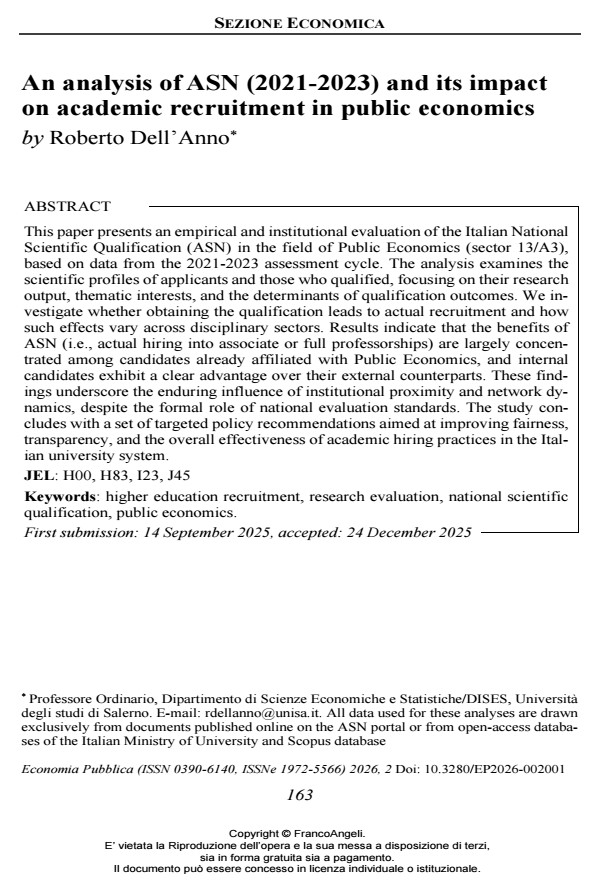
This paper presents an empirical and institutional evaluation of the Italian National Scientific Qualification (ASN) in the field of Public Economics (sector 13/A3), based on data from the 2021-2023 assessment cycle. The analysis examines the scientific profiles of applicants and those who qualified, focusing on their research output, thematic interests, and the determinants of qualification outcomes. We investigate whether obtaining the qualification leads to actual recruitment and how such effects vary across disciplinary sectors. Results indicate that the benefits of ASN (i.e., actual hiring into associate or full professorships) are largely concentrated among candidates already affiliated with Public Economics, and internal candidates exhibit a clear advantage over their external counterparts. These findings underscore the enduring influence of institutional proximity and network dynamics, despite the formal role of national evaluation standards. The study concludes with a set of targeted policy recommendations aimed at improving fairness, transparency, and the overall effectiveness of academic hiring practices in the Italian university system.
Keywords: higher education recruitment, research evaluation, national scientific qualification, public economics
Jel codes: H00, H83, I23, J45
- Abramo G., D’Angelo C. A. (2015a). An assessment of the first “scientific habilitation” for university appointments in Italy. Economia Politica, 32(3), 329-357.
- Abramo G., D’Angelo C. A., Rosati F. (2015b). The determinants of academic career advancement: Evidence from Italy. Science and Public Policy, 42(6), 761-774.
- Bagues M., Sylos-Labini M., & Zinovyeva N. (2019). Connections in scientific committees and applicants’ self-selection: Evidence from a natural randomized experiment. Labour Economics, 58, 81-97.
- Bethmann D., Bransch F., Kvasnicka M., Sadrieh A. (2023). Home Bias in Top Economics Journals. IZA Discussion Paper No. 15965.
- Bises B., Papagni E., Pignataro G. (2020). L’evoluzione della Scienza delle Finanze dall’osservatorio della Commissione Asn 2016-2018. Rivista di Diritto Finanziario e Scienza delle Finanze, LXXIX(4), I, 363-424.
- Card D., DellaVigna S. (2013). Nine facts about top journals in economics. Journal of Economic Literature, 51(1), 144-161.
- Colussi T. (2018). Social ties in academia: A friend is a treasure. Review of Economics and Statistics, 100(1), 45-50.
- Combes P., Linnemer L., Visser M. (2008). Publish or peer-rich? The role of skills and networks in hiring economics professors. Labour Economics, 15(3), 423-441.
- Ductor L., Visser B. (2022). When a coauthor joins an editorial board. Journal of Economic Behavior and Organization, 200(8), 576-595. DOI: 10.1016/J.JEBO.2022.06.014
- Durante R., Labartino G. and Perotti R. (2011). Academic Dynasties: Decentralization and Familism in the Italian Academia. NBER working paper 17572.
- Fratini S. M., Naccarato A. (2025). L’Abilitazione Scientifica Nazionale nei sei settori economici: un esame dei dati (2025). Presentazione SIE-CURV. Downloaded on June 4, 2025, from: -- https://www.siecon.org/sites/siecon.org/files/media_wysiwyg/analisi_asn_ottobre_2024_1.pdf.
- Gläser J., Laudel G. (2007). The Social Construction of Bibliometric Evaluations. In: Whitley R., Gläser J. (eds). The Changing Governance of the Sciences. Sociology of the Sciences Yearbook, vol 26. Springer, Dordrecht, The Netherlands.
- Hicks D., Wouters P., Waltman L., de Rijcke S., Rafols I. (2015). The Leiden Manifesto for Research Metrics. Nature, 520, 429-431.
- Marini G. (2017). New promotion patterns in Italian universities: Less seniority and more productivity? Data from ASN. Higher Education, 73(2), 189-207.
- Marzolla M. (2015). Quantitative analysis of the Italian national scientific qualification. Journal of Informetrics, 9(2), 285-316.
- Marzolla M. (2016). Assessing evaluation procedures for individual researchers: The case of the Italian National Scientific Qualification. Journal of Informetrics, 10(2), 408-438.
- Medoff M. H. (2003). Editorial favoritism in economics?. Southern Economic Journal, 70(2), 425-434.
- Moed H. F. (2005). Citation Analysis in Research Evaluation. Springer, Dordrecht, The Netherlands.
- Musselin C. (2009). The Market for Academics. Routledge, New York, USA. DOI: 10.4324/9780203863060
- Perotti R. (2002). The Italian University System: Rules vs. Incentives, presented at the First Conference on Monitoring, ISAE, Rome -- (Available from: https://igier.unibocconi.eu/sites/default/files/media/attach/Universita_6_4-02.pdf).
- Pezzoni M., Sterzi V., Lissoni F. (2012). Career progress in centralized academic systems: Social capital and institutions in France and Italy. Research Policy, 41(4), 704-719.
- Rettore E., Rocco L., Dal Maso C. (2017). Procedures vs. incentives: the university promotion system in Italy. Education Economics, 26(3), 213-232. DOI: 10.1080/09645292.2017.1398123
- Seglen P. O. (1997). Why the impact factor of journals should not be used for evaluating research. BMJ, 314(7079), 498-502.
- Waltman L., and van Eck N. J. (2013). Source normalized indicators of citation impact: An overview of different approaches and an empirical comparison. Scientometrics, 96(3), 699-716.
- Wooldridge J. (2010). Econometric Analysis of Cross-Section and Panel Data. Second edition, MIT Press.
- Zinovyeva N., Bagues M. (2015). The Role of Connections in Academic Promotions. American Economic Journal: Applied Economics, 7(2), 264-92.
Roberto Dell’Anno, An analysis of ASN (2021-2023) and its impact on academic recruitment in public economics in "ECONOMIA PUBBLICA " 2/2026, pp 163-219, DOI: 10.3280/EP2026-002001