ICT, FDI, and trade openness as determinants of GDP per capita: Insights from BRICS panel data analysis
Journal title ECONOMIA PUBBLICA
Author/s Rajesh Kumar, Debasis Neogi
Publishing Year 2026 Issue 2026/2
Language English Pages 17 P. 221-237 File size 274 KB
DOI 10.3280/EP2026-002002
DOI is like a bar code for intellectual property: to have more infomation
click here
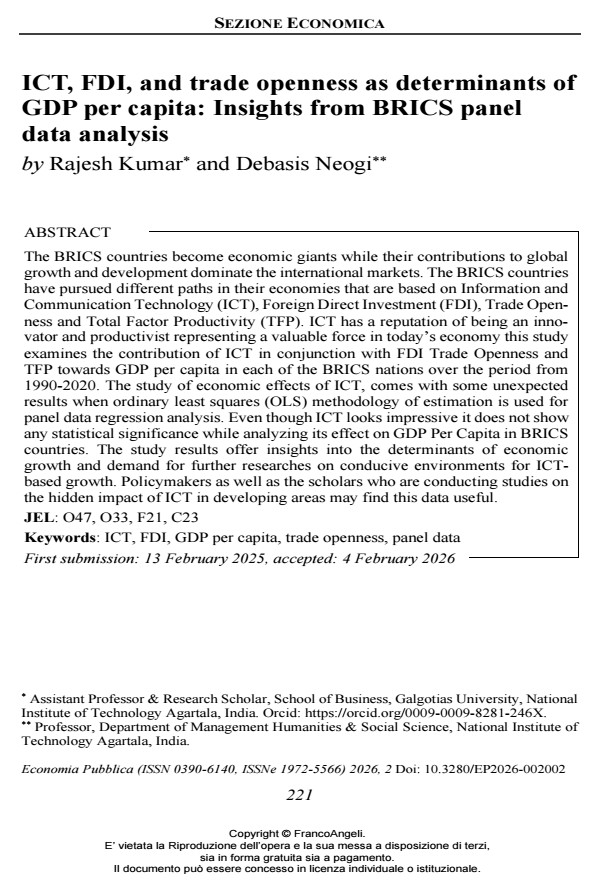
Below, you can see the article first page
If you want to buy this article in PDF format, you can do it, following the instructions to buy download credits
FrancoAngeli is member of Publishers International Linking Association, Inc (PILA), a not-for-profit association which run the CrossRef service enabling links to and from online scholarly content.
The BRICS countries become economic giants while their contributions to global growth and development dominate the international markets. The BRICS countries have pursued different paths in their economies that are based on Information and Communication Technology (ICT), Foreign Direct Investment (FDI), Trade Openness and Total Factor Productivity (TFP). ICT has a reputation of being an innovator and productivist representing a valuable force in today’s economy this study examines the contribution of ICT in conjunction with FDI Trade Openness and TFP towards GDP per capita in each of the BRICS nations over the period from 1990-2020. The study of economic effects of ICT, comes with some unexpected results when ordinary least squares (OLS) methodology of estimation is used for panel data regression analysis. Even though ICT looks impressive it does not show any statistical significance while analyzing its effect on GDP Per Capita in BRICS countries. The study results offer insights into the determinants of economic growth and demand for further researches on conducive environments for ICT-based growth. Policymakers as well as the scholars who are conducting studies on the hidden impact of ICT in developing areas may find this data useful
Keywords: ICT, FDI, GDP per capita, trade openness, panel data
Jel codes: O47, O33, F21, C23
- Goldman Sachs (2001). Building better global economic BRICs. Goldman Sachs Global Economics Paper No. 66.
- Hausman J. A. (1978). Specification tests in econometrics. Econometrica, 46(6): 1251-1271.
- Alfaro L. (2003). Foreign direct investment and growth: Does the sector matter?. Journal of International Economics, 61(2): 512-532.
- Baltagi B. H. (2021). Econometric analysis of panel data (6th ed.). Springer.
- Bano S., Tabbada E. M. (2021). Foreign direct investment, institutional quality and economic growth: Evidence from BRICS economies. International Journal of Economics and Finance, 13(8): 45-62.
- Borensztein E., De Gregorio J., Lee J. W. (1998). How does foreign direct investment affect economic growth?. Journal of International Economics, 45(1): 115-135. DOI: 10.1016/S0022-1996(97)00033-0
- Bresnahan T. F., Trajtenberg M. (1995). General purpose technologies ‘Engines of growth’?. Journal of Econometrics, 65(1): 83-108.
- Chattopadhyay S., Bose S., Das P. (2022). Economic growth dynamics in BRICS nations: Trade and investment perspectives. Economic Research Publications.
- Chen L., Wang M., Liu X. (2020). Trade openness and global value chains in emerging economies. International Economics Review, 28(3): 178-195.
- Czernich N., Falck O., Kretschmer T., Woessmann L. (2011). Broadband infrastructure and economic growth. The Economic Journal, 121(552): 505-532.
- Dosi G., Roventini A., Russo E. (2021). Public policies and the art of catching up: Matching the historical evidence with a multicountry agent-based model. Industrial and Corporate Change, 30(4): 1011-1036.
- Dreher A. (2006). Does globalization affect growth? Evidence from a new index of globalization. Applied Economics, 38(10): 1091-1110. DOI: 10.1080/00036840500412414
- Égert B. (2022). Regulation, institutions, and productivity: New macroeconomic evidence from OECD countries. American Economic Journal: Macroeconomics, 14(2): 109-142.
- Frankel J. A., Romer D. (1999). Does trade cause growth?. American Economic Review, 89(3): 379-399.
- Kumar R., Singh A., Patel N. (2019). Total factor productivity and economic growth in BRICS economies: Policy implications for sustainable development. Economic Development Quarterly, 33(2): 145-168.
- Ndubuisi G., Omoteso K., Tanna S. (2020). ICT adoption, institutional quality and economic growth in emerging economies. Technological Forecasting and Social Change, 157: 120-135.
- Niebel T. (2018). ICT and economic growth – Comparing developing, emerging and developed countries. World Development, 104: 197-211.
- Pohjola M. (2000). Information technology and economic growth: A cross-country analysis. Information Economics and Policy, 12(1): 19-38.
- Qiang C. Z. W., Rossotto C. M., & Kimura K. (2009). Economic impacts of broadband. In Information and communications for development 2009: Extending reach and increasing impact (pp. 35-50). World Bank.
- Sahoo P., Sethi N. (2023). Trade liberalization, foreign direct investment, and economic growth nexus in emerging economies. Journal of Economic Development, 48(3): 89-115.
- Singh K., Dube M. (2014). BRICS economies and their changing dynamics in global GDP. International Journal of Economic Research, 11(2): 299-312.
- Solow R. M. (1956). A contribution to the theory of economic growth. Quarterly Journal of Economics, 70(1): 65-94. DOI: 10.2307/1884513
- Vu K. M. (2023). Digital transformation and economic development: New evidence from global panel data. Technology in Society, 72: 102-118.
- World Bank (2020). World development indicators. World Bank Group.
- Zhang K. H. (2001). Does foreign direct investment promote economic growth? Evidence from East Asia and Latin America. Contemporary Economic Policy, 19(2): 175-185.
Rajesh Kumar, Debasis Neogi, ICT, FDI, and trade openness as determinants of GDP per capita: Insights from BRICS panel data analysis in "ECONOMIA PUBBLICA " 2/2026, pp 221-237, DOI: 10.3280/EP2026-002002