Sicilian Secondary Railways Serving Inner Areas: Sulphur Extraction, Citrus Trade and Rural Development
Journal title STORIA URBANA
Author/s Giulio Pappa
Publishing Year 2026 Issue 2026/183
Language Italian Pages 20 P. 79-98 File size 807 KB
DOI 10.3280/SU2026-183005
DOI is like a bar code for intellectual property: to have more infomation
click here
Below, you can see the article first page
If you want to buy this article in PDF format, you can do it, following the instructions to buy download credits
FrancoAngeli is member of Publishers International Linking Association, Inc (PILA), a not-for-profit association which run the CrossRef service enabling links to and from online scholarly content.
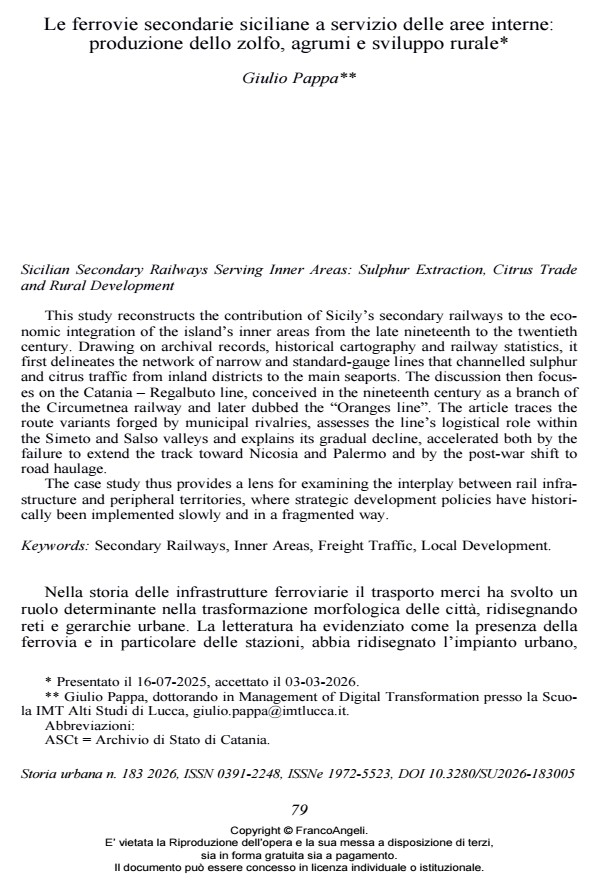
This study reconstructs the contribution of Sicily’s secondary railways to the eco-nomic integration of the island’s inner areas from the late nineteenth to the twentieth century. Drawing on archival records, historical cartography and railway statistics, it first delineates the network of narrow and standard-gauge lines that channelled sulphur and citrus traffic from inland districts to the main seaports. The discussion then focus-es on the Catania – Regalbuto line, conceived in the nineteenth century as a branch of the Circumetnea railway and later dubbed the “Oranges line”. The article traces the route variants forged by municipal rivalries, assesses the line’s logistical role within the Simeto and Salso valleys and explains its gradual decline, accelerated both by the failure to extend the track toward Nicosia and Palermo and by the post-war shift to road haulage. The case study thus provides a lens for examining the interplay between rail infra-structure and peripheral territories, where strategic development policies have histori-cally been implemented slowly and in a fragmented way.
Keywords: Secondary Railways, Inner Areas, Freight Traffic, Local Development.
Giulio Pappa, Le ferrovie secondarie siciliane a servizio delle aree interne: produzione dello zolfo, agrumi e sviluppo rurale in "STORIA URBANA " 183/2026, pp 79-98, DOI: 10.3280/SU2026-183005