The Weimar Warning: How Market-Oriented Sovereigntism By-passed Democracy
Journal title PRISMA Economia - Società - Lavoro
Author/s Ronald Car
Publishing Year 2026 Issue 2026/1
Language Italian Pages 14 P. 40-53 File size 115 KB
DOI 10.3280/PRI2026-001004
DOI is like a bar code for intellectual property: to have more infomation
click here
Below, you can see the article first page
If you want to buy this article in PDF format, you can do it, following the instructions to buy download credits
FrancoAngeli is member of Publishers International Linking Association, Inc (PILA), a not-for-profit association which run the CrossRef service enabling links to and from online scholarly content.
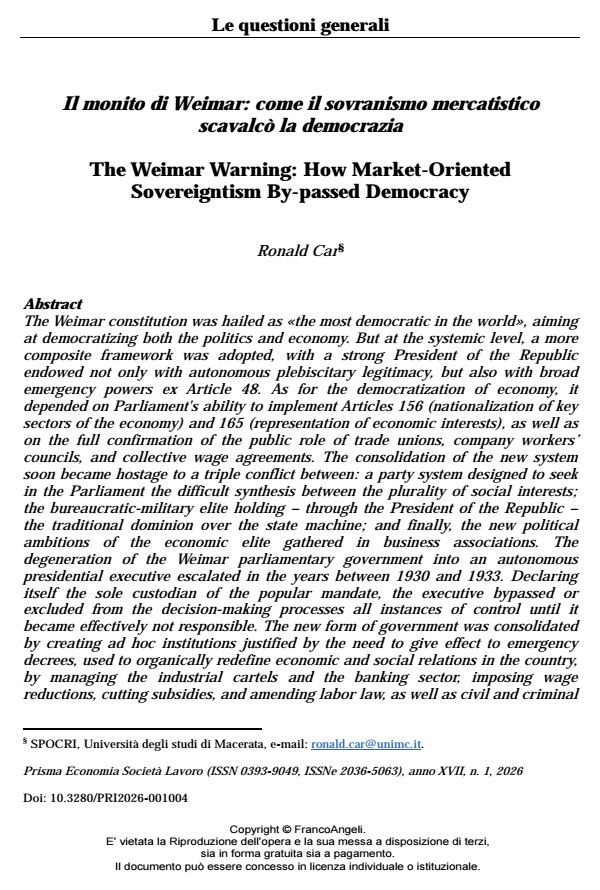
The Weimar constitution was hailed as «the most democratic in the world», aiming at democratizing both the politics and economy. But at the systemic level, a more composite framework was adopted, with a strong President of the Republic endowed not only with autonomous plebiscitary legitimacy, but also with broad emergency powers ex Article 48. As for the democratization of economy, it depended on Parliament's ability to implement Articles 156 (nationalization of key sectors of the economy) and 165 (representation of economic interests), as well as on the full confirmation of the public role of trade unions, company workers’ councils, and collective wage agreements. The consolidation of the new system soon became hostage to a triple conflict between: a party system designed to seek in the Parliament the difficult synthesis between the plurality of social interests; the bureaucratic-military elite holding – through the President of the Republic – the traditional dominion over the state machine; and finally, the new political ambitions of the economic elite gathered in business associations. The degeneration of the Weimar parliamentary government into an autonomous presidential executive escalated in the years between 1930 and 1933. Declaring itself the sole custodian of the popular mandate, the executive bypassed or excluded from the decision-making processes all instances of control until it became effectively not responsible. The new form of government was consolidated by creating ad hoc institutions justified by the need to give effect to emergency decrees, used to organically redefine economic and social relations in the country, by managing the industrial cartels and the banking sector, imposing wage reductions, cutting subsidies, and amending labor law, as well as civil and criminal procedure. The systematic use of emergency decrees paved the way for a tacit redefinition of the form of government, which in turn opened the way to the Hitlerian autocracy in 1933.
Keywords: Weimar constitution, emergency decrees, business associations, market rationality, Wirtschaftsbeirat.
- Bracher K.D. (1980), “Demokratie und Machtvakuum. Zum Problem des Parteienstaats in der Auflösung der Weimarer Republik”, in idem (Hrsg.), Weimar - Selbstpreisgabe einer Demokratie: Eine Bilanz heute, Droste, Düsseldorf, p. 129.
- Brauchitsch I. von (1990), Staatliche Zwangsschlichtung: Die Aushöhlung der Tarifautonomie in der Weimarer Republik, P. Lang, Frankfurt a. M./New York.
- Chapoutot J. (2025), Les Irresponsables. Qui a porté Hitler au pouvoir?, Gallimard, Paris.
- David E. (1919), in Stenographische Berichte der Verfassungsgebenden Deutschen Nationalversammlung, 71. Sitzung vom 31. Juli 1919, in -- https://www.reichstagsprotokolle.de/Blatt2_wv_bsb00000013_00069.html.
- Dessauer F. (1928), Recht, Richtertum und Ministerialbürokratie: Eine Studie über der Einfluß von Machtverschiebungen auf die Gestaltung des Privatrechts, Bensheimer, Mannheim, Berlin, Leipzig.
- Fraenkel E. (1932), “Verfassungsform und Sozialdemokratie”, in Die Gesellschaft. Internationale Revue für Sozialismus und Politik, 12, p. 486.
- Gusy Ch., Eichenhofer J. (2023), “The ‘dictatorship’ of the Reichspräsident (Art. 48 Weimar Constitution)”, in M. Gregorio, P. Corona (a cura di), Weimar 1919. Alle origini del costituzionalismo democratico novecentesco, Giuffrè Francis Lefebvre, Milano, pp. 101-115.
- Hamburger E. (1932), “Dialektik der staatsrechtlichen Entwicklung in der Wirtschaftskrise”, in Die Gesellschaft. Internationale Revue für Sozialismus und Politik, n. 1, pp. 20-21.
- Holzbach H. (1981), Das “System Hugenberg”: die Organisation bürgerlicher Sammlungspolitik vor dem Aufstieg der NSDAP, Dt. Verl.-Anst., Stuttgart.
- Hömig H. (2000), Brüning: Kanzler in der Krise der Republik; eine Weimarer Biographie, Schöningh, Paderborn.
- John J. (1992), “Zur politischen Rolle der Großindustrie in der Weimarer Staatskrise. Gesicherte Erkenntnisse und strittige Meinungen”, in H.A. Winkler, a cura di, Die deutsche Staatskrise 1930-1933. Handlungsspielräume und Alternativen, Oldenbourg, München, p. 235.
- Jones L.E. (2020), The German Right, 1918-1930: Political Parties, Organized Interests, and Patriotic Associations in the Struggle against Weimar Democracy, Cambridge University Press, New York, pp. 549-550.
- Käppner J. (2017), 1918 - Aufstand für die Freiheit. Die Revolution der Besonnenen, Piper, München.
- Kluge U. (1985), Die deutsche Revolution 1918/1919. Staat, Politik und Gesellschaft zwischen Weltkrieg und Kapp-Putsch, Suhrkamp, Frankfurt am Main.
- Köhler V. (2018), Genossen-Freunde-Junker: die Mikropolitik personaler Beziehungen im politischen Handeln während der Weimarer Republik, Wallstein Verlag, Göttingen.
- Kühne J.D. (2022), Die Entstehung der Weimarer Reichsverfassung: Grundlagen und anfängliche Geltung, Droste, Düsseldorf, in particolare pp. 281-291.
- Lösche P. (1967), Der Bolschewismus im Urteil der deutschen Sozialdemokratie, Colloquium, Berlin.
- Mommsen H. (2018), Die verspielte Freiheit: Aufstieg und Untergang der Weimarer Republik, Ullstein, Berlin (ed. or. 1989), capitolo XI, Der Weg zur Präsidialdiktatur, pp. 542-592.
- Neebe R. (1981), Großindustrie, Staat und NSDAP 1930-1933: Paul Silverberg und der Reichsverband der Deutschen Industrie in der Krise der Weimarer Republik, Vandenhoeck & Ruprecht, Göttingen, p. 104.
- Niess W. (2017), Die Revolution von 1918/19. Der wahre Beginn unserer Demokratie, Europa, Berlin.
- Oertzen P. von (2008), “Arbeiterbewegung, Arbeiterräte und Arbeiterbewußtsein in der Deutschen Revolution 1918/19”, in H. Grebing (Hrsg.), Die deutsche Revolution 1918/19. Eine Analyse, Vorwärts, Berlin, pp. 68-102.
- Patch W.L. (2006), Heinrich Brüning and the Dissolution of the Weimar Republic, Cambidge University Press, Cambridge, pp. 207 ss.
- Richter L. (2002), Die Deutsche Volkspartei 1918-1933, Droste-Verlag, Düsseldorf.
- Schmitt C. (1931), Der Hüter der Verfassung, Mohr, Tübingen, pp. 225 ss.
- Schmitt C. (1958), “Das Problem der innerpolitischen Neutralität des Staates”, ripubblicato in Id., Verfassungsrechtliche Aufsätze aus den Jahren 1924-1954: Materialien zu einer Verfassungslehre, Duncker & Humblot, Berlin, p. 41 ss.
- Schneider M. (1987), “Zwischen Machtanspruch und Integrationsbereitschaft: Gewerkschaften und Politik 1918-1933”, in K.D. Bracher, M. Funke, H.-A. Jacobsen (Hrsg.), Die Weimarer Republik 1918-1933. Politik. Wirtschaft. Gesellschaft, Droste, Düsseldorf, p. 179-196, qui p. 192.
- Schneider M. (1987), “Höhen, Krisen und Tiefen: Die Gewerkschaften in der Weimarer Republik 1918 bis 1933”, in K. Tenfelde (Hrsg.), Geschichte der deutschen Gewerkschaften von den Anfängen bis 1945, Bund, Köln, p. 393.
- Schneider M. (2007), “Arbeitsbeschaffung: der Vorstoß der Freien Gewerkschaften in der Weltwirtschaftskrise der 1930er Jahre”, in U. Achten, P. Gerstenkorn, H. Menze (Hrsg.), Recht auf Arbeit, Recht auf Faulheit, ver.di Bildung + Beratung, Düsseldorf, p. 87.
- Stegmann D. (1976), “Kapitalismus und Faschismus in Deutschland 1929-1934: Thesen und Materialien zur Restituierung des Primats der Großindustrie zwischen Weltwirtschaftskrise und beginnender Rüstungskonjunktur. Fritz Fischer zum 5.3.1976”, Gesellschaft, 6, p. 54.
- Steiger K. (1998), Kooperation, Konfrontation, Untergang: Das Weimarer Tarif-und Schlichtungswesen während der Weltwirtschaftskrise und seine Vorbedingungen, Beiträge zur Unternehmensgeschichte 5, Steiner, Stuttgart.
- Steiniger A. (1948), Commissione costituzionale del Deutscher Volksrat, l’11 maggio 1948, in SAPMO-BA DA / 1/149/51 / M319 / 82, pp. 21-22.
- Vereinigung Deutscher Staatsrechtler (1924), “Die Diktatur des Reichspräsidenten”, in Veröffentlichungen der Vereinigung Deutscher Staatsrechtler, Berlin, Leipzig, pp. 91 ss, 115 ss.
- Winkler H.A. (1969), “Unternehmerverbände zwischen Ständeideologie und Nationalsozialismus”, Vierteljahrshefte für Zeitgeschichte, 4, p. 342.
- Winkler H.A. (1974), “Einleitende Bemerkungen zu Hilferdings Theorie des organisierten Kapitalismus”, in Idem (Hrsg.), Organisierter Kapitalismus. Voraussetzungen und Anfänge, Vandhoeck & Ruprecht, Göttingen, pp. 9-17.
- Winkler H.A. (1998), La repubblica di Weimar: 1918-1933: storia della prima democrazia tedesca, Donzelli, Roma, p. 391.
- Winkler H.A. (2002), Weimar im Widerstreit. Deutungen der ersten deutschen Republik im geteilten Deutschland, Oldenbourg Verlag, München.
- Winkler H.A. (2020), Der lange Weg nach Westen: Deutsche Geschichte vom Ende des Alten Reiches bis zum Untergang der Weimarer Republik, Band 1, Beck, München, p. 491.
Ronald Car, Il monito di Weimar: come il sovranismo mercatistico scavalcò la democrazia in "PRISMA Economia - Società - Lavoro" 1/2026, pp 40-53, DOI: 10.3280/PRI2026-001004