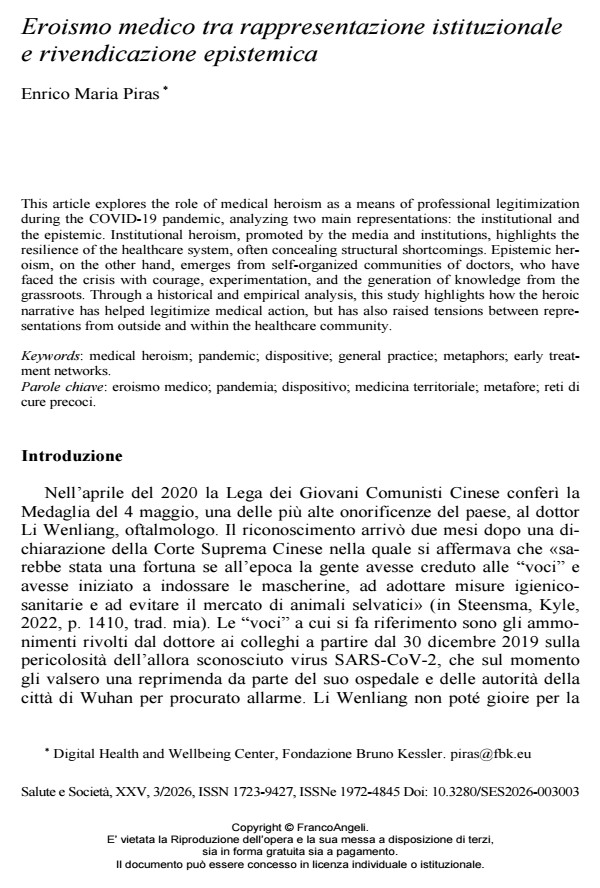
Eroismo medico tra rappresentazione istituzionale e rivendicazione epistemica
Journal title SALUTE E SOCIETÀ
Author/s Enrico Maria Piras
Publishing Year 2026 Issue 2026/3
Language Italian Pages 17 P. 25-41 File size 357 KB
DOI 10.3280/SES2026-003003
DOI is like a bar code for intellectual property: to have more infomation
click here
Below, you can see the article first page
If you want to buy this article in PDF format, you can do it, following the instructions to buy download credits
FrancoAngeli is member of Publishers International Linking Association, Inc (PILA), a not-for-profit association which run the CrossRef service enabling links to and from online scholarly content.
This article explores the role of medical heroism as a means of professional legitimization during the COVID-19 pandemic, analyzing two main representations: the institutional and the epistemic. Institutional heroism, promoted by the media and institutions, highlights the resilience of the healthcare system, often concealing structural shortcomings. Epistemic heroism, on the other hand, emerges from self-organized communities of doctors, who have faced the crisis with courage, experimentation, and the generation of knowledge from the grassroots. Through a historical and empirical analysis, this study highlights how the heroic narrative has helped legitimize medical action, but has also raised tensions between representations from outside and within the healthcare community.
Keywords: medical heroism; pandemic; dispositive; general practice; metaphors; early treatment networks.
- Dada S., Ashworth H.C., Bewa M.J., Dhatt R. (2021). Words matter: Political and gender analysis of speeches made by heads of government during the COVID-19 pandemic. BMJ Global Health, 6(1): e003910.
- Darlow J. (2020). Thanks for the support, but I don’t want your clapping. The BMJ Opinion, April 16. Testo disponibile al sito: https://blogs.bmj.com/bmj/2020/04/16/jennifer-darlow-thanks-for-the-support-but-i-dont-want-your-clapping/ (09/07/2026)
- Deleuze G., Guattari F. (1980). Mille plateaux. Paris: Les Éditions de Minuit.
- Dik B.J., Shimizu A.B., O’Connor W.F. (2016). Career development and a sense of calling: Contexts for heroism. In: Allison S.T., Goethals G.R., Kramer R.M., a cura di, Handbook of heroism and heroic leadership. New York: Routledge.
- Eyre A. (2018). The making of a hero: an exploration of heroism in disasters and implications for the emergency services. In: Murphy P., Greenhalgh K., a cura di, Fire and rescue services: Leadership and management perspectives. Cham: Springer International Publishing.
- Foucault M. (1994). Dits et écrits, 1954-1988, Tome I: 1954-1969. Paris: Gallimard.
- Gillis M. (2020). Ventilators, missiles, doctors, troops… the justification of legislative responses to COVID-19 through military metaphors. Law and Humanities, 14(2): 135-159. DOI: 10.1080/17521483.2020.180195
- Green A. (2020). Li Wenliang. The Lancet, 395(10225): 682.
- Hsin D.H.C., Macer D.R. (2004). Heroes of SARS: professional roles and ethics of health care workers. Journal of Infection, 49(3): 210-215.
- Jarvis L. (2022). Constructing the coronavirus crisis: Narratives of time in British political discourse on COVID-19. British Politics, 17(1): 24-43.
- Kinsella E.L., Hughes S., Lemon S., Stonebridge N., Sumner R.C. (2021). “We shouldn’t waste a good crisis”: the lived experience of working on the frontline through the first surge (and beyond) of COVID-19 in the UK and Ireland. Psychology & Health, 37(2): 151-177. DOI: 10.1080/08870446.2021.192866
- Lusardi R., Bronzini M., Piras E.M. (2023). Low-intensity epistemic war. Medical communities and the development of legitimate knowledge in times of radical uncertainty. Rassegna Italiana di Sociologia, 64(4): 643-674. DOI: 10.1423/11240
- Malm H., May T., Francis L.P., Omer S.B., Salmon D.A., Hood R. (2008). Ethics, pandemics, and the duty to treat. The American Journal of Bioethics, 8(8): 4-19. DOI: 10.1080/1526516080231797
- McCormick L. (2020). Marking time in lockdown: Heroization and ritualization in the UK during the coronavirus pandemic. American Journal of Cultural Sociology, 8(3): 324-351.
- McEwan C., Lewis K.V., Szablewska L. (2023). UK street art and the meaning of masks during the COVID-19 pandemic, 2020-21. Social & Cultural Geography, 24(3-4): 503-523. DOI: 10.1080/14649365.2022.206569
- Melden A.I., a cura di (1958). Essays in moral philosophy. Seattle: University of Washington Press.
- Mohammed S., Peter E., Killackey T., Maciver, J. (2021). The “nurse as hero” discourse in the COVID-19 pandemic: A poststructural discourse analysis. International journal of nursing studies, 117, 103887.
- Pangborn S.M., Boatwright B.C., Miller C.L., Velting M.N. (2023). “I Don’t feel like a Hero”: frontline healthcare providers’ social media storytelling during COVID-19. Health Communication, 38(8): 1508-1518. DOI: 10.1080/10410236.2021.201710
- Pellegrinelli C., Parolin L.L. (2025). Changing Narrative Through Theatre. The Case of Bergamo ER Theatre Covid Play. In: de Vaujany F.-X., Pulk K., Labardin P., a cura di, Historicity in Organization Studies: Describing Events and Actuality at the Borders of Our Present. Cham: Springer Nature Switzerland.
- Petersen E., Hui D., Hamer D.H., Blumberg L., Madoff L.C. et al. (2020). Li Wenliang, a face to the frontline healthcare worker. The first doctor to notify the emergence of the SARS-CoV-2, (COVID-19), outbreak. International journal of infectious diseases, 93: 205-207.
- Piredda P. (2022). War metaphors during the Covid-19 pandemic: Persuasion and manipulation. In: Blumczynski P., Wilson S., a cura di, The Languages of COVID-19. Translational and Multilingual Perspectives on Global Healthcare. New York: Routledge.
- Plews-Ogan M., Owens J.E., May N., Ardelt M. (2016). Heroism and wisdom in medicine. In: Plews-Ogan M., Owens J.E., May N., Ardelt M., a cura di, Handbook of heroism and heroic leadership. New York: Routledge.
- Redfield P. (2005). Doctors, borders, and life in crisis. Cultural anthropology, 20(3): 328-361.
- Reid L. (2005). Diminishing returns? risk and the duty to care in the SARS epidemic. Bioethics,19(4):348-361.
- Reilley B., Van Herp M., Sermand D., Dentico N. (2003). SARS and Carlo Urbani. New England Journal of Medicine, 348(20): 1951-1952.
- Sarkar U., Cassel C. (2021). Humanism before heroism in medicine. JAMA, 326(2): 127-128.
- Skog F., Lundström, R. (2022). Heroes, victims, and villains in news media narratives about COVID-19. Analysing moralising discourse in Swedish newspaper reporting during the spring of 2020. Social Science & Medicine, 294: 114718.
- Spicksley K., Franklin E. (2023). Who works on the ‘frontline’? comparing constructions of ‘frontline’work before and during the COVID-19 pandemic. Applied Corpus Linguistics, 3(3): 100059.
- Steensma D.P., Kyle R.A. (2022). Dr Li Wenliang: Wuhan “whistleblower” and early COVID-19 victim. Mayo Clinic Proceedings, 97(7): 1409-1410.
- Sumner R.C. (2024). Medical heroism. In: Allison S.T., Beggan J.K., Goethals G.R., a cura di, Encyclopedia of heroism studies. Cham: Springer International Publishing.
- Weisse A.B. (2012). Self-experimentation and its role in medical research. Texas Heart Institute Journal, 39(1): 51.
- Agamben G. (2006). Che cos’è un dispositivo. Roma: Nottetempo.
- American Medical Association (1897). Code of medical ethics of the American Medical Association: Originally adopted at the adjourned meeting of the national medical convention in Philadelphia, may 1847. Chicago: American Medical Association Press.
- American Medical Association (1957). Principles of medical ethics. Chicago: American Medical Association Press.
- Bencivelli S. (2024). Eroica, folle e visionaria. Storie di medicina spericolata. Torino: Bollati Boringhieri.
- Brotherton S., Kao A., Crigger B.J. (2016). Professing the values of medicine: the modernized AMA code of medical ethics. Jama, 316(10): 1041.
- Brown M. (2010). “Like a devoted army”: medicine, heroic masculinity, and the military paradigm in Victorian Britain. Journal of British Studies, 49(3): 592-622. DOI: 10.1086/65200
- Chen J., Cheng, J. (2025). The generation of “instant memory”: the digital memory of Dr. Li Wenliang in the COVID-19 outbreak in China. Chinese Journal of Communication, 1-16. DOI: 10.1080/17544750.2025.249617
Enrico Maria Piras, Eroismo medico tra rappresentazione istituzionale e rivendicazione epistemica in "SALUTE E SOCIETÀ" 3/2026, pp 25-41, DOI: 10.3280/SES2026-003003