Rabbia sociale: origine, cause e implicazioni. Una Systematic review
Journal title SALUTE E SOCIETÀ
Author/s Carmelo Guarino
Publishing Year 2026 Issue 2026/3
Language Italian Pages 14 P. 157-170 File size 459 KB
DOI 10.3280/SES2026-003011
DOI is like a bar code for intellectual property: to have more infomation
click here
Below, you can see the article first page
If you want to buy this article in PDF format, you can do it, following the instructions to buy download credits
FrancoAngeli is member of Publishers International Linking Association, Inc (PILA), a not-for-profit association which run the CrossRef service enabling links to and from online scholarly content.
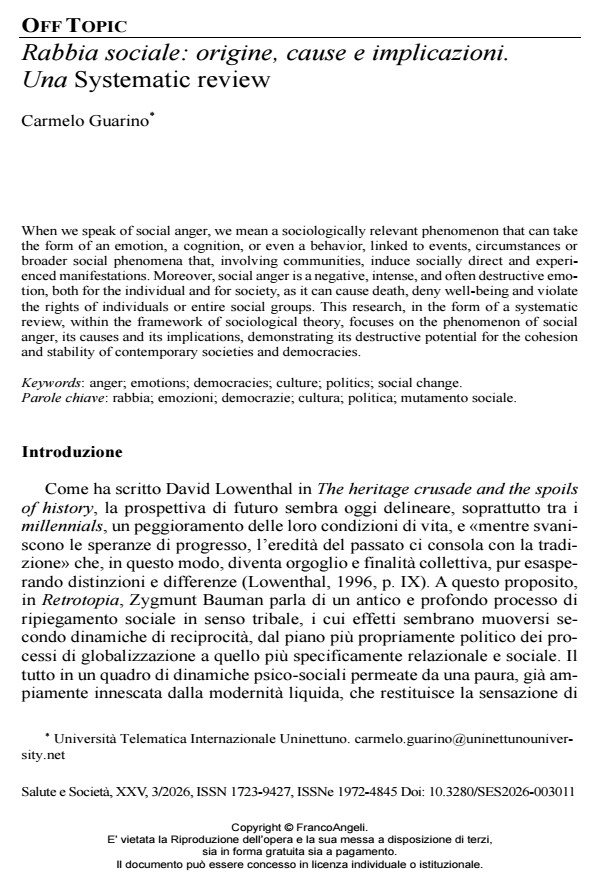
When we speak of social anger, we mean a sociologically relevant phenomenon that can take the form of an emotion, a cognition, or even a behavior, linked to events, circumstances or broader social phenomena that, involving communities, induce socially direct and experienced manifestations. Moreover, social anger is a negative, intense, and often destructive emotion, both for the individual and for society, as it can cause death, deny well-being and violate the rights of individuals or entire social groups. This research, in the form of a systematic review, within the framework of sociological theory, focuses on the phenomenon of social anger, its causes and its implications, demonstrating its destructive potential for the cohesion and stability of contemporary societies and democracies.
Keywords: anger; emotions; democracies; culture; politics; social change.
- Alia-Klein N., Gan G., Gilam G., Bezek J., Bruno A., Denson T.F., Hendler T., Lowe L., Mariotti V., Muscatello M.R., Palumbo S., Pellegrini S., Pietrini P., Rizzo A., Verona, E. (2020). The feeling of anger: from brain networks to linguistic expressions. Neuroscience and biobehavioral reviews, 108: 480-497.
- Alia-Klein N., Preston-Campbell R.N., Moeller S.J., Parvaz M.A., Bachi K., Gan G., Zilverstand A., Konova A.B., Goldstein R.Z. (2018). Trait anger modulates neural activity in the fronto-parietal attention network. PloS one, 13(4): e0194444.
- Averill R.J. (2012). Anger and aggression. An essay on emotion. New York, Heidelberg, Berlin: Springer-Verlag.
- Bailey K.D. (1982). Methods of social research. New York: The Free Press (trad. it.: Metodi della ricerca sociale. Bologna: Il Mulino, 2006).
- Barrett L.F. (2006). Solving the emotion paradox: categorization and the experience of emotion. Personality and social psychology review: an official journal of the Society for Personality and Social Psychology, Inc, 10(1): 20-46.
- Barrett L.F., Quigley K.S., Bliss-Moreau E., Aronson K.R. (2004). Interoceptive sensitivity and self-reports of emotional experience. Journal of personality and social psychology, 87(5): 684-697. DOI: 10.1037/0022-3514.87.5.68
- Bauman Z. (2006). Liquid fear. Cambridge (MA): Polity Press (trad. it.: Paura liquida. Roma-Bari: Laterza, 2008).
- Bauman Z. (2017). Retrotopia. Cambridge (MA): Polity Press (trad. it.: Retrotopia. Roma-Bari: Laterza, 2017).
- Bauman Z., Bordoni C. (2015). Stato di crisi. Torino: Einaudi.
- Beck U. (2016). The metamorphosis of the world. Cambridge (UK): Polity Press.
- Bender A., Spada H., Rothe-Wulf A., Traber S., Rauss K. (2012). Anger elicitation in tonga and Germany: the impact of culture on cognitive determinants of emotions. Frontiers in psychology, 3: 435.
- Berkowitz L. (1990). On the formation and regulation of anger and aggression. A cognitive-neoassociationistic analysis. The American psychologist, 45(4): 494-503.
- Berkowitz L. (2012). A different view of anger: the cognitive-neoassociation conception of the relation of anger to aggression. Aggressive behavior, 38(4): 322-333.
- Berkowitz L., Harmon-Jones E. (2004). Toward an understanding of the determinants of anger. Emotion, 4(2): 107-130. DOI: 10.1037/1528-3542.4.2.10
- Bernat E.M., Hall J.R., Steffen B.V., Patrick C.J. (2007). Violent offending predicts P300 amplitude. International journal of psychophysiology: Official Journal of the International Organization of Psychophysiology, 66(2): 161-167.
- Boiger M., Mesquita, B., Uchida Y., Feldman Barrett L. (2013). Condoned or condemned: the situational affordance of anger and shame in the United States and Japan. Personality & social psychology bulletin, 39(4): 540-553. DOI: 10.1177/014616721347820
- Buades-Rotger M., Beyer F., Krämer U.M. (2017). Avoidant responses to interpersonal provocation are associated with increased amygdala and decreased mentalizing network activity. eNeuro, 4(3): ENEURO.0337-16.2017. DOI: 10.1523/ENEURO.0337-16.201
- Buades-Rotger M., Engelke C., Beyer F., Keevil B.G., Brabant G., Krämer U.M. (2016). Endogenous testosterone is associated with lower amygdala reactivity to angry faces and reduced aggressive behavior in healthy young women. Scientific report, 6: 38538.
- Butler A., Hall H., Copnell B. (2016). A guide to writing a qualitative systematic review protocol to enhance evidence-based practice in nursing and health care. Worldviews evidence based-nursing, 13(3): 241-249.
- CENSIS (2024). 58° Rapporto sulla situazione sociale del Paese. Milano: FrancoAngeli.
- Cipolla C., a cura di (2004). Manuale di sociologia della salute. Milano: FrancoAngeli.
- Clark-Polner E., Johnson T.D., Barrett L.F. (2017). Multivoxel pattern analysis does not provide evidence to support the existence of basic emotions. Cerebral cortex, 27(3): 1944-1948.
- Coccaro E.F., Noblett K.L., McCloskey M.S. (2009). Attributional and emotional responses to socially ambiguous cues: validation of a new assessment of social/emotional information processing in healthy adults and impulsive aggressive patients. Journal of psychiatric research, 43(10): 915-925.
- Corbetta P. (1999). Metodologie e tecniche della ricerca sociale. Bologna: Il Mulino.
- Corbin J., Strauss A. (1990). Grounded theory research: procedures, canons, and evaluative criteria. Qualitative sociology, 13(1): 3-21. DOI: 10.1007/BF00988593
- Damasio A., Carvalho G.B. (2013). The nature of feelings: evolutionary and neurobiological origins. Nature reviews. Neuroscience, 14(2): 143-152.
- Garfinkel S.N., Zorab E., Navaratnam N., Engels M., Mallorquí-Bagué N., Minati L., Dowell N.G., Brosschot J.F., Thayer J.F., Critchley H.D. (2016). Anger in brain and body: the neural and physiological perturbation of decision-making by emotion. Social cognitive and affective neuroscience, 11(1): 150-158.
- Gilam G., Abend R., Gurevitch G., Erdman A., Baker H., Ben-Zion Z., Hendler T. (2018). Attenuating anger and aggression with neuromodulation of the vmPFC: A simultaneous tDCS-fMRI study. Cortex, 109: 156-170.
- Gilam G., Hendler T. (2015). Deconstructing anger in the human brain. Current topics in behavioral neurosciences, 30: 257-273. DOI: 10.1007/7854_2015_40
- Glaser G.B., Strauss L.A. (1967). The discovery of grounded theory: strategies for qualitative research. New Brunswich (NJ) and London (UK): Aldine Transaction.
- Grecucci A., Giorgetta C., Lorandini S., Sanfey A.G., Bonini N. (2020). Changing decisions by changing emotions: Behavioral and physiological evidence of two emotion regulation strategies. Journal of neuroscience, psychology and economics, 13(3): 178-189.
- Grecucci A., Giorgetta C., Van’t Wout M., Bonini N., Sanfey A.G. (2013). Reappraising the ultimatum: an fMRI study of emotion regulation and decision making. Cerebral cortex, 23(2): 399-410.
- Helliwell J.F., Putnam R.D. (2004). The social context of well-being. Philosophical transactions of the royal society B. Biological science, 359(1449): 1435-1446.
- Hjørland B. (2013). Facet analysis: the logical approach to knowledge organization. Information Processing & Management, 49(2): 545-557.
- Invernizzi-Accetti C. (2024). Vent’anni di rabbia. Come il risentimento ha preso il posto della politica. Milano: Mondadori.
- Lowenthal D. (1996). The heritage crusade and the spoils of history. New York: The Free Press.
- Manchikanti L., Datta S., Smith U.S., Hirsch J.A. (2009). Evidence-based medicine, systematic reviews, and guidelines in interventional pain management: part 6. Systematic reviews and meta-analyses of observational studies. Pain Physician, 12(5): 819-850.
- Maoz K., Adler A.B., Bliese P.D., Sipos M.L., Quartana P.J., Bar-Haim Y. (2017). Attention and interpretation processes and trait anger experience, expression, and control. Cognition & emotion, 31(7): 1453-1464. DOI: 10.1080/02699931.2016.123166
- Mattevi A., Sorella S., Vellani V., Job R., Grecucci A. (2019). Regulating anger: Which strategy? A preliminary study. Giornale italiano di psicologia, 4: 997-1010. DOI: 10.1421/9557
- Mishra P. (2017). Age of anger. A history of the present. New York: Farrar, Straus and Giroux (trad. it.: L’età della rabbia. Una storia del presente. Milano: Mondadori, 2018).
- Nichols T. (2017). The death of expertise. The campaign against established knowledge and why it matters. New York (NY): Oxford University Press.
- Nussbaum M.C. (2016). Anger and forgiveness. Resentment, generosity, justice. New York (NY): Oxford University Press.
- Oxfam (2025). Takers not makers. The unjust poverty and unearned wealth of colonialism. Disponibile al sito: https://www.oxfamamerica.org/explore/issues/economic-justice/extreme-inequality-and-poverty/ (30/09/2025).
- Parsons T. (1951). The social system. Glencoe: The Free Press.
- Putnam R.D. (2000). Bowling alone. The collapse and revivavl of american community. New York (NY): Simon & Schuster Paperbacks.
- Radke S., Seidel E.M., Boubela R.N., Thaler H., Metzler H., Kryspin-Exner I., Moser E., Habel U., Derntl B. (2018). Immediate and delayed neuroendocrine responses to social exclusion in males and females. Psychoneuroendocrinology, 93: 56-64.
- Rampini F. (2012). Non ci possiamo permettere uno Stato sociale. Falso! Roma-Bari: Laterza.
- Revelli M. (2017). Populismo 2.0. Torino: Einaudi (trad. en.: The new populism. Democracy stares into the abyss. London-New York: Verso, 2019).
- Revelli M. (2026). La democrazia è antiquata. Bari-Roma: Laterza.
- Rosell D.R., Siever L.J. (2015). The neurobiology of aggression and violence. CNS spectrums, 20(3): 254-279. DOI: 10.1017/S109285291500019X
- Roth G., Strüber D. (2009). Neurobiological aspects of reactive and proactive violence in antisocial personality disorder and “psychopathy”. Praxis der kinderpsychologie und kinderpsychiatrie, 58(8): 587-609.
- Sala V., Moja L., Moschetti I., Bidoli S., Pistotti V., Liberati A. (2006). Revisioni sistematiche. Disponibile al sito: https://www.cochrane.it/sites/cochrane.it/files/uploads/guidausorevisioni.pdf (08/09/2026).
- Scarpa A., Raine A. (1997). Psychophysiology of anger and violent behavior. The Psychiatric clinics of North America, 20(2): 375-394.
- Seok J.W., Cheong C. (2019). Dynamic causal modeling of effective connectivity during anger experience in healthy young men: 7T magnetic resonance imaging study. Advances in cognitive psychology, 15(1): 52-62.
- Siever L.J. (2008). Neurobiology of aggression and violence. The American journal of psychiatry, 165(4): 429-442.
- Sorella S., Grecucci A., Piretti L., Job R. (2021). Do anger perception and the experience of anger share common neural mechanisms? Coordinate-based meta-analytic evidence of similar and different mechanisms from functional neuroimaging studies. Neuroimage, 230: 117777.
- Stemmler G., Wacker J. (2010). Personality, emotion, and individual differences in physiological responses. Biological psychology, 84(3): 541-551.
- Touraine A. (2004). Un nouveau paradigme. Pour comprendre le monde aujourd’hui. Paris: Librairie Arthème Fayard.
- Urbinati N. (2014). Democracy disfigured. Opinion, truth and people. Cambridge (MA): Harvard University Press.
- Urbinati N. (2024). La violenza come arma politica. Trump e i sacerdoti della rabbia. La Stampa, 15 luglio.
Carmelo Guarino, Rabbia sociale: origine, cause e implicazioni. Una Systematic review in "SALUTE E SOCIETÀ" 3/2026, pp 157-170, DOI: 10.3280/SES2026-003011