Therapist and patient facing the therapist’s serious illness
Journal title PSICOTERAPIA E SCIENZE UMANE
Author/s Roberto Carnevali, Paolo Chiappero, Giorgio Meneguz, Fabrizio Rizzi, Francesca Tondi, Daniela Cantone
Publishing Year 2026 Issue 2026/4
Language Italian Pages 6 P. 789-794 File size 248 KB
DOI 10.3280/PU2026-004009
DOI is like a bar code for intellectual property: to have more infomation
click here
Below, you can see the article first page
If you want to buy this article in PDF format, you can do it, following the instructions to buy download credits
FrancoAngeli is member of Publishers International Linking Association, Inc (PILA), a not-for-profit association which run the CrossRef service enabling links to and from online scholarly content.
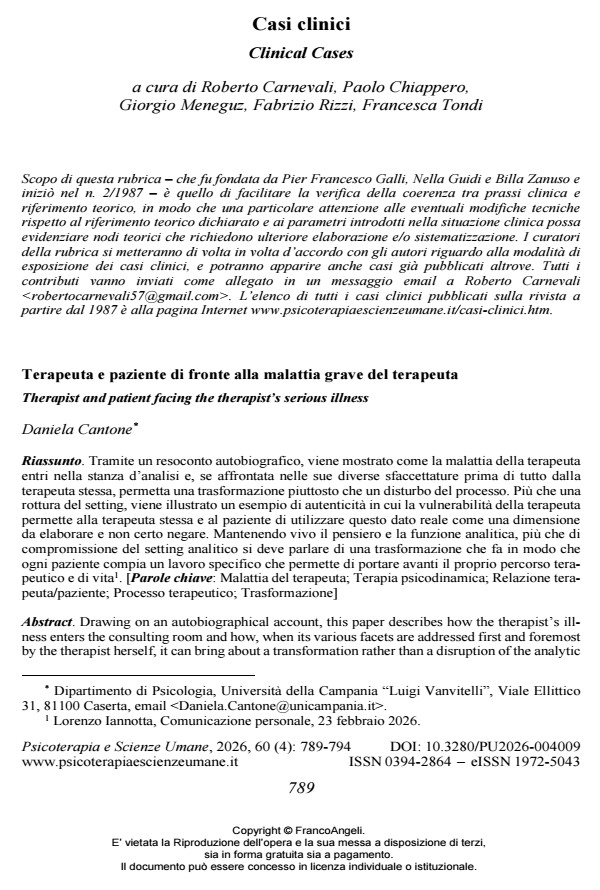
Drawing on an autobiographical account, this paper describes how the therapist’s illness enters the consulting room and how, when its various facets are addressed first and foremost by the therapist herself, it can bring about a transformation rather than a disruption of the analytic process. Rather than a rupture of the setting, the paper illustrates an instance of authenticity in which the therapist’s vulnerability enables both the therapist and the patient to use this real fact as a dimension to be worked through, and certainly not denied. Provided that analytic thinking and the analytic function are kept alive, what takes place should be understood not as an impairment of the analytic frame but as a transformation that leads each patient to undertake a specific kind of work, allowing them to carry forward their own therapeutic and life journey (Lorenzo Iannotta, Personal communication, February 23, 2026).
Keywords: Therapist’s illness; Psychodynamic therapy; Therapist/patient relationship; Therapeutic process; Transformation
- Abend S.M. (1982). Serious illness in the analyst: Countertransference considerations. Journal of the American Psychoanalytic Association, 30, 2: 365-379.
- Dewald P.A. (1982). Serious illness in the analyst: Transference, countertransference, and reality responses. Journal of the American Psychoanalytic Association, 30, 2: 347-363.
- Dewald P.A. & Schwartz H.J. (1993). The life cycle of the analyst: Pregnancy, illness, and disability. Journal of the American Psychoanalytic Association, 41, 1: 191-207.
- Baudrillard J. (1976). L’échange symbolique et la mort. Paris: Gallimard (trad. it.: Lo scambio simbolico e la morte. Milano: Feltrinelli, 1979).
- Bollas C. (1989). Forces of Destiny: Psychoanalysis and Human Idiom. London: Free Association Books (trad. it.: Forze del destino: psicoanalisi e idioma umano. Roma: Borla, 1991; Milano: Raffaello Cortina, 2021).
- Corsa R. (2008). L’identità violata: quando l’analista perde la salute. Segreti e confessioni nella malattia dell’analista. Rivista di Psicoanalisi, 54, 2: 315-335.
- Corsa R. (2011). Se la cura si ammala. La caducità dell’analista. Seriate (BG): Kolbe.
- Corsa R. (2014). La malattia dell’analista: www.spiweb.it/la-ricerca/ricerca-psicoanalisi/malattia-dellanalista.
- Freud S. (1915 [1916]). Caducità. Opere, 8: 173-176. Torino: Boringhieri, 1976.
- Goisis P.R. (2020). Nella stanza dei sogni. Un analista e i suoi pazienti. Bologna: Damiani.
- Nelson M. (2024). Facing the unthinkable: Life-threatening illness in the analyst and its impact on the analytic couple. International Journal of Psychoanalysis, 105, 2: 142-152. DOI 10.1080/00207578.2023.2237128.
- Sherman S. (2024). Illness, aging, dying, and the psychoanalytic process: Bibliography. Psychoanalytic Review, 111, 1: 95-101.
- Fajardo B. (2001). Life-threatening illness in the analyst. Journal of the American Psychoanalytic Association, 49, 2: 569-586.
- Gerson S. (2024). Life-threatening illness in the analyst and its impact on the analytic couple. International Journal of Psychoanalysis, 105, 1: 45-61.
- Gervais L. (1994). Serious illness in the analyst: A time for analysis and a time for self-analysis. Canadian Journal of Psychoanalysis, 2, 2: 191-202.
- Lasky R. (1990). Catastrophic illness in the analyst and the analyst’s emotional reaction to it. International Journal of Psychoanalysis, 71, 3: 455-473.
- Lazar S.G. (1982). Serious illness in the analyst. Journal of the American Psychoanalytic Association, 30, 1: 189-215.
- Morrison A.L. (1997). Ten years of doing psychotherapy while living with a life-threatening illness. Psychoanalytic Dialogues, 7, 2: 255-281.
- Pizer B. (1997). When the analyst is ill: Dimensions of self-disclosure. Psychoanalytic Quarterly, 66, 3: 450-469.
- Schwartz H.J., & Silver A.-L., editors (1990). Illness in the Analyst: Implications for the Treatment Relationship. Madison, CT: International Universities Press.
- Silver A.-L. (1982). Resuming the work with a life-threatening illness. Contemporary Psychoanalysis, 18, 3: 314-326.
- Van Dam H. (1987). Countertransference during an analyst’s brief illness. Journal of the American Psychoanalytic Association, 35, 3: 647-655.
- Vassallo Torrigiani M.G. & Marzi A. (2005). When the analyst is physically ill: Vicissitudes in the analytical relationship. International Journal of Psychoanalysis, 86, 5: 1373-1389.
- Weinberg H. (1988). Illness and the working analyst. Contemporary Psychoanalysis, 24, 3: 451-461.
Roberto Carnevali, Paolo Chiappero, Giorgio Meneguz, Fabrizio Rizzi, Francesca Tondi, Daniela Cantone, Terapeuta e paziente di fronte alla malattia grave del terapeuta. Interventi in "PSICOTERAPIA E SCIENZE UMANE" 4/2026, pp 789-794, DOI: 10.3280/PU2026-004009