Exploring Barriers to Circular Economy Transitions in Slow Fashion SMEs: Insights from the Balanced Scorecard Framework
Titolo Rivista MANAGEMENT CONTROL
Autori/Curatori Rodrigo Bruno Santolin, Nicoletta Fadda, Sofia Siotto, Ludovico Marinò
Anno di pubblicazione 2026 Fascicolo 2026/1 Suppl.
Lingua Inglese Numero pagine 25 P. 11-35 Dimensione file 238 KB
DOI 10.3280/MACO2026-001-S1002
Il DOI è il codice a barre della proprietà intellettuale: per saperne di più
clicca qui
Qui sotto puoi vedere in anteprima la prima pagina di questo articolo.
Se questo articolo ti interessa, lo puoi acquistare (e scaricare in formato pdf) seguendo le facili indicazioni per acquistare il download credit. Acquista Download Credits per scaricare questo Articolo in formato PDF
FrancoAngeli è membro della Publishers International Linking Association, Inc (PILA), associazione indipendente e non profit per facilitare (attraverso i servizi tecnologici implementati da CrossRef.org) l’accesso degli studiosi ai contenuti digitali nelle pubblicazioni professionali e scientifiche.
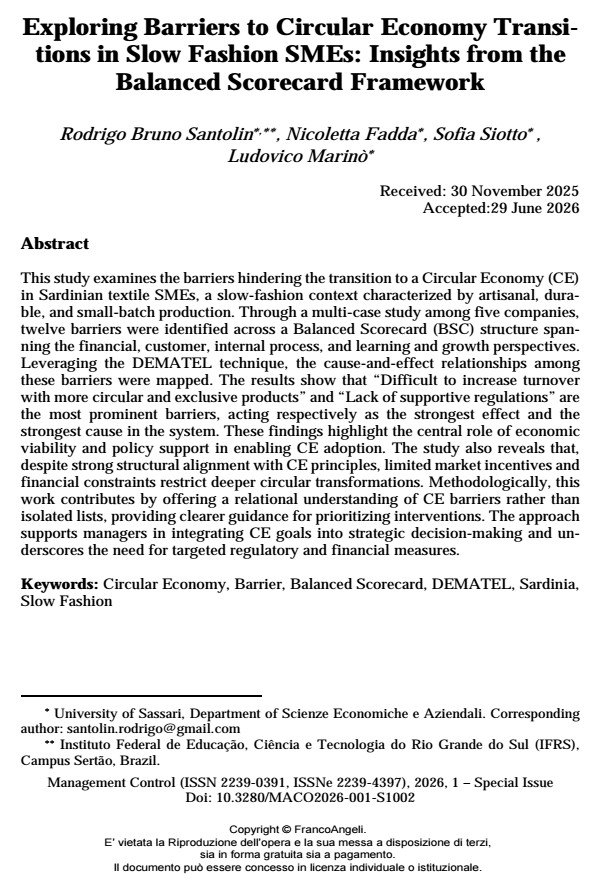
This study examines the barriers hindering the transition to a Circular Economy (CE) in Sardinian textile SMEs, a slow-fashion context characterized by artisanal, dura-ble, and small-batch production. Through a multi-case study among five companies, twelve barriers were identified across a Balanced Scorecard (BSC) structure span-ning the financial, customer, internal process, and learning and growth perspectives. Leveraging the DEMATEL technique, the cause-and-effect relationships among these barriers were mapped. The results show that “Difficult to increase turnover with more circular and exclusive products” and “Lack of supportive regulations” are the most prominent barriers, acting respectively as the strongest effect and the strongest cause in the system. These findings highlight the central role of economic viability and policy support in enabling CE adoption. The study also reveals that, despite strong structural alignment with CE principles, limited market incentives and financial constraints restrict deeper circular transformations. Methodologically, this work contributes by offering a relational understanding of CE barriers rather than isolated lists, providing clearer guidance for prioritizing interventions. The approach supports managers in integrating CE goals into strategic decision-making and un-derscores the need for targeted regulatory and financial measures.
Parole chiave:Circular Economy, Barrier, Balanced Scorecard, DEMATEL, Sardinia, Slow Fashion
- Abbate S., Centobelli P., Cerchione R., Nadeem S. P., & Riccio E. (2024). Sustainability trends and gaps in the textile, apparel and fashion industries. Environment, Development and Sustainability, 26(2), pp. 2837-2864.
- Acuña-Carvajal F., Pinto-Tarazona L., López-Ospina H., Barros-Castro R., Quezada L., & Palacio K. (2019). An integrated method to plan, structure and validate a business strategy using fuzzy DEMATEL and the balanced scorecard. Expert Systems with Applications, 122, pp. 351-368.
- Adamkiewicz J., Kochanska E., Adamkiewicz I., & Lukasik R. M. (2022). Greenwashing and sustainable fashion industry. Current Opinion in Green and Sustainable Chemistry, 38.
- Alves L., Ferreira Cruz E., Lopes S. I., Faria P. M., & Rosado da Cruz A. M. (2022). Towards circular economy in the textiles and clothing value chain through blockchain technology and IoT: A review. Waste Management and Research, 40(1), Artigo 1. DOI: 10.1177/0734242X211052858
- Asadi S., Nilashi M., Iranmanesh M., Hyun S. S., & Rezvani A. (2022). Effect of internet of things on manufacturing performance: A hybrid multi-criteria decision-making and neuro-fuzzy approach. Technovation, 118, 102426.
- Azungah T. (2018). Qualitative research: deductive and inductive approaches to data analysis. Qualitative Research Journal, 18, pp. 383-400. DOI: 10.1108/QRJ-D-18-00035
- Balluchi F., Borgato B., Corsi K., & Fundoni M. (2024). L’integrazione degli obiettivi di sostenibilità nei processi di pianificazione strategica: Analisi empirica nel contesto ita-liano. Management Control, (2), pp. 65-88. DOI: 10.3280/MACO2024-002004
- Bhandari N., Garza-Reyes J. A., Rocha-Lona L., Kumar A., Naz F., & Joshi R. (2022). Bar-riers to sustainable sourcing in the apparel and fashion luxury industry. Sustainable Pro-duction and Consumption, 31, pp. 220-235.
- Bin Hameed H., Strozzi F., Puliga G., Verdoliva G., Fronzetti Colladon A., & Muhammad Abbas S. (2026). Sourcing Risk in Supply Chains: A Systematic Literature Review. Lo-gistics, 10(4), 88.
- Boutkhoum O., Hanine M., Nabil M., Barakaz F. E. L., Lee E., Rustam F., & Ashraf I. (2021). Analysis and evaluation of barriers influencing blockchain implementation in moroccan sustainable supply chain management: An integrated IFAHP-DEMATEL framework. Mathematics, 9(14), Artigo 14.
- Boyer R. H. W., Hunka A. D., Linder M., Whalen K. A., & Habibi S. (2021). Product Labels for the Circular Economy: Are Customers Willing to Pay for Circular? Sustainable Pro-duction and Consumption, 27, pp. 61-71.
- Bukhari M. A., Carrasco-Gallego R., & Ponce-Cueto E. (2018). Developing a national pro-gramme for textiles and clothing recovery. Waste Management and Research, 36(4), pp. 321-331.
- Centobelli P., Abbate S., Nadeem S. P., & Garza-Reyes J. A. (2022). Slowing the fast fashion industry: An all-round perspective. Current Opinion in Green and Sustainable Chemistry, 38, 100684.
- Chen C.-L., Guo L.-H., Zhou M., Tsaur W.-J., Sun H., Zhan W., Deng Y.-Y., & Li C.-T. (2022). Blockchain-Based Anti-Counterfeiting Management System for Traceable Lux-ury Products. Sustainability (Switzerland), 14(19), Artigo 19.
- de Boissieu E., Kondrateva G., Baudier P., & Ammi C. (2021). The use of blockchain in the luxury industry: Supply chains and the traceability of goods. Journal of Enterprise Infor-mation Management, 34(5), Artigo 5. DOI: 10.1108/JEIM-11-2020-0471
- De Camillis E., Izzo T., & Mancini D. (2025). Percorsi di decarbonizzazione e sistemi di controllo: Un modello di analisi per il settore energetico. Management Control, (2), pp. 179-204. DOI: 10.3280/MACO2025-002009
- Della Porta A., De Luca F., & Aufiero C. (2023). “Radicare” la sostenibilità nella strategia attraverso i sistemi di management control: Un caso di studio relativo ad una PMI. Man-agement Control, (2), pp. 43-68. DOI: 10.3280/MACO2023-002003
- Diddi S., & Yan R.-N. (2019). Consumer perceptions related to clothing repair and commu-nity mending events: A circular economy perspective. Sustainability (Switzerland), 11(19).
- Dorrego Viera J. I., Santolin R. B., Lazzarotti V., & Urbinati A. (2024). Sustainability deci-sion-making in times of crisis: An empirical study in Italy under the lens of the Russian-Ukraine war. Corporate Social Responsibility and Environmental Management.
- Dorrego-Viera J. I., Urbinati A., & Lazzarotti V. (2025). Transition towards circular economy: Exploiting open innovation for circular product development. Journal of Innovation & Knowledge, 10(2), 100668.
- Dragomir V. D., & Dumitru M. (2022). Practical solutions for circular business models in the fashion industry. Cleaner Logistics and Supply Chain, 4.
- Eisenhardt K. M. (1989). Building Theories from Case Study Research. The Academy of Man-agement Review, 14(4), pp. 532-550. DOI: 10.2307/258557
- Eisenhardt K. M., & Graebner M. E. (2007). Theory building from cases: Opportunities and challenges. Academy of Management Journal, 50(1), pp. 25-32. DOI: 10.5465/AMJ.2007.24160888
- Ellen MacArthur Foundation (2021). Completing the picture: How the circular economy tack-les climate change. https://ellenmacarthurfoundation.org/completing-the-picture.
- European Commission (2022). Communication from the Commission to the European Par-liament, the Council, the European Economic and Social Committee and the Committee of the Regions: EU Strategy for Sustainable and Circular Textiles. https://environ-ment.ec.europa.eu/publications/textiles-strategy_en.
- European Parliament (2021). New Circular Economy Action Plan (2020/2077(INI)). Resolu-tion of 10 February 2021. https://www.europarl.europa.eu/doceo/document/TA-9-2021-0040_EN.html.
- Farrukh A., & Sajjad A. (2024). Drivers for and barriers to circular economy transition in the textile industry: A developing economy perspective. Sustainable Development, 32(6), pp. 7309-7329.
- Fischer A., & Pascucci S. (2017). Institutional incentives in circular economy transition: The case of material use in the Dutch textile industry. Journal of Cleaner Production, 155, pp. 17-32.
- Gabus A., & Fontela E. (1972). World Problems, An Invitation to Further Thought within the Framework of DEMATEL. Battelle Geneva Research Centre, Geneva.
- Gasulla Tortajada E., Moreira A., Duarte P., & Silva S. (2024). Circular Economy and Sus-tainability in Luxury Fashion Consumer Behavior: A Review and Research Agenda. In-ternational Journal of Consumer Studies, 48(5).
- Gomes G. M., Moreira N., Iritani D. R., Amaral W. A., & Ometto A. R. (2023). Systemic Circular Innovation: barriers, windows of opportunity and an analysis of Brazil’s apparel Scenario. Fashion Practice, 15(1), pp. 6-35. DOI: 10.1080/17569370.2021.1987645
- Hartley K., Roosendaal J., & Kirchherr J. (2022). Barriers to the circular economy: The case of the Dutch technical and interior textiles industries. Journal of Industrial Ecology, 26(2), pp. 477-490.
- Hasanbeigi A., & Price L. (2015). A technical review of emerging technologies for energy and water efficiency and pollution reduction in the textile industry. Journal of Cleaner Production, 95, pp. 30-44.
- House of Commons Environmental Audit Committee (2019). Fixing Fashion: Clothing, Con-sumption and Sustainability. https://publications.parlia-ment.uk/pa/cm201719/cmselect/cmenvaud/1952/report-summary.html.
- Huang C.-Y., Shyu J. Z., & Tzeng G.-H. (2007). Reconfiguring the innovation policy portfo-lios for Taiwan’s SIP Mall industry. Technovation, 27(12), pp. 744-765.
- Huang Y.-F., Azevedo S. G., Lin T.-J., Cheng C.-S., & Lin C.-T. (2021). Exploring the deci-sive barriers to achieve circular economy: Strategies for the textile innovation in Taiwan. Sustainable Production and Consumption, 27, pp. 1406-1423.
- Jia F., Yin S., Chen L., & Chen X. (2020). The circular economy in the textile and apparel industry: A systematic literature review. Journal of Cleaner Production, 259, 120728.
- Kaplan R. S., & Norton D. P. (1992). The Balanced Scorecard – Measures that Drive Perfor-mance. Harvard Business Review, Jan-Feb, pp. 71-79.
- Kaplan R. S., & Norton D. P. (2000). Having trouble with your strategy? Then map it. Har-vard business review, 78(5), pp. 167-176, 202.
- Kaplan R. S., & Norton D. P. (2004). Strategy Maps: Converting Intangible Assets into Tan-gible Outcomes. Harvard Business Press.
- Kazancoglu I., Kazancoglu Y., Kahraman A., Yarimoglu E., & Soni G. (2022). Investigating barriers to circular supply chain in the textile industry from Stakeholders’ perspective. International Journal of Logistics Research and Applications, 25(4-5), pp. 521-548. DOI: 10.1080/13675567.2020.1846694
- Kazancoglu I., Kazancoglu Y., Yarimoglu E., & Kahraman A. (2020). A conceptual frame-work for barriers of circular supply chains for sustainability in the textile industry. Sus-tainable Development, 28(5), pp. 1477-1492.
- Khan S. A., Mubarik M. S., & Paul S. K. (2022). Analyzing cause and effect relationships among drivers and barriers to circular economy implementation in the context of an emerging economy. Journal of Cleaner Production, 364, 132618.
- Khitous F., Urbinati A., & Verleye K. (2022). Product-Service Systems: A customer engage-ment perspective in the fashion industry. Journal of Cleaner Production, 336.
- Kumar S., Raut R. D., Agrawal N., Cheikhrouhou N., Sharma M., & Daim T. (2022). Inte-grated blockchain and internet of things in the food supply chain: Adoption barriers. Tech-novation, 118.
- Laitala K., Klepp I. G., Haugrønning V., Throne-Holst H., & Strandbakken P. (2021). Increas-ing repair of household appliances, mobile phones and clothing: Experiences from con-sumers and the repair industry. Journal of Cleaner Production, 282.
- Leal Filho W., Ellams D., Han S., Tyler D., Boiten V. J., Paco A., Moora H., & Balogun A.-
- L. (2019). A review of the socio-economic advantages of textile recycling. Journal of Cleaner Production, 218, pp. 10-20.
- Liu X., Liu Y., Li H., & Wen D. (2023). Identification and analysis of barriers to the effectiveness of ISO 45001 certification in Chinese certified organisations: A DEMATEL-ISM approach. J. of Cleaner Production, 383.
- López-Ospina H., Pardo D., Rojas A., Barros-Castro R., Palacio K., & Quezada L. (2022). A revisited fuzzy DEMATEL and optimization method for strategy map design under the BSC framework: Selection of objectives and relationships. Soft Computing, 26(14), pp. 6619-6644.
- Madonna S., Cestari G., & Giuliani F. (2024). L’integrazione della sostenibilità ambientale nei sistemi di controllo e gestione delle imprese: Evidenze dal settore energetico italiano. Management Control, (1), pp. 39-61. DOI: 10.3280/MACO2024-001003
- Maher R., Yarnold J., & Pushpamali N. N. C. (2023). Circular economy 4 business: A pro-gram and framework for small-to-medium enterprises (SMEs) with three case studies. Journal of Cleaner Production, 412.
- Mizrachi M. P., & Tal A. (2022). Regulation for Promoting Sustainable, Fair and Circular Fashion. Sustainability (Switzerland), 14(1).
- Niero M., Negrelli A. J., Hoffmeyer S. B., Olsen S. I., & Birkved M. (2016). Closing the loop for aluminum cans: Life Cycle Assessment of progression in Cradle-to-Cradle certifica-tion levels. Journal of Cleaner Production, 126, pp. 352-362.
- OECD (2018). Environmental Policy Toolkit for SME Greening in EU Eastern Partnership Countries. OECD Green Growth Studies, OECD Publishing, Paris.
- Rayhan Md. G. S., Masum Md., & Karuppiah K. (2025). A Fuzzy Multi-Criteria Decision-Making Approach to Evaluate Circular Economy Barriers in the Textile and Apparel In-dustry. Circular Economy & Sustainability.
- Riso V., Cantele S., & Thanh Arianna Truong L. (2026). La gestione delle informazioni di sostenibilità nella catena di fornitura: Un caso studio nel settore agroalimentare. Manage-ment Control, (3), pp. 89-109. DOI: 10.3280/MACO2025-003005
- Rizos V., Behrens A., van der Gaast W., Hofman E., Ioannou A., Kafyeke T., Flamos A., Rinaldi R., Papadelis S., Hirschnitz-Garbers M., & Topi C. (2016). Implementation of circular economy business models by small and medium-sized enterprises (SMEs): Bar-riers and enablers. Sustainability (Switzerland), 8(11).
- Saha K., Dey P. K., & Papagiannaki E. (2021). Implementing circular economy in the textile and clothing industry. Business Strategy and the Environment, 30(4), pp. 1497-1530.
- Sandin G., & Peters G. M. (2018). Environmental impact of textile reuse and recycling – A review. Journal of Cleaner Production, 184, pp. 353-365.
- Santolin R. B., Hameed H. B., Urbinati A., & Lazzarotti V. (2023). Exploiting circular econ-omy enablers for SMEs to advance towards a more sustainable development: An empiri-cal study in the post COVID-19 era. Resources, Conservation & Recycling Advances, 19, 200164.
- Santolin R.B., Lazzarotti V. & Urbinati A. (2026). Transition of Manufacturing Companies towards the Circular Economy: The Role of the Balanced Scorecard Approach. Circular Economy and Sustainability. 6(12).
- Santolin R. B., Urbinati A., & Lazzarotti V. (2024). How can managerial practices for Circular Business Models contribute to achieving carbon neutrality? A taxonomy of their preven-tive and corrective role. Journal of Cleaner Production, 477, 143831.
- Santolin R. B., & Nonemacher T. B. (2024). Barreiras para implementação de Modelos de Negócio de Economia Circular na Indústria Manufatureira Brasileira. Revista Gestão & Sustentabilidade, 5, e14165.
- Sardinia Region (2021). Sardegna2030: La strategia della regione Sardegna per lo Sviluppo Sostenibile. Deliberazione della giunta regionale n. 39/56 del 8 ottobre 2021; https://deli-bere.regione.sardegna.it/delibera/57095.
- Schepers D. H. (2010). Challenges to Legitimacy at the Forest Stewardship Council. Journal of Business Ethics, 92(2), pp. 279-290.
- Schmutz M., & Som C. (2022). Identifying the potential for circularity of industrial textile waste generated within Swiss companies. Resources, Conservation and Recycling, 182, 106132.
- Seawright J., & Gerring J. (2008). Case Selection Techniques in Case Study Research: A Menu of Qualitative and Quantitative Options. Political Research Quarterly, 61(2), pp. 294-308. DOI: 10.1177/1065912907313077
- Shirvanimoghaddam K., Motamed B., Ramakrishna S., & Naebe M. (2020). Death by waste: Fashion and textile circular economy case. Science of the Total Environment, 718.
- Sinha E. (2022). Identifying enablers and outcomes of circular economy for sustainable development: A systematic literature review. Business Strategy and Development.
- Tellis W. (1997). Application of a Case Study Methodology. The Qualitative Report, 3(3), pp. 1-19. DOI: 10.46743/2160-3715/1997.2015
- Tzeng G.-H., Chiang C.-H., & Li C.-W. (2007). Evaluating intertwined effects in e-learning programs: A novel hybrid MCDM model based on factor analysis and DEMATEL. Expert Systems with Applications, 32(4), pp. 1028-1044.
- Urbinati A., Chiaroni D., & Chiesa V. (2017). Towards a new taxonomy of circular economy business models. Journal of Cleaner Production, 168, pp. 487-498.
- Urbinati A., Franzò S., & Chiaroni D. (2021). Enablers and Barriers for Circular Business Models: An empirical analysis in the Italian automotive industry. Sustainable Production and Consumption, 27, pp. 551-566.
- Wei Y., Liu Y., Siraj A., Xu J., Taneja S., & Wang N. (2024b). A strategic framework for sustainable quality management in the waste textile recycling industry within the context of the circular economy. Business Strategy and the Environment, 33(8), pp. 9214-9232.
- Wells V., Athwal N., Nervino E., & Carrigan M. (2021). How legitimate are the environmen-tal sustainability claims of luxury conglomerates?. Journal of Fashion Marketing and Management, 25(4), Artigo 4. DOI: 10.1108/JFMM-09-2020-0214
- Wu W.-W., & Lee Y.-T. (2007). Developing global managers’ competencies using the fuzzy DEMATEL method. Expert Systems with Applications, 32(2), pp. 499-507.
- Yin R. K. (2003). Case Study Research: Design and Methods. SAGE.
- Zuddas C., & Cocco A. (2024). TCEs, IPRs protection and business inclusivity: The Sardinian example. Em Research Handbook on Intellectual Property Rights and Inclusivity (pp. 249-265). DOI: 10.4337/9781803927268.00022
Rodrigo Bruno Santolin, Nicoletta Fadda, Sofia Siotto, Ludovico Marinò, Exploring Barriers to Circular Economy Transitions in Slow Fashion SMEs: Insights from the Balanced Scorecard Framework in "MANAGEMENT CONTROL" 1 Suppl./2026, pp 11-35, DOI: 10.3280/MACO2026-001-S1002