Fostering Well-Being in Later Life Among Neurodiverse Older Adults: A Call for Inclusive Policy and Relational Care
Titolo Rivista SALUTE E SOCIETÀ
Autori/Curatori Samuel Ragot, Aglaé Mastrostefano, Marie-Hélène Deshaies, Shari Brotman, Laura Pacheco
Anno di pubblicazione 2026 Fascicolo 2026/1
Lingua Inglese Numero pagine 26 P. 59-84 Dimensione file 798 KB
DOI 10.3280/SES2026-001005
Il DOI è il codice a barre della proprietà intellettuale: per saperne di più
clicca qui
Qui sotto puoi vedere in anteprima la prima pagina di questo articolo.
Se questo articolo ti interessa, lo puoi acquistare (e scaricare in formato pdf) seguendo le facili indicazioni per acquistare il download credit. Acquista Download Credits per scaricare questo Articolo in formato PDF
FrancoAngeli è membro della Publishers International Linking Association, Inc (PILA), associazione indipendente e non profit per facilitare (attraverso i servizi tecnologici implementati da CrossRef.org) l’accesso degli studiosi ai contenuti digitali nelle pubblicazioni professionali e scientifiche.
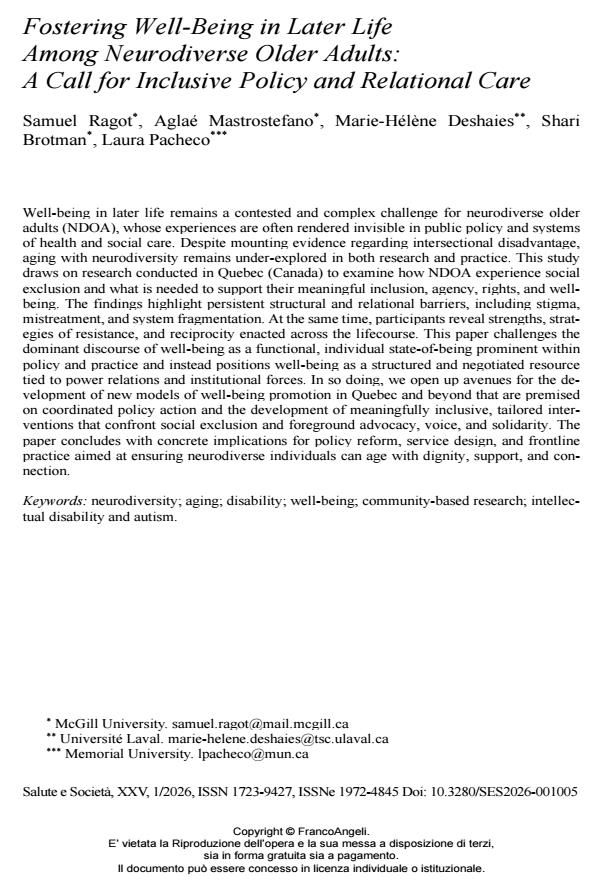
Well-being in later life remains a contested and complex challenge for neurodiverse older adults (NDOA), whose experiences are often rendered invisible in public policy and systems of health and social care. Despite mounting evidence regarding intersectional disadvantage, aging with neurodiversity remains under-explored in both research and practice. This study draws on research conducted in Quebec (Canada) to examine how NDOA experience social exclusion and what is needed to support their meaningful inclusion, agency, rights, and well-being. The findings highlight persistent structural and relational barriers, including stigma, mistreatment, and system fragmentation. At the same time, participants reveal strengths, strategies of resistance, and reciprocity enacted across the lifecourse. This paper challenges the dominant discourse of well-being as a functional, individual state-of-being prominent within policy and practice and instead positions well-being as a structured and negotiated resource tied to power relations and institutional forces. In so doing, we open up avenues for the development of new models of well-being promotion in Quebec and beyond that are premised on coordinated policy action and the development of meaningfully inclusive, tailored interventions that confront social exclusion and foreground advocacy, voice, and solidarity. The paper concludes with concrete implications for policy reform, service design, and frontline practice aimed at ensuring neurodiverse individuals can age with dignity, support, and connection.
Parole chiave:neurodiversity; aging; disability; well-being; community-based research; intellectual disability and autism.
Samuel Ragot, Aglaé Mastrostefano, Marie-Hélène Deshaies, Shari Brotman, Laura Pacheco, Fostering Well-Being in Later Life Among Neurodiverse Older Adults: A Call for Inclusive Policy and Relational Care in "SALUTE E SOCIETÀ" 1/2026, pp 59-84, DOI: 10.3280/SES2026-001005