Rischio di aggressione e lavoro front-line: una lettura sociologica post-COVID

Titolo Rivista SALUTE E SOCIETÀ
Autori/Curatori Matteo Jacopo Zaterini
Anno di pubblicazione 2026 Fascicolo 2026/1
Lingua Italiano Numero pagine 16 P. 143-158 Dimensione file 295 KB
DOI 10.3280/SES2026-001010
Il DOI è il codice a barre della proprietà intellettuale: per saperne di più clicca qui

Qui sotto puoi vedere in anteprima la prima pagina di questo articolo.

Se questo articolo ti interessa, lo puoi acquistare (e scaricare in formato pdf) seguendo le facili indicazioni per acquistare il download credit. Acquista Download Credits per scaricare questo Articolo in formato PDF
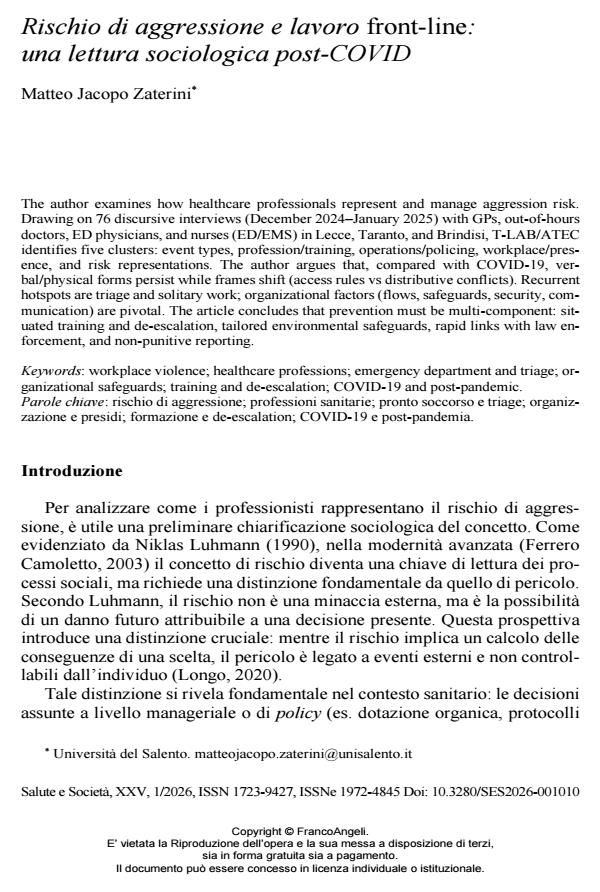
Anteprima articolo

FrancoAngeli è membro della Publishers International Linking Association, Inc (PILA), associazione indipendente e non profit per facilitare (attraverso i servizi tecnologici implementati da CrossRef.org) l’accesso degli studiosi ai contenuti digitali nelle pubblicazioni professionali e scientifiche.

The author examines how healthcare professionals represent and manage aggression risk. Drawing on 76 discursive interviews (December 2024–January 2025) with GPs, out-of-hours doctors, ED physicians, and nurses (ED/EMS) in Lecce, Taranto, and Brindisi, T-LAB/ATEC identifies five clusters: event types, profession/training, operations/policing, workplace/presence, and risk representations. The author argues that, compared with COVID-19, verbal/physical forms persist while frames shift (access rules vs distributive conflicts). Recurrent hotspots are triage and solitary work; organizational factors (flows, safeguards, security, communication) are pivotal. The article concludes that prevention must be multi-component: situated training and de-escalation, tailored environmental safeguards, rapid links with law enforcement, and non-punitive reporting.

Parole chiave:rischio di aggressione; professioni sanitarie; pronto soccorso e triage; organizzazione e presidi; formazione e de-escalation; COVID-19 e post-pandemia.

  1. Aljohani B., Burkholder J., Tran Q.K. (2021). Workplace violence in the emergency department: A systematic review and meta-analysis. Public Health, 196: 194-205.
  2. Arnetz J.E., Arnetz B.B., Söderman E. (1998). Violence toward health care workers: Prevalence and incidence at a large, regional hospital in Sweden. AAOHN journal, 46(3): 107-114.
  3. Beck U. (1992). Risk Society: Towards a New Modernity. London: Sage.
  4. Berger P.L., Luckmann T. (1966). The Social Construction of Reality: A Treatise in the Sociology of Knowledge. London: Penguin Books.
  5. Bhatti O.A., Rauf H., Aziz N., Martins R.S., Khan J.A. (2021). Violence against healthcare workers during the COVID-19 pandemic: a review of incidents from a lower-middle-income country. Annals of global health, 87(1): 41.
  6. Braun V., Clarke V. (2021). Thematic analysis: A practical guide. London: SAGE Publications.
  7. Cohen L.E., Felson M. (1979). Social change and crime rate trends: A routine activity approach. American Sociological Review, 44(4): 588–608. DOI: 10.2307/209458
  8. Collins R. (2004). Interaction Ritual Chains. Princeton, NY: Princeton University Press.
  9. Douglas M. (1992). Risk and Blame: Essays in Cultural Theory. London: Routledge.
  10. Edward K.L., Ousey K., Warelow P., Lui S. (2014). Nursing and aggression in the workplace: a systematic review. British Journal of Nursing, 23(12): 653–659.
  11. Ferrero Camoletto R. (2003). Una vecchia storia: il processo di individualizzazione nella seconda modernità. Quaderni di sociologia, (32): 188-196.
  12. Fielding N.G. (2017). Combining digital and physical data. In: Denzin N. K., Lincoln Y. S., a cura di, The SAGE Handbook of Qualitative Research (5th ed., pp. 637-656). Thousand Oaks, CA: SAGE Publications.
  13. Foucault M. (1972). The Archaeology of Knowledge. New York: Pantheon Books.
  14. Garfinkel H. (1967). Studies in ethnomethodology. Englewood Cliffs, NJ: Prentice-Hall.
  15. Gates D.M., Ross C.S., McQueen L. (2006). Violence against emergency department workers. The Journal of emergency medicine, 31(3): 331-337.
  16. Giménez Lozano J.M., Martinez Ramon J.P., Morales Rodriguez F.M. (2021). Doctors and nurses: a systematic review of the risk and protective factors in workplace violence and burnout. International journal of environmental research and public health, 18(6): 3280.
  17. Goffman E. (1967). Interaction Ritual: Essays on Face-to-Face Behavior. London: Routledge.
  18. Heckemann B., Zeller A., Hahn S., Dassen T., Schols J.M.G.A., Halfens R.J.G. (2015). The effect of aggression management training programmes for nursing staff and students working in an acute hospital setting. A narrative review of current literature. Nurse education today, 35(1): 212-219.
  19. Hobbs F.R., Keane U.M. (1996). Aggression against doctors: a review. Journal of the Royal Society of Medicine, 89(2): 69-72.
  20. Kowalenko T., Walters B.L., Khare R.K., Compton S., Michigan College of Emergency Physicians Workplace Violence Task Force. (2005). Workplace violence: a survey of emergency physicians in the state of Michigan. Annals of emergency medicine, 46(2): 142-147.
  21. Kvale S. (2007). InterViews: An introduction to qualitative research interviewing. Thousand Oaks, CA: SAGE Publications.
  22. Lancia F. (2004). T-LAB: Strumenti per l’analisi del contenuto. Guida all’uso. Milano: FrancoAngeli.
  23. Lanza M.L., Kayne H.L., Pattison I., Hicks C., Islam S. (1996). The relationship of behavioral cues to assaultive behavior. Clinical Nursing Research, 5(1): 6-25. DOI: 10.1177/10547738960050010
  24. Lipsky M. (1980). Street-Level Bureaucracy: Dilemmas of the Individual in Public Services. New York: Russell Sage Foundation.
  25. Liu J., Gan Y., Jiang H., Li L., Dwyer R., Lu K. (2019). Prevalence of workplace violence against healthcare workers: A systematic review and meta-analysis. Occupational and Environmental Medicine, 76(12): 927-937.
  26. Longo M. (2020). Paura: La dimensione emozionale del rischio. In: Longo M., Preite G., Bevilacqua E., Lorubbio V., a cura di, Politica dell’emergenza, 17: 27–44. Trento: Tangram Edizioni Scientifiche
  27. Luhmann N. (1990). Technology, environment and social risk: A systems perspective. Industrial Crisis Quarterly, 4: 223–231.
  28. Mol A. (2002). The Body Multiple: Ontology in Medical Practice. Durham, NC: Duke University Press.
  29. Occupational Safety and Health Administration (OSHA) (2015). Guidelines for Preventing Workplace Violence for Healthcare and Social Service Workers. DC: U.S. Department of Labor.
  30. Silverman D. (2020). Interpreting qualitative data (6th ed.). London: SAGE Publications.
  31. Slovic P. (1987). Perception of risk. Science, 236(4799): 280–285.
  32. Spector P.E., Zhou Z.E., Che X.X. (2014). Nurse exposure to physical and nonphysical violence, bullying, and sexual harassment: A quantitative review. International Journal of Nursing Studies, 51(1): 72–84.
  33. Strauss A., Schatzman L., Ehrlich D., Bucher R., Sabshin M. (1963). The hospital and its negotiated order. In: Freidson E., a cura di, The Hospital in Modern Society (pp. 147–169). Glencoe, IL: Free Press of Glencoe.
  34. Weiss C.H. (1979). The Many Meanings of Research Utilization. Public Administration Review, 39(5): 426–431. DOI: 10.2307/310991
  35. World Health Organization. (2020, May 26). Attacks on health care in the context of COVID-19. Geneva: World Health Organization.

Matteo Jacopo Zaterini, Rischio di aggressione e lavoro front-line: una lettura sociologica post-COVID in "SALUTE E SOCIETÀ" 1/2026, pp 143-158, DOI: 10.3280/SES2026-001010