«Se non sei su GePI non esisti»: opacità e visibilità del lavoro nella riconfigurazione digitale del welfare
Titolo Rivista SOCIOLOGIA DEL LAVORO
Autori/Curatori Eleonora Costantini, Francesca Nannetti
Anno di pubblicazione 2026 Fascicolo 2025/173
Lingua Italiano Numero pagine 26 P. 103-128 Dimensione file 324 KB
DOI 10.3280/SL2025-173006
Il DOI è il codice a barre della proprietà intellettuale: per saperne di più
clicca qui
Qui sotto puoi vedere in anteprima la prima pagina di questo articolo.
Se questo articolo ti interessa, lo puoi acquistare (e scaricare in formato pdf) seguendo le facili indicazioni per acquistare il download credit. Acquista Download Credits per scaricare questo Articolo in formato PDF
FrancoAngeli è membro della Publishers International Linking Association, Inc (PILA), associazione indipendente e non profit per facilitare (attraverso i servizi tecnologici implementati da CrossRef.org) l’accesso degli studiosi ai contenuti digitali nelle pubblicazioni professionali e scientifiche.
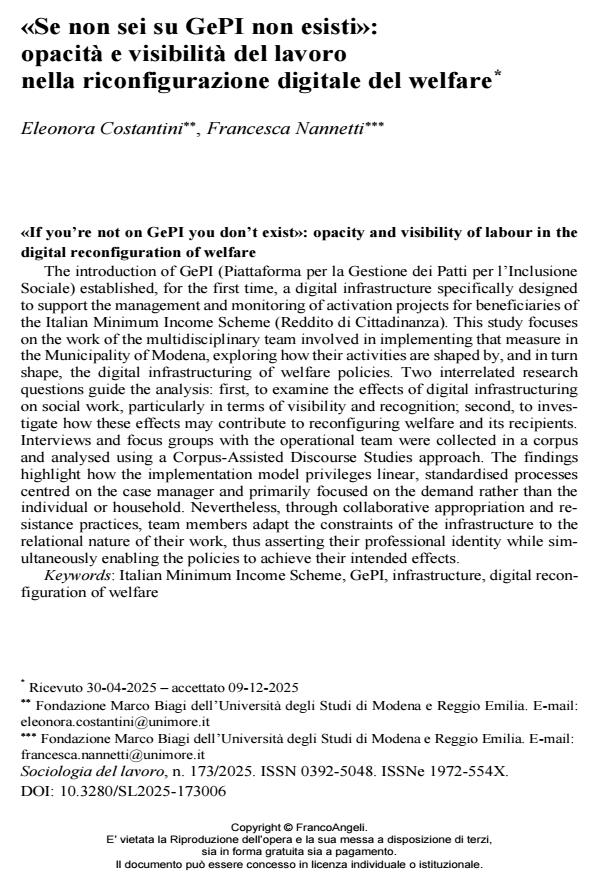
The introduction of GePI (Piattaforma per la Gestione dei Patti per l’Inclusione Sociale) established, for the first time, a digital infrastructure specifically designed to support the management and monitoring of activation projects for beneficiaries of the Italian Minimum Income Scheme (Reddito di Cittadinanza). This study focuses on the work of the multidisciplinary team involved in implementing that measure in the Municipality of Modena, exploring how their activities are shaped by, and in turn shape, the digital infrastructuring of welfare policies. Two interrelated research questions guide the analysis: first, to examine the effects of digital infrastructuring on social work, particularly in terms of visibility and recognition; second, to inves-tigate how these effects may contribute to reconfiguring welfare and its recipients. Interviews and focus groups with the operational team were collected in a corpus and analysed using a Corpus-Assisted Discourse Studies approach. The findings highlight how the implementation model privileges linear, standardised processes centred on the case manager and primarily focused on the demand rather than the individual or household. Nevertheless, through collaborative appropriation and re-sistance practices, team members adapt the constraints of the infrastructure to the relational nature of their work, thus asserting their professional identity while sim-ultaneously enabling the policies to achieve their intended effects.
Parole chiave:Italian Minimum Income Scheme, GePI, infrastructure, digital recon-figuration of welfare
- Digital Welfare in Platform Societies Eleonora Costantini, Francesca Nannetti, pp.65 (ISBN:9798260030486)
Eleonora Costantini, Francesca Nannetti, «Se non sei su GePI non esisti»: opacità e visibilità del lavoro nella riconfigurazione digitale del welfare in "SOCIOLOGIA DEL LAVORO " 173/2025, pp 103-128, DOI: 10.3280/SL2025-173006