Psychotypological determinants of the resocialization potential of juvenile offenders under non-custodial sentences
Titolo Rivista MALTRATTAMENTO E ABUSO ALL’INFANZIA
Autori/Curatori Ivan Danyliuk, Tetiana Traverse, Yuliia Krasilova, Julia Udovenko, Nataliia Burkalo
Anno di pubblicazione 2026 Fascicolo 2026/2
Lingua Inglese Numero pagine 23 P. 71-93 Dimensione file 128 KB
DOI 10.3280/MAL2026-002005
Il DOI è il codice a barre della proprietà intellettuale: per saperne di più
clicca qui
Qui sotto puoi vedere in anteprima la prima pagina di questo articolo.
Se questo articolo ti interessa, lo puoi acquistare (e scaricare in formato pdf) seguendo le facili indicazioni per acquistare il download credit. Acquista Download Credits per scaricare questo Articolo in formato PDF
FrancoAngeli è membro della Publishers International Linking Association, Inc (PILA), associazione indipendente e non profit per facilitare (attraverso i servizi tecnologici implementati da CrossRef.org) l’accesso degli studiosi ai contenuti digitali nelle pubblicazioni professionali e scientifiche.
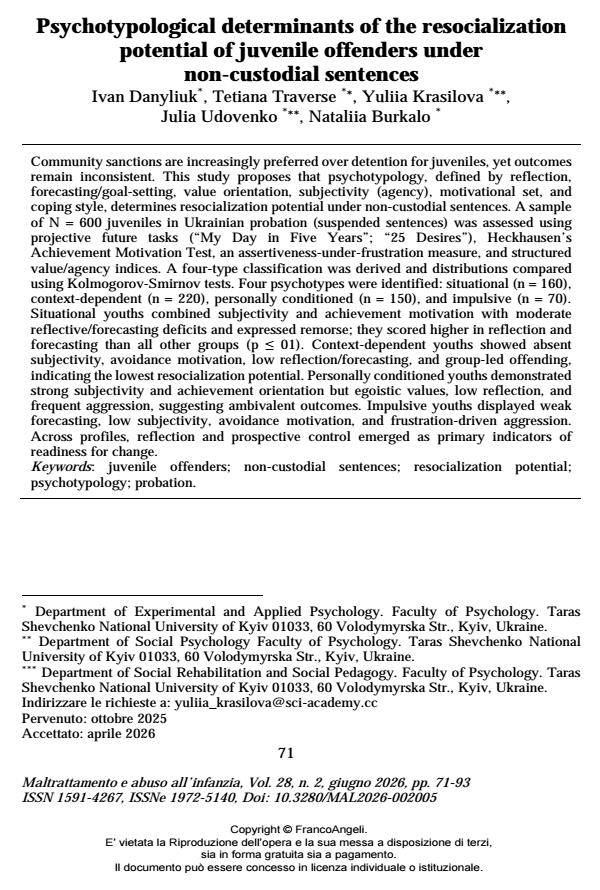
Community sanctions are increasingly preferred over detention for juveniles, yet outcomes remain inconsistent. This study proposes that psychotypology, defined by reflection, forecasting/goal-setting, value orientation, subjectivity (agency), motivational set, and coping style, determines resocialization potential under non-custodial sentences. A sample of N = 600 juveniles in Ukrainian probation (suspended sentences) was assessed using projective future tasks (“My Day in Five Years”; “25 Desires”), Heckhausen’s Achievement Motivation Test, an assertiveness-under-frustration measure, and structured value/agency indices. A four-type classification was derived and distributions compared using Kolmogorov-Smirnov tests. Four psychotypes were identified: situational (n = 160), context-dependent (n = 220), personally conditioned (n = 150), and impulsive (n = 70). Situational youths combined subjectivity and achievement motivation with moderate reflective/forecasting deficits and expressed remorse; they scored higher in reflection and forecasting than all other groups (p = 01). Context-dependent youths showed absent subjectivity, avoidance motivation, low reflection/forecasting, and group-led offending, indicating the lowest resocialization potential. Personally conditioned youths demonstrated strong subjectivity and achievement orientation but egoistic values, low reflection, and frequent aggression, suggesting ambivalent outcomes. Impulsive youths displayed weak forecasting, low subjectivity, avoidance motivation, and frustration-driven aggression. Across profiles, reflection and prospective control emerged as primary indicators of readiness for change.
Parole chiave:juvenile offenders; non-custodial sentences; resocialization potential; psychotypology; probation.
- Bosomprah, E. (2023). Life after detention: challenges encountered by released juvenile offenders in Accra, Ghana. Journal of Offender Rehabilitation, 62(3), 191-214. DOI: 10.1080/10509674.2023.2182864
- Cebotari, S. (2025). Conceptual approaches in the study of the re-socialization of young inmates. Legea si Viata, 259-267.
- Creemers, H., Van Logchem, E., Assink, M., & Asscher, J. (2022). Ramping up detention of young serious offenders: A safer future?. Trauma, Violence & Abuse, 24(4), 2863-2881. DOI: 10.1177/15248380221119514
- Dabrowa, N. (2023). Legal and psychological determinants of the resocialisation of juvenile offenders: Psychological methods used in resocialisation. Journal of Modern Science, 51(2), 421-438.
- Djubina, J., & Vilks, A. (2024). Educational issues in the resocialization process of criminal offenders. Society. Integration. Education. Proceedings of the International Scientific Conference, 2, 76-90.
- Dubovyk, K. (2024). Features of mechanisms of socialization and resocialization of minors from the point of view of increasing their efficiency. Theory and Practice of Public Administration, 1(78), 36-52. DOI: 10.26565/1727-6667-2024-1-03
- Durán Palacio, N. M., Gómez Tabares, A. S., & Castrillón Ángel, E. F. (2025). Effects of Empathy and regulatory emotional self-efficacy on difficulties and strengths in juvenile offenders. International Journal of Offender Therapy and Comparative Criminology. DOI: 10.1177/0306624X251326113
- Engel, C., Goerg, S., & Traxler, C. (2022). Intensified support for juvenile offenders on probation: Evidence from Germany. Journal of Empirical Legal Studies, 19(2), 447-490.
- Flora, H., Harmono, H., & Alves, L. (2025). Effectiveness of the implementation of restorative justice in the juvenile criminal justice system. Rechtsnormen: Journal of Law, 3(1), 33-44.
- Frimpong-Manso, K., & Bosomprah, E. (2025). Navigating reintegration challenges: Coping strategies of juvenile offenders in Ghana. Youth Justice. DOI: 10.1177/14732254251326814
- Goworko-Skladanek, B., & Prymak, T. (2023). Probation officers’ perspective on the application of the educational measure in the form referral to an attendance centre. Probacja, 2, 109-131. DOI: 10.5604/01.3001.0053.6700
- Hausam, J., Franke, M., Lehmann, R., & Dahle, K. (2022). Effectiveness of social-therapeutic treatment for serious offenders in juvenile detention: A quasi-experimental study of recidivism. Frontiers in Psychiatry, 13.
- Konaszewski, K., Niesiobedzka, M., & Surzykiewicz, J. (2021). Resilience and mental health among juveniles: role of strategies for coping with stress. Health and Quality of Life Outcomes, 19, 58.
- Kroc, E., & Olvera Astivia, O. L. (2022). The importance of thinking multivariately when setting subscale cutoff scores. Educational and Psychological Measurement, 82(3), 517-538. DOI: 10.1177/00131644211023569
- Lensch, T., Clements-Nolle, K., Oman, R., Evans, W., Lu, M., & Yang, W. (2021). Adverse childhood experiences and co-occurring psychological distress and substance abuse among juvenile offenders: the role of protective factors. Public Health, 194, 42-47.
- Liu, H., Hou, W., Lau, E., Birk, J., & Bonanno, G. (2024). Identifying multilevel predictors of trajectories of psychopathology and resilience among juvenile offenders: A machine learning approach. Development and Psychopathology, 36(3), 1503-1519. DOI: 10.1017/S0954579423000755
- Lunov, V., Lytvynenko, O., Maltsev, O., & Zlatova, L. (2022). The impact of Russian military aggression on the psychological health of Ukrainian youth. American Behavioral Scientist, 67(3), 426-448. DOI: 10.1177/00027642221144846
- Luo, S., Hu, J., Zhang, J., Mei, Z., Tang, Z., & Luo, S. (2025). The correlation between resilience and mental health of adolescents and young adults: a systematic review and meta-analysis. Frontiers in Psychiatry, 16.
- Macanovic, N. (2024). Resocialization and reintegration of convicted individuals: Possibilities and challenges. In M., Milicevic, I., Stevanovic, & Lj., Ilijic (Eds.), Life in Prison: Criminological, Penological, Psychological, Sociological, Legal, Security, and Medical Issues (pp. 57-62). Belgrade: Institute of Criminological and Sociological Research.
- Maksymova, N., Krasilova, Y., & Luch, V. (2022). Social and psychological conditions of juvenile convicts’ resocialization in the probation service. Paradigm of Knowledge, 3(53). DOI: 10.26886/2520-7474.3(53)2022.5
- Malizia, N. (2021). Juvenile offenders: Suspension of trial and “probationary period”. A study on re-educational role of social service in Italy. Advances in Applied Sociology, 11, 130-140. DOI: 10.4236/AASOCI.2021.113010
- Melnychuk, T., Grubi, T., Alieksieieva, S., Maslich, S., & Lunov, V. (2022). Peculiarities of psychological assistance in overcoming the consequences of COVID-19: A resilience approach. Neuropsychiatria I Neuropsychologia, 17(1-2), 95-107.
- Mesman, E., Vreeker, A., & Hillegers, M. (2021). Resilience and mental health in children and adolescents: An update of the recent literature and future directions. Current Opinion in Psychiatry, 34(6), 586-592. DOI: 10.1097/YCO.0000000000000741
- Miklósi, M., & Kovács, K. (2025). Factors influencing school bonding among juvenile offenders – The experience of a systematic review. International Journal of Educational Research Open, 8, 100441.
- Mischel, W., & Shoda, Y. (1995). A cognitive-affective system theory of personality: Reconceptualizing situations, dispositions, dynamics, and invariance in personality structure. Psychological Review, 102(2), 246-268. DOI: 10.1037/0033-295X.102.2.246
- Moeller, M. (2024). (Re)socialisation theory. In K., Hutchings, S., Michailova, & A., Wilkinson (Eds.), A Guide to Key Theories for Human Resource Management Research (pp. 224-230). Cheltenham: Edward Elgar.
- Nedybaliuk, O. S., & Maksymova, N. Y. (2020). A method for determining the social personality orientation of modern teenage children. Science and Education a New Dimension, VIII(9)(227), 65-69.
- Okah, P., Onalu, C., Aghedo, G., Iyiani, C., Ramsey-Soroghaye, B., & Abonyi, S. (2024). A phenomenological inquiry into the barriers against effective rehabilitation and reintegration of juvenile delinquents at a juvenile remand home in Nigeria. Journal of Offender Rehabilitation, 63(4), 228-249. DOI: 10.1080/10509674.2024.2331473
- Pappas, L., & Dent, A. (2021). The 40-year debate: A meta-review on what works for juvenile offenders. Journal of Experimental Criminology, 19, 1-30.
- Petrenko, O., Petrenko, I., & Brychok, S. (2023). Theoretical and applied principles of resocialisation of juvenile convicts in correctional colonies of Ukraine. Social Work and Social Education, 2(11), 247-256. DOI: 10.31499/2618-0715.2(11).2023.291911
- Prop, L., Van Der Laan, A., Beerthuizen, M., Barendregt, C., & Van Nieuwenhuizen, C. (2025). Juvenile sanctions for young adult offenders in the Netherlands: An opportunity for rehabilitation? Child and Adolescent Psychiatry and Mental Health, 19, 33.
- Rock, J., McKenna, N., Vervalin, H., Rodriguez, D., Commodore-Mensah, M., Munshi, A., Boucher, I., & Duron, J. F. (2025). Resilience factors in reentry from juvenile legal facility settings: A scoping review. Trauma, Violence & Abuse, 26(2), 283-299. DOI: 10.1177/15248380241309384
- Romero, R., Van Der Meulen, K., Granizo, L., Del Barrio, C., Puyol, P., Lara, L., & Olmos, R. (2025). Interpersonal risk and protective factors for adolescents’ psychosocial wellbeing in secondary education: A latent profile analysis. Psychosocial Intervention, 34(2), 117-135.
- Sandøy, T., Østhus, S., & Bretteville-Jensen, A. (2022). Preventing future crime in adolescent drug offenders: A study of differential sanction effects on recidivism. Criminology & Criminal Justice, 24(1), 164-183. DOI: 10.1177/17488958211070364
- Storck, W. (2023). More education of juvenile offenders in sentences of imprisonment: A reform and justification approach as a consequence of Niklas Luhmann’s systems theory. Access to Justice in Eastern Europe, 3(20), 54-80.
- Tajak-Bobek, A. (2022). Perception of risk by offenders: Relevance to resocialisation interventions. Resocjalizacja Polska, 24(1), 227-245.
- Tapalova, O. B. (2016). Achievement motivation in normality and in mental pathology (on a Kazakhstani sample). Kharkiv: V. N. Karazin Kharkiv National University.
- Valtorta, N. K. (2016). Are loneliness and social isolation risk factors for ill health? York: University of York.
- Van Der Stouwe, T., Gubbels, J., Castenmiller, Y., Van Der Zouwen, M., Asscher, J., Hoeve, M., Van Der Laan, P., & Stams, G. (2020). The effectiveness of social skills training (SST) for juvenile delinquents: a meta-analytical review. Journal of Experimental Criminology, 17, 369-396.
- Witkowski, P. (2022). Achievement motivation, core self-evaluations and social competence of juvenile offenders. Annales Universitatis Mariae Curie-Sklodowska, 35(3), 209-218.
- Wong, D., & Fung, C. (2022). Juvenile community corrections in China: The quest for a restorative approach. Asian Journal of Criminology, 18, 113-132.
- Yuan, M., He, Y., Wang, F., Wen, X., Tong, Y., Zhu, D., Wang, G., & Su, P. (2024). Multi-level factors associated with psychological resilience in the face of adverse childhood experiences among Chinese early adolescents. Child Abuse & Neglect, 153, 106861.
- Zambrano, V., Gemignani, M., Fernández-Pacheco, G., & Anwandter, L. (2024). Resiliencia en adolescentes infractores con trayectorias en los sistemas chilenos de bienestar infantil y de justicia adolescente. Revista de Estudios Sociales, 88, 59-78.
- Zhang, B., Zhang, W., Sun, L., Jiang, C., Zhou, Y., & He, K. (2023). Relationship between alexithymia, loneliness, resilience and non-suicidal self-injury in adolescents with depression: a multi-center study. BMC Psychiatry, 23, 445.
Ivan Danyliuk, Tetiana Traverse, Yuliia Krasilova, Julia Udovenko, Nataliia Burkalo, Psychotypological determinants of the resocialization potential of juvenile offenders under non-custodial sentences in "MALTRATTAMENTO E ABUSO ALL’INFANZIA" 2/2026, pp 71-93, DOI: 10.3280/MAL2026-002005