John Stuart Mill’s System of Taxation reconsidered
Titolo Rivista HISTORY OF ECONOMIC THOUGHT AND POLICY
Autori/Curatori Michel S. Zouboulakis
Anno di pubblicazione 2026 Fascicolo 2026/1
Lingua Inglese Numero pagine 11 P. 149-159 Dimensione file 53 KB
DOI 10.3280/SPE2026-001006
Il DOI è il codice a barre della proprietà intellettuale: per saperne di più
clicca qui
Qui sotto puoi vedere in anteprima la prima pagina di questo articolo.
Se questo articolo ti interessa, lo puoi acquistare (e scaricare in formato pdf) seguendo le facili indicazioni per acquistare il download credit. Acquista Download Credits per scaricare questo Articolo in formato PDF
FrancoAngeli è membro della Publishers International Linking Association, Inc (PILA), associazione indipendente e non profit per facilitare (attraverso i servizi tecnologici implementati da CrossRef.org) l’accesso degli studiosi ai contenuti digitali nelle pubblicazioni professionali e scientifiche.
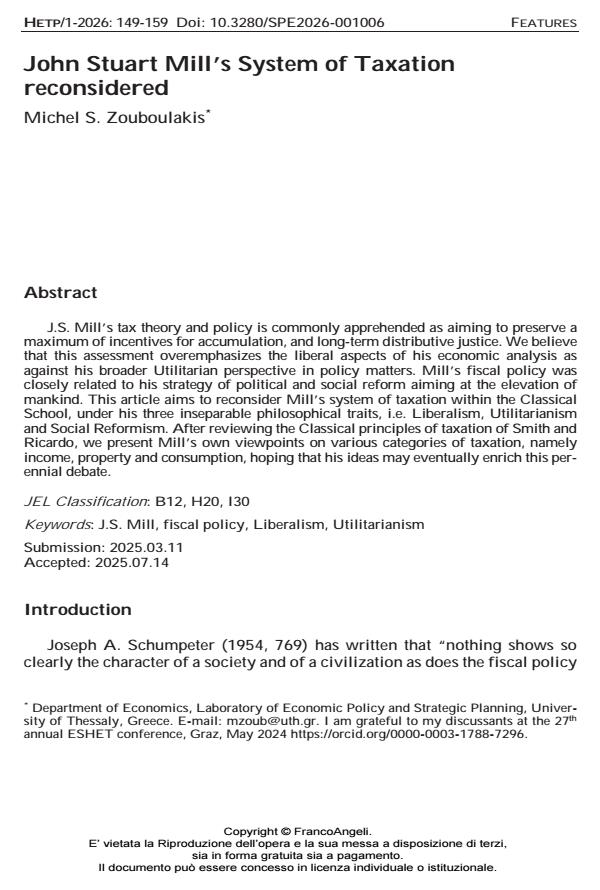
J.S. Mill’s tax theory and policy is commonly apprehended as aiming to preserve a maximum of incentives for accumulation, and longterm distributive justice. We believe that this assessment overemphasizes the liberal aspects of his economic analysis as against his broader Utilitarian perspective in policy matters. Mill’s fiscal policy was closely related to his strategy of political and social reform aiming at the elevation of mankind. This article aims to reconsider Mill’s system of taxation within the Classical School, under his three inseparable philosophical traits, i.e. Liberalism, Utilitarianism and Social Reformism. After reviewing the Classical principles of taxation of Smith and Ricardo, we present Mill’s own viewpoints on various categories of taxation, namely income, property and consumption, hoping that his ideas may eventually enrich this perennial debate.
Parole chiave:J.S. Mill, fiscal policy, Liberalism, Utilitarianism
Jel codes:B12, H20, I30
- Blaug M. 1962. Economic Theory in Retrospect, Cambridge, C.U.P. 4th edition 1985.
- Cappelen C. and Pedersen J. 2018. Just wealth transfer taxation: Defending John Stuart Mill’s scheme, Politics, Philosophy & Economics, 17 (3): 317335.
- Dome T. 1999. Bentham and J. S. Mill on Tax Reform, Utilitas, 11(3), 320339.
- Dome T. 2015. Taxation. In Kurz H. and Salvadori N. (eds.) The Elgar Companion to David Ricardo. Cheltenham, Edward Elgar, 538546.
- Dwyer T. 2014. Taxation: The Lost History, The American Journal of Economics and Sociology, 73(4), 664988.
- Ekelund R.B. and Tollison R.D. 1976. The new political economy of J.S. Mill: the means to social justice, Canadian Journal of Economics, IX(2), 213231.
- Ekelund R.B. and Walker D.M. 1996. J.S. Mill on the income tax exemption and inheritance taxes: the evidence reconsidered, History of Political Economy, 28(4), 559581.
- Hollander S. 1985. The Economics of John Stuart Mill. Oxford, Blackwell.
- Jensen H. 2001. John Stuart Mill’s Theories of Wealth and income distribution, Review of Social Economy, 59(4), 491507.
- Kurer O. 1989. John Stuart Mill on Government Intervention, History of Political Thought, 10(3), 457480.
- Mill J.S. 1848. Principles of Political Economy with some of their Applications to Social Philosophy. In Robson J.M. (Ed.) 1965. Collected Works of J.S. Mill, vols. IIIII. Toronto, Toronto University Press.
- Mill J.S. 1852. The Income and Property Tax I. In Robson J.M. (ed.) 1967. Collected Works of J.S. Mill, vol. V. Toronto, Toronto University Press, 463498.
- Mill J.S. 1861a. The Income and Property Tax II. In Robson J.M. (ed.) 1967. Collected Works of J.S. Mill, vol. V. Toronto, Toronto University Press, 549598.
- Mill J.S. 1861. Utilitarianism. In Robson J.M. (ed.) 1969. Collected Works of John Stuart Mill, vol. X. Toronto, Toronto University Press.
- Mill J.S. 1873. Property and Taxation. In Robson J.M. (ed.) 1967, Collected Works of J.S. Mill, vol. V. Toronto, Toronto University Press, 697702.
- Miller D. E. 2010. J. S. Mill. Cambridge, Polity Press.
- Nathanson S. 2012. John Stuart Mill on economic justice and the alleviation of poverty, Journal of Social Philosophy, 43(2), 161–176.
- Ricardo D. 1817. Principles of Political Economy and Taxation. In Sraffa P. (ed.) 1951, The Works and correspondence of David Ricardo, vol. I, Cambridge, CUP. Riley J. 1988. Liberal Utilitarianism: Social choice theory and J.S. Mill’s
- Philosophy. Cambridge University Press.
- Schumpeter J.A. 1954. History of Economic Analysis. London, Allen and Unwin. Schwartz P. 1972. The new Political economy of J. S. Mill. London, Weidenfeld & Nicholson.
- Smith A. 1776. An Inquiry into the Causes and Nature of the Wealth of Nations, Chicago, The University of Chicago Press, two vols. 1976.
- Su H. 2013. Economic Justice and Liberty. The social philosophy in John Stuart Mill’s Utilitarianism. London, Routledge.
- Witztum A. 2005. Economic Sociology: The Recursive Economic System of J. S. Mill, Journal of the History of Economic Thought, 27(3), 251281.
- Zouboulakis M.S. 2017. Democracy and Economic Progress in the work of J. S. Mill. In Bitros G.C. and Kyriazis N.K. (Eds.). Democracy and an openeconomy world order, Heidelberg, Springer, 3748.
Michel S. Zouboulakis, John Stuart Mill’s System of Taxation reconsidered in "HISTORY OF ECONOMIC THOUGHT AND POLICY" 1/2026, pp 149-159, DOI: 10.3280/SPE2026-001006